Skip to content
recaplica

    One moment: security check

    Cloudflare wants to make sure you're not a robot. Tick the box below and your search will continue on its own.

    IT
    recaplica Art Restoration: The Principles Behind Saving a Masterpiece from Decay
    © 2026 Recaplica · recaplica.com — All rights reserved
    Home › History

    Art Restoration: The Principles Behind Saving a Masterpiece from Decay

    By Recaplica Newsroom · Updated on October 20, 2026

    What to print

    Page numbers appear when printing with default margins.

    Slides

    Choose a cut

    Flash10 slidesThe essential thread, to present in classFull15 slidesEvery chapter and the deeper detail

    Both come with speaker notes.

    Telegram channel
    recaplica Clear in 30 seconds, yours in 10 minutes.
    In 30 seconds Key points Figures Deep dive Slides Myths Mind map Quiz Flashcards FAQ

    In 30 seconds quick read

    Artworks deteriorate over time due to several factors acting together: light, humidity, pollution, pests and accidental impact. Restoration tries to stop or correct this damage by following principles shared internationally, such as intervening as little as possible, using materials compatible with the original, and keeping every addition recognizable. Behind a successful intervention, art historians, chemists and restorers work together, because understanding the problem before acting prevents worse damage. The restoration of the Sistine Chapel, which ran from 1980 to 1994, shows how these principles played out in practice on one of the masterpieces of the Renaissance.

    Key Points

    • Decay in artistic materials depends on several factors together: light, humidity, pollution, pests, impact.
    • The principle of recognizability requires that parts added by a restorer stay distinguishable from the original.
    • The principle of reversibility asks that an intervention can be removed without ruining the artwork, even if practice doesn't always manage to guarantee it.
    • Materials used in restoration must be compatible with the original ones: they must not damage them, physically or in appearance.
    • Minimal intervention and teamwork among historians, chemists and restorers guide the decisions before acting.
    • Every intervention is documented before, during and after treatment, following the ethical standards of conservation.

    Key figures

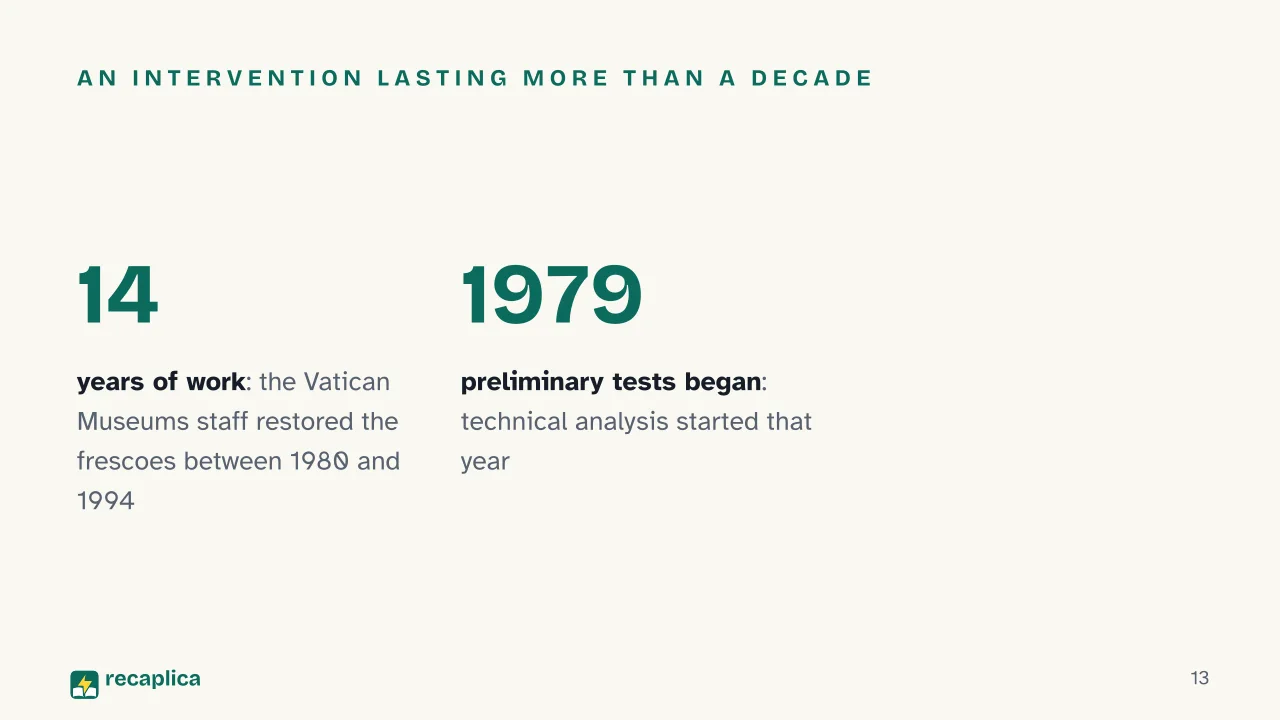
    • 1980-1994 the years the Vatican Museums' own staff spent restoring the Sistine Chapel frescoes Source: Wikipedia
    • 1979 the year preliminary technical tests began on Michelangelo's frescoes, before any actual intervention Source: Wikipedia

    Deep Dive

    A painting locked inside a museum looks safe, yet it keeps deteriorating anyway. Light and humidity wear it down slowly, along with other environmental factors, almost without leaving any mark visible to the naked eye.

    What makes an artwork age

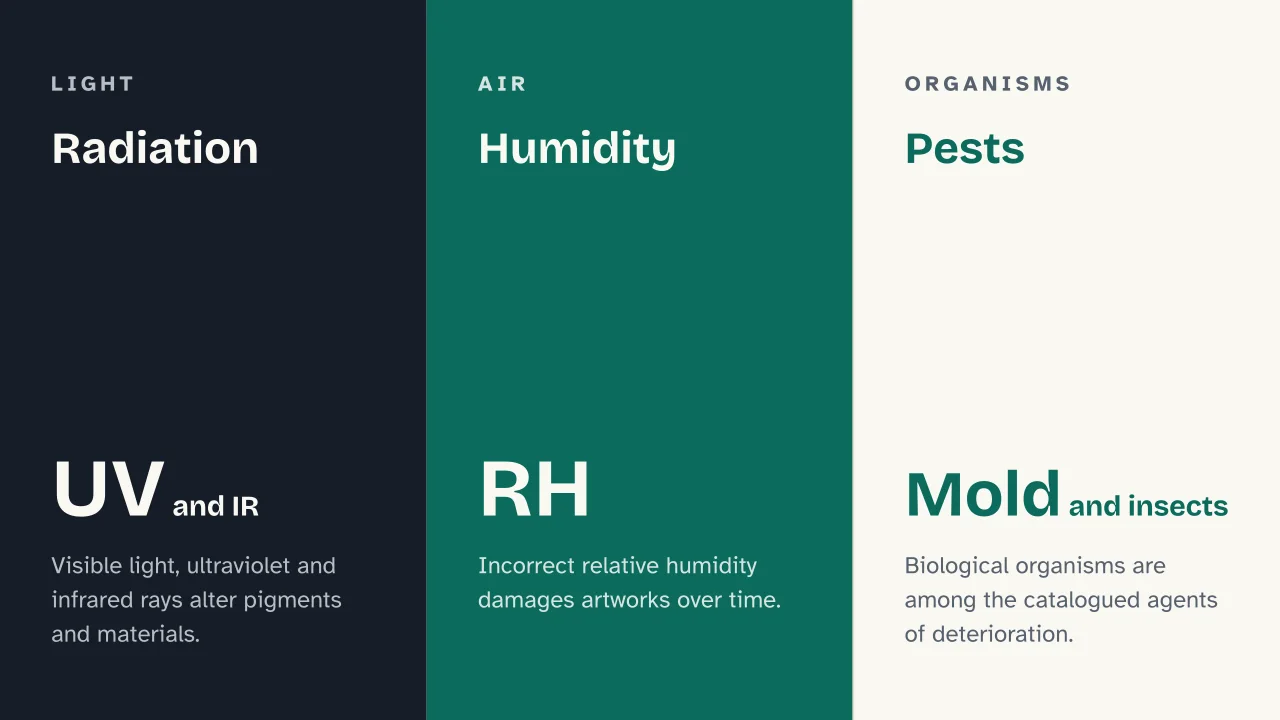
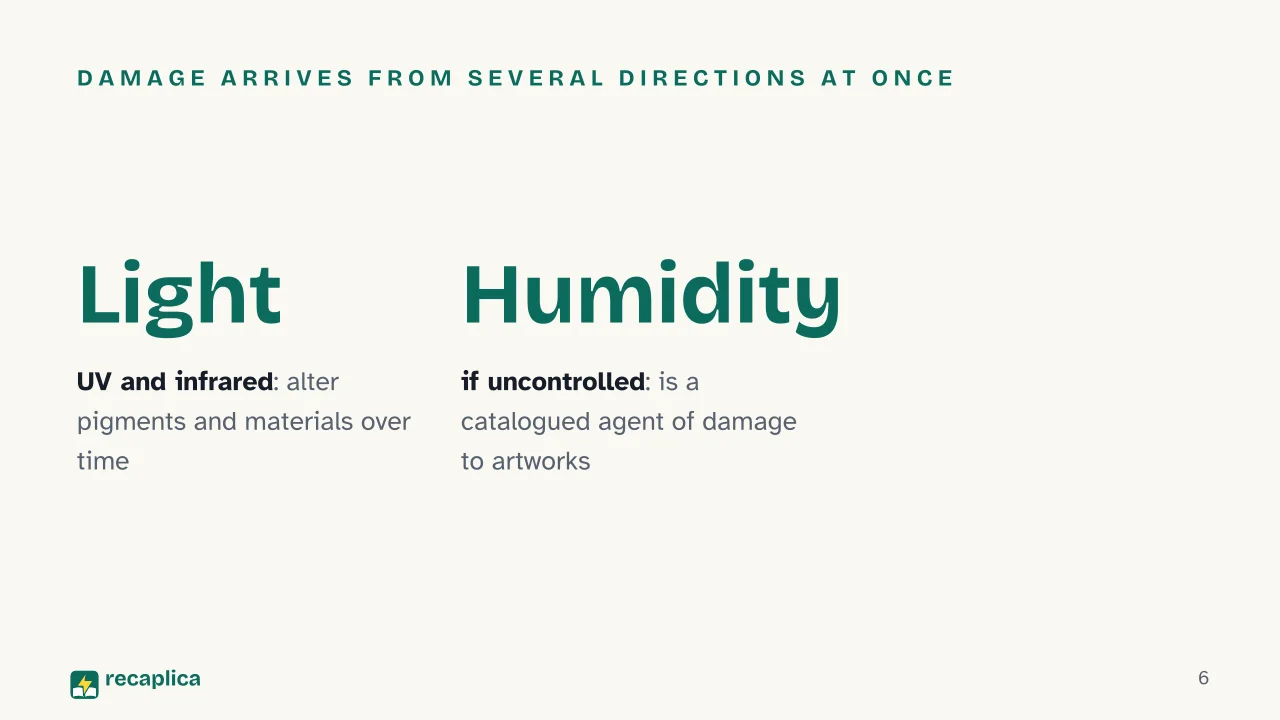
    The Canadian Conservation Institute, Canada’s reference body on the conservation of cultural heritage, catalogs several agents of damage for works of art. Visible light alters pigments and materials over time. The same applies to ultraviolet and infrared radiation, even in rooms that look dark. Incorrect relative humidity is another agent of damage, because different materials expand and contract differently in dry or humid air. Air pollutants are also listed among the agents of deterioration. Pests cause a recognized form of biological damage too: insects and mold are the most common examples. Physical forces such as impact and vibration make up a category of their own.

    AgentExampleNature of the damage
    Light and radiationVisible light, UV and infrared raysAlteration of pigments and materials
    HumidityIncorrect relative humidityExpansion, contraction, warping
    Air pollutantsParticles and gases in the airDeposits, chemical reactions
    PestsInsects, moldBiological damage to materials
    Physical forcesImpact, vibrationDirect mechanical damage

    An encyclopedia entry on the conservation of cultural heritage adds a useful detail: many artworks are sensitive to temperature, humidity and light exposure together, not to a single isolated factor. One estimate from that entry shows how much temperature matters: keeping a cellulose acetate film at 10°C rather than 21°C could add more than a century to its usable life, a general principle about how temperature affects material lifespan, more than a figure tied to one specific artwork. Watercolors make a similar point: direct sunlight gradually fades their pigments, which is why conservators keep them shielded from it.

    The principles of restoration

    Faced with this kind of damage, a restorer cannot work by instinct. Istituto Restauro Roma lists a set of key principles for restoration work, designed to protect the artwork from the intervention itself.

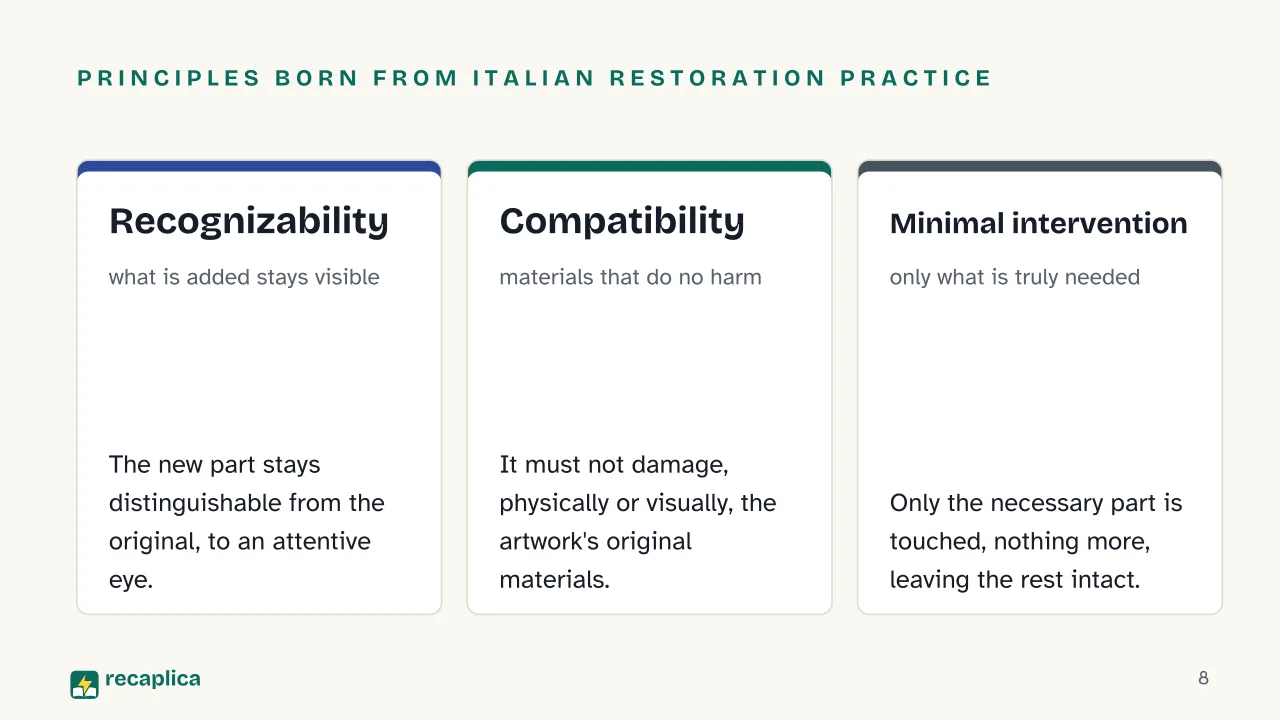
    The principle of recognizability requires that any part added during a restoration stays distinguishable from the original: anyone looking closely should be able to tell what is new from what is old. Compatibility works on the materials themselves: whatever a restorer uses must not harm the artwork’s original materials, in how they look or how they hold up over time. Minimal intervention sets a limit on how much gets touched, only what is strictly necessary and nothing more. Interdisciplinarity means art historians, chemists and restorers carry out that research together, before anyone lays a hand on the work.

    Then there is reversibility, which traditionally requires that an intervention can be removed in the future without ruining the original artwork, should it degrade over time or for other reasons. It is a historic guiding principle of conservation; within the profession, it has been questioned, because no restoration material is guaranteed to stay reversible forever. Ethical standards still require a restorer to justify every intervention and keep a full record of it.

    Practical example: in the restoration of the Sistine Chapel, the varnish layer applied by restorers of earlier centuries had darkened and was altering Michelangelo’s original colors. Removing it meant assessing, fresco by fresco, what was grime to take off and what was original pigment to protect: the principle of minimal intervention, applied across a surface of hundreds of square meters.

    The restoration of the Sistine Chapel

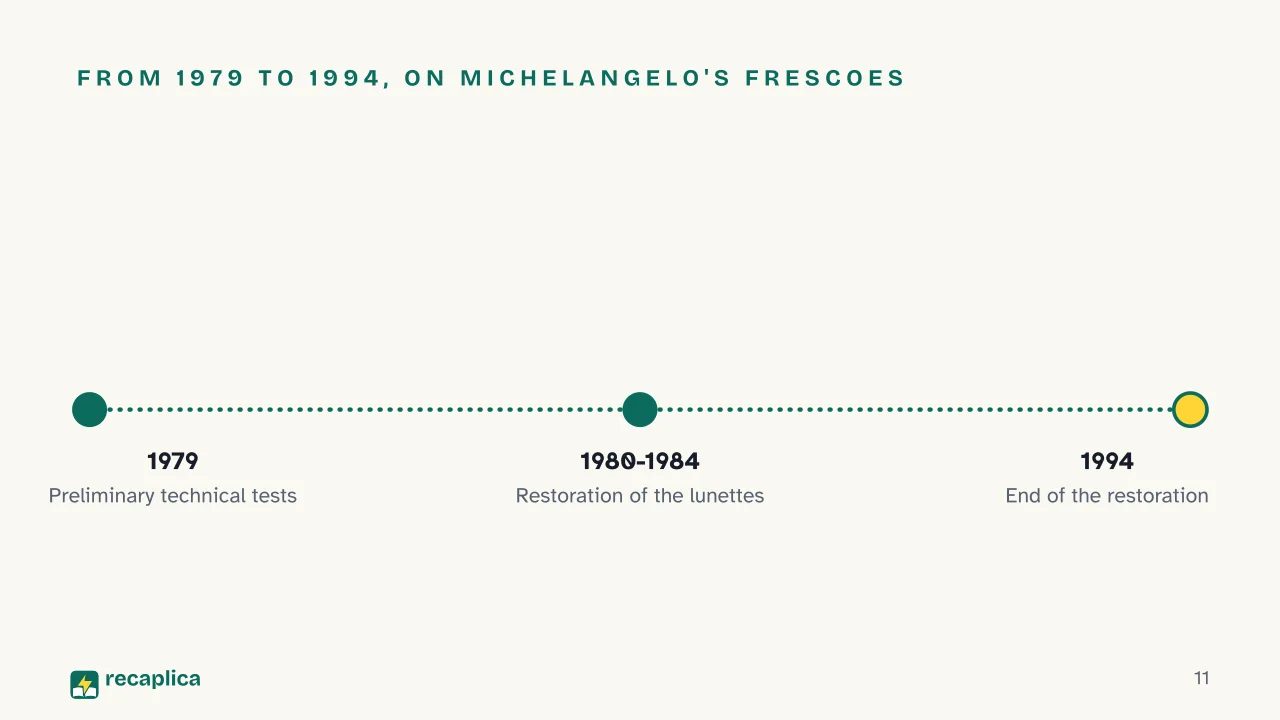
    The best-known case of large-scale restoration remains the Sistine Chapel, in the Vatican. Preliminary technical tests began in 1979. The actual restoration was carried out by the in-house staff of the Vatican Museums between June 1980 and April 1994, roughly fourteen years of work. The first phase, devoted to the lunettes painted by Michelangelo, ran from June 1980 to October 1984.

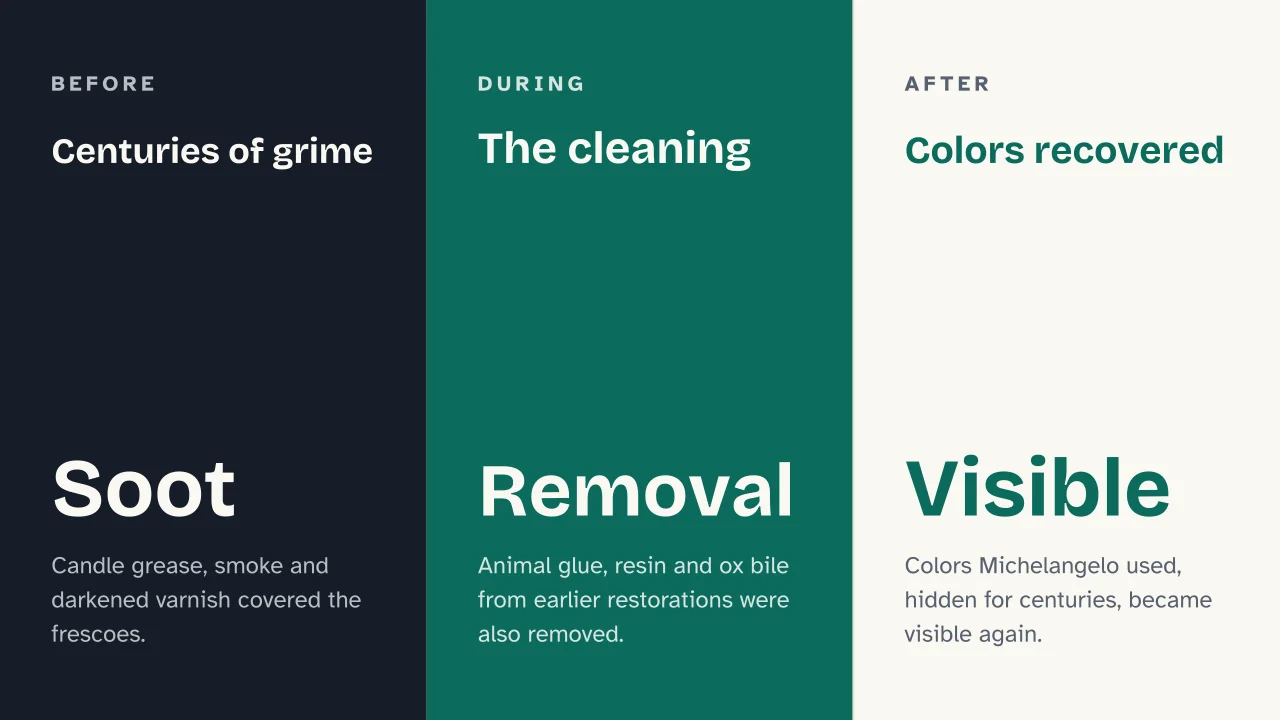
    Over the centuries, a dark layer had built up on the frescoes, made mostly of grease and wax from the candles used to light the chapel, together with soot from braziers. Earlier restorers had added their own layers on top, coating the frescoes with varnish meant to make the colors pop. Over time that coating darkened too, burying the original tones instead of bringing them out. The 1980-1994 restoration stripped away the grime from candles and braziers, plus the animal glue, resin and ox bile left behind by those earlier interventions. The result brought back color tones chosen by Michelangelo, hidden for centuries under the accumulated layers. A significant share of the funding, 4.2 million US dollars, came from an agreement with the Japanese broadcaster Nippon Television: the figure covered the entire project across its full span from 1980 to 1994, not an annual expense.

    Michelangelo’s work in the Sistine Chapel was created at the height of the High Renaissance, the same period when Bramante, Leonardo and Raphael were active. Understanding that context also helps explain why those frescoes were already seen, at the time, as a work worth protecting over the long run: the Renaissance itself had already changed how Europe looked at works of art, as a heritage to preserve through time.

    What remains open

    Restoration is not an exact science with one single right answer. Reversibility, as we have seen, remains a point of reference, but practice does not always manage to guarantee it: a restoration material can behave differently than expected as time passes. That is why ethical standards call for complete documentation, from the start of the work to its end: whoever takes care of the artwork in the future needs to know what was done and with which materials.

    Slide deck

    Slides ready to download and make your own in PowerPoint or Google Slides, with speaker notes. Pick the Flash cut or the Full one.
    Slide 1 of the presentation on Art Restoration: Art RestorationSlide 2 of the presentation on Art Restoration: Why does a masterpiece decay even inside a museum?Slide 3 of the presentation on Art Restoration: Where the damage comes from, and how it stopsSlide 4 of the presentation on Art Restoration: Chapter 01: Why artworks decaySlide 5 of the presentation on Art Restoration: Radiation · Humidity · PestsSlide 6 of the presentation on Art Restoration: Damage arrives from several directions at onceSlide 7 of the presentation on Art Restoration: Chapter 02: The principles that guide restorationSlide 8 of the presentation on Art Restoration: Principles born from Italian restoration practice: Recognizability, Compatibility, Minimal interventionSlide 9 of the presentation on Art Restoration: Reversibility is not the certainty it sounds likeSlide 10 of the presentation on Art Restoration: Chapter 03: The case of the Sistine ChapelSlide 11 of the presentation on Art Restoration: From 1979 to 1994, on Michelangelo's frescoesSlide 12 of the presentation on Art Restoration: Centuries of grime · The cleaning · Colors recoveredSlide 13 of the presentation on Art Restoration: An intervention lasting more than a decadeSlide 14 of the presentation on Art Restoration: Why does restoring an artwork often require several specialists together?Slide 15 of the presentation on Art Restoration: Now, time to review
    Flash10 slidesThe essential thread, to present in classFull15 slidesEvery chapter and the deeper detail

    Common myths

    • ✗ Myth Restoring an artwork means making it look brand new.

      ✓ Reality The principle of recognizability points the opposite way: parts added by a restorer must stay distinguishable from the original, because the goal is to preserve the authentic artwork, not erase its history.

    • ✗ Myth A restoration is a one-time, permanent fix.

      ✓ Reality The principle of reversibility exists precisely because materials used in a restoration can change over time: an intervention should be designed so it can be removed without ruining the artwork, even though specialists disagree on how achievable that really is in practice.

    • ✗ Myth The grime built up on an old painting is part of its history and should be left alone.

      ✓ Reality In the case of the Sistine Chapel, the dark layer was not a historic patina worth keeping, but candle grease, soot and darkened varnish from earlier restorations that covered Michelangelo's original colors: removing it brought those tones back to light after centuries of invisibility.

    Mind map

    Drag the background to move around and the nodes to reposition them; use − and + to collapse and expand branches.
    Customize
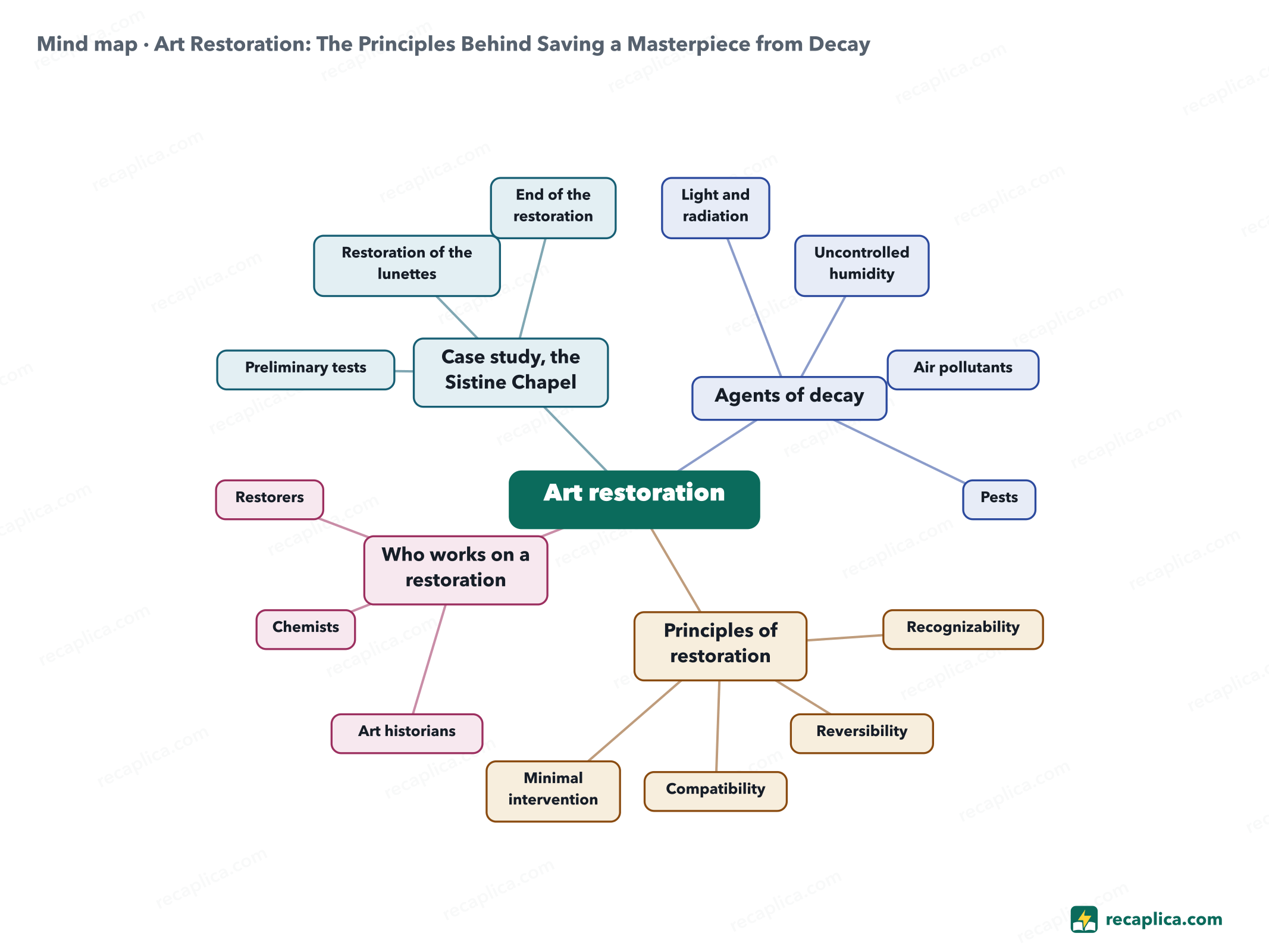
    Mind map: Art Restoration: The Principles Behind Saving a Masterpiece from Decay
    • Art restoration
      • Agents of decay
        • Light and radiation visible light, ultraviolet and infrared rays alter pigments and materials
        • Uncontrolled humidity
        • Air pollutants
        • Pests insects, mold and similar organisms
      • Principles of restoration
        • Recognizability added parts stay distinguishable from the original
        • Reversibility an intervention that in theory can be removed, a principle debated among specialists
        • Compatibility new materials do not damage the original ones
        • Minimal intervention
      • Who works on a restoration
        • Art historians
        • Chemists
        • Restorers
      • Case study, the Sistine Chapel
        • Preliminary tests 1979
        • Restoration of the lunettes June 1980, October 1984
        • End of the restoration April 1994

    Quiz: test yourself

    Answer the questions to check what you have learned: you get instant feedback and a short explanation.

    Grade 0/10 0/5
    1 What does the principle of recognizability require in restoration?

    Recognizability makes sure what a restorer has added can always be told apart from what is original, so the artwork's history stays legible.

    2 Which of these is NOT an agent of decay catalogued by the Canadian Conservation Institute?

    The original color is part of the artwork, not an agent of damage: light, humidity, pests, pollutants and physical forces are instead among the catalogued causes of decay.

    3 True or false: the profession considers reversibility a clear, undisputed concept.

    False: reversibility remains a traditional guiding principle, but it has been criticized, and several specialists consider it a poorly defined concept.

    4 How long did the Vatican Museums' restoration of the Sistine Chapel take?

    The restoration ran between June 1980 and April 1994, about fourteen years, with a first phase on the lunettes finished in 1984.

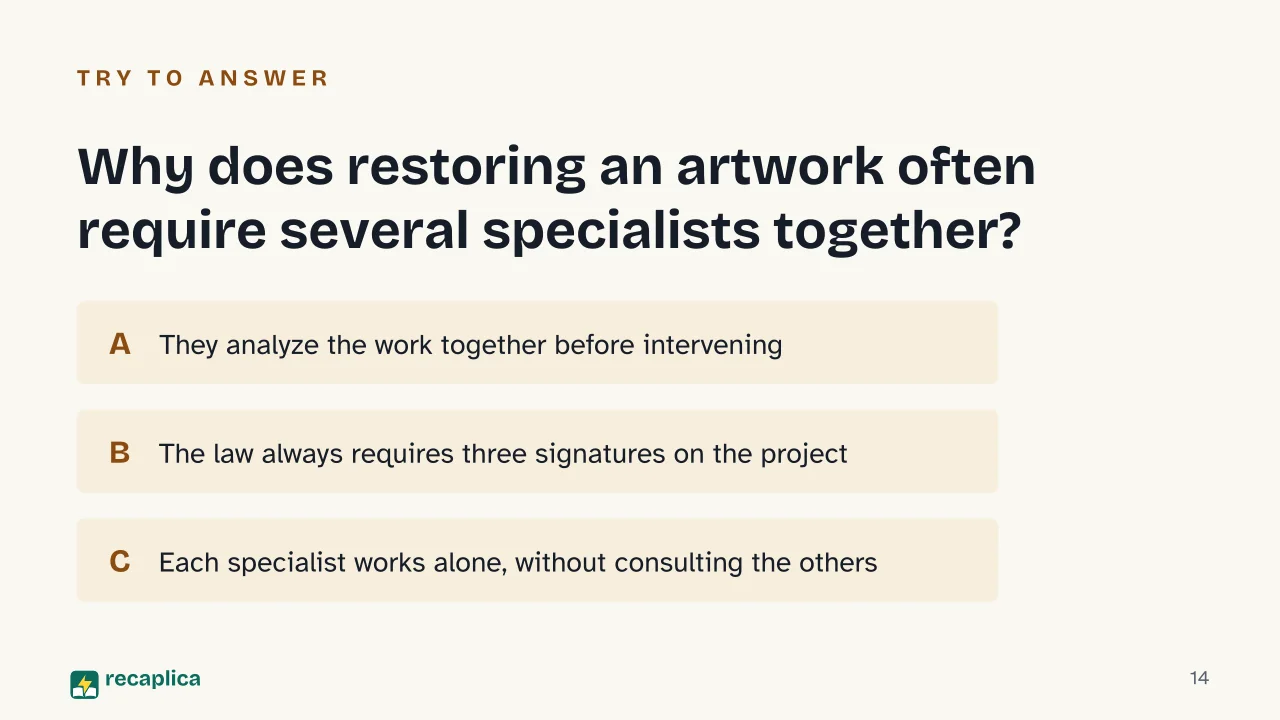
    5 Why does restoring an artwork often need several specialists working together?

    Understanding a work's materials, history and techniques before acting reduces the risk of damage: that is the point of interdisciplinarity.

    Answers: 1-A · 2-D · 3-B · 4-A · 5-A

    Flashcards

    Tap the card to flip it and check whether you remember the answer, then move to the next one.

    1 / 8

    Explain it in your own words

    The ultimate test: if you can explain it in simple words, you've truly understood it. Write your explanation, then compare it with the Recap.

    Your explanation is saved only on this device.

    Artworks deteriorate over time due to several factors acting together: light, humidity, pollution, pests and accidental impact. Restoration tries to stop or correct this damage by following principles shared internationally, such as intervening as little as possible, using materials compatible with the original, and keeping every addition recognizable. Behind a successful intervention, art historians, chemists and restorers work together, because understanding the problem before acting prevents worse damage. The restoration of the Sistine Chapel, which ran from 1980 to 1994, shows how these principles played out in practice on one of the masterpieces of the Renaissance.

    Frequently asked questions

    What is the restoration of a work of art?

    It is the set of interventions that stop or correct an artwork's decay, following shared principles such as minimal intervention, material compatibility and, where possible, recognizability and reversibility for every addition.

    What are the main agents of decay for works of art?

    The Canadian Conservation Institute catalogs, among others, light (visible, ultraviolet and infrared), uncontrolled relative humidity, air pollutants, pests such as insects and mold, and physical forces such as impact and vibration.

    What does the principle of reversibility mean in restoration?

    It means that an intervention should be removable in the future, if it degrades over time or for other reasons, leaving the original artwork intact. It is a historic idea in conservation, though practice does not always manage to fully guarantee it.

    How long did the restoration of the Sistine Chapel take?

    The restoration, led by the Vatican Museums' own conservation staff, ran between June 1980 and April 1994, about fourteen years, after preliminary technical tests that began in 1979.

    Who actually works on a restoration?

    A successful restoration comes from art historians, chemists and restorers working together: understanding the artwork before intervening, with different skills, reduces the risk of damage that a single viewpoint would miss.

    Sources

    • Istituto Restauro Roma - I principi chiave dell'attività di restauro
    • Canadian Conservation Institute, Government of Canada - Agents of Deterioration
    • Wikipedia - Conservation and restoration of cultural heritage
    • Wikipedia - Restoration of the Sistine Chapel frescoes

    Every Recap goes through an independent review before publication.

    Every evening, the day's new Recaps on our Telegram channel. Join the channel →

    Keep learning

    • History Ancient Greek Art: The Periods, Statues and Temples From Kouroi to the Hellenistic Age Greek art is usually split into four periods, from Geometric to Hellenistic, with the Severe style as the bridge between the two in the middle. Statues begin as the stiff kouroi of the sixth century BC, turn into the moving bodies of the Classical age and end as the theatrical groups of the Hellenistic world. Temples such as the Parthenon give sculpture its places: pediments, friezes and metopes. The dates are a teaching convention, because the changes were never sharp. Read the Recap →
    • History What Is Kinship? Types of Family, Descent and Residence Across Cultures In anthropology, kinship is the set of ties that a culture recognises as family: ties of blood, ties created by marriage and, in some cases, ties with neither, such as adoption. Families exist in every society, but in very different forms: nuclear, extended, joint, with several wives or several husbands. Cultures also differ in the line through which descent is counted, in where a couple goes to live and in the names given to relatives. A couple with young children is therefore one form among many. Read the Recap →
    • History Geocentric vs heliocentric model: from Ptolemy to Galileo In Ptolemy's system the Earth sat at the center of the cosmos, and the movements of the planets were explained by combining circles. Copernicus moved the Earth, which also called Aristotle's physics into question. Tycho Brahe, the greatest observer before the telescope, found none of the parallax that the Copernican model implied, and he proposed a compromise. Kepler's ellipses came in 1609 and Galileo's telescope discoveries in 1610, followed by Galileo's condemnation in 1633. Read the Recap →

    recaplica

    Clear in 30 seconds, yours in 10 minutes.

    Recaps Mind maps Request a Recap Telegram channel Mind map maker Our method About Privacy & cookies Legal notes & terms of use

    © 2026 Recaplica · A project by Curi S.r.l. — VAT IT05472000750

    Statistics, only if you say so

    To learn which Recaps help most we would use Google Analytics, with aggregate, anonymous data. It starts only with your OK, and you can change your mind anytime. Privacy policy