|
recaplica
Alpine Pastures: What a Malga Is and How Summer Grazing Works | ||||||||
| © 2026 Recaplica · recaplica.com — All rights reserved | ||||||||
Alpine Pastures: What a Malga Is and How Summer Grazing WorksWhat to print Page numbers appear when printing with default margins. SlidesChoose a cut Flash10 slidesThe essential thread, to present in classFull19 slidesEvery chapter and the deeper detailBoth come with speaker notes. In 30 seconds quick readAlpine pastures sit at the heart of summer mountain grazing: the high meadow, the herd that climbs to it, and the rustic building where herders live and turn milk into cheese for the whole season. From late May to mid-September, herds and herders leave the valley floor for altitudes of roughly 1,000 to 2,300-2,500 metres, in a seasonal move called transhumance. Up there, milk still becomes mountain cheese, often under rules written into protected-name production standards. The pastures aren't unclaimed land either: many belong to communities of residents through common land rights, a status recognised by law. And a grazed pasture seems to be good news for the streams running through it too. Key Points
Key figures
Deep DiveMalga or Alpeggio? Two Words People Mix UpAnyone who climbs into the mountains in summer and spots cows grazing on a green slope tends to call everything in sight a “malga”: the meadow, the herd, the stone hut with smoke curling from its chimney. According to the entry the Italian Encyclopedia Treccani devotes to the term, though, in the technical usage of the eastern Alps (Trentino, the Belluno Dolomites, Cadore) “malga” actually names three things at once: the high alpine pasture, the group of livestock driven up to it, and the rustic building — part stone, part timber — that serves as a temporary home for both animals and people through the summer. Alpeggio is a different matter: it names the practice, not the place. The Treccani dictionary defines it as the exercise of grazing livestock in the mountains (not just the Alps, but the Apennines, the Pyrenees and the Carpathians too) from roughly 1,000 metres up to 2,300-2,500 metres, typically between late May and mid-September, though the exact window shifts with altitude, aspect and vegetation. Its technical synonyms are monticazione and estatatura: different words for the same seasonal climb toward cooler ground. The distinction carries over into regional names too: what gets called malga (or casera, a term that on the Asiago plateau and in the Valsugana valley is simply another word for malga) in Trentino becomes gias in Piedmont, Alm in South Tyrol, mont in Friuli. The word changes from area to area, but the place stays the same: a seasonal settlement where herders and their herds live for the whole summer.
The Season: Down in the Valley, Up on the Mountain, and BackThe alpeggio calendar follows the seasons more than the civil calendar. Herds go up once the high grass is ready, usually between late May and June, and come back down once the cold thins it out again, around mid-September. In Trentino that descent has its own name and its own festival, the Desmontegada; in Valle d’Aosta it’s called Désarpa. Both are village processions, with decorated cattle parading back into town, but they also mark the close of a working season. Operating altitudes vary from area to area: the Italian Alpine Club’s magazine, Lo Scarpone, puts the typical range for malghe between 1,600 and 2,200 metres, consistent with the broader band Treccani gives for alpeggio overall. As for herd size, a malga in the eastern Alps typically houses somewhere between 25-30 and 200-250 head of cattle, occasionally sheep and pigs too, depending on how much grazing land is available. Life in the Casera: Where Mountain Cheese Is MadeInside, or right next to, the malga sits the casera: the room where the herder milks the animals, works the milk, and often lives for the whole season. When the animals aren’t sheltering under the pendana (an open-sided lean-to), they graze the campigol, the patch of ground closest to the building, naturally enriched by their own manure. The link between alpeggio and cheesemaking isn’t just folklore: several protected food names have put it in writing. Fontina DOP’s production rules, updated in September 2023, include a specific “alpeggio” label reserved for wheels made exclusively from milk milked at alpine grazing sites: to identify them, the rules call for a green casein tag with a dedicated code and a producer stamp with its own numbering. Asiago DOP took a similar route with its “Prodotto della Montagna” (“Mountain Product”) category, established around 2006-2007 and later recognised by the European Union, which requires both raising the animals and processing the milk above 600 metres. According to figures from the trade consortium reported by the business daily Il Sole 24 Ore (in an article that dates them to roughly ten years after the category was created, so around 2017), production of “mountain” wheels climbed from 37,292 in 2013 to 61,038 in 2016, a 63% jump, and had grown to represent 32% of all producing dairies by the time the article was written. Who Actually Owns the PasturesA common assumption is that alpine pastures are unclaimed land, free for anyone to use. That’s not the case, even though ownership is often not individual. Across large parts of the Alps, pastures, woodland and the malghe themselves fall under “usi civici”: common land rights that a community of residents holds as members of that community, not as private owners. Law no. 168 of 20 November 2017 clarified the legal nature of these assets, recognising them as perpetual collective property rather than simple public goods. In Trentino, dedicated local bodies called ASUC (Amministrazioni Separate dei Beni di Uso Civico Frazionale), established in 1952, manage these assets under a provincial legal framework that has been rewritten several times since. Piedmont offers a concrete sense of scale: the region counts 305,000 hectares of alpine pasture, close to a third of its farmed land, of which 42% is publicly owned. Concessions on public alpine pastures follow a 2013 regional law, and every pasture has its own Piano Pastorale Foraggero, a forage management plan setting minimum and maximum livestock loads, a grazing calendar and supporting maps.
A Well-Tended Pasture Is Good for the Stream TooThere’s a last, less obvious piece to this picture, and it concerns the environment. A research team at Eurac Research (the Institute for Alpine Environment) studied 15 streams in South Tyrol, examining roughly 70 genera and species of aquatic macroinvertebrates across four types of habitat: rocky terrain above 2,000 metres, high-altitude pastures around 2,000 metres, coniferous forest between 1,500 and 1,600 metres, and valley-floor pastures between 1,000 and 1,200 metres. The study, published in the journal Freshwater Biology in January 2020, found that streams running through grazed land supported a greater variety of organisms and ecological functions than those running through rock or forest, regardless of altitude. The researchers link that finding to a wider concern: the abandonment of high-altitude pastures, together with the rising tree line driven by climate change (the same greenhouse effect warming the Alps too), could, over time, reduce the biodiversity of alpine streams. It’s an observed association between active grazing and ecological richness, not a universal law — but it’s enough to explain why, alongside milk fermentation and cheese wheels, people who work with malghe increasingly talk about tending the mountain itself, not just the herd. Slide deckSlides ready to download and make your own in PowerPoint or Google Slides, with speaker notes. Pick the Flash cut or the Full one.     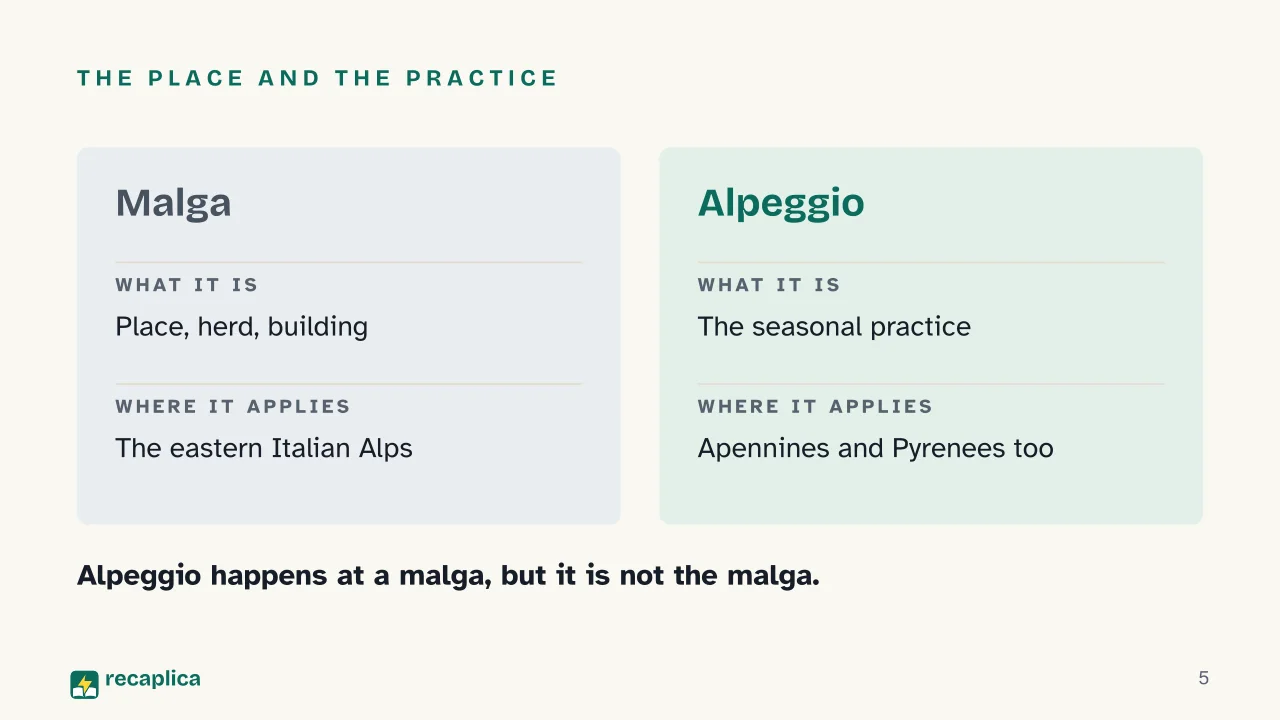 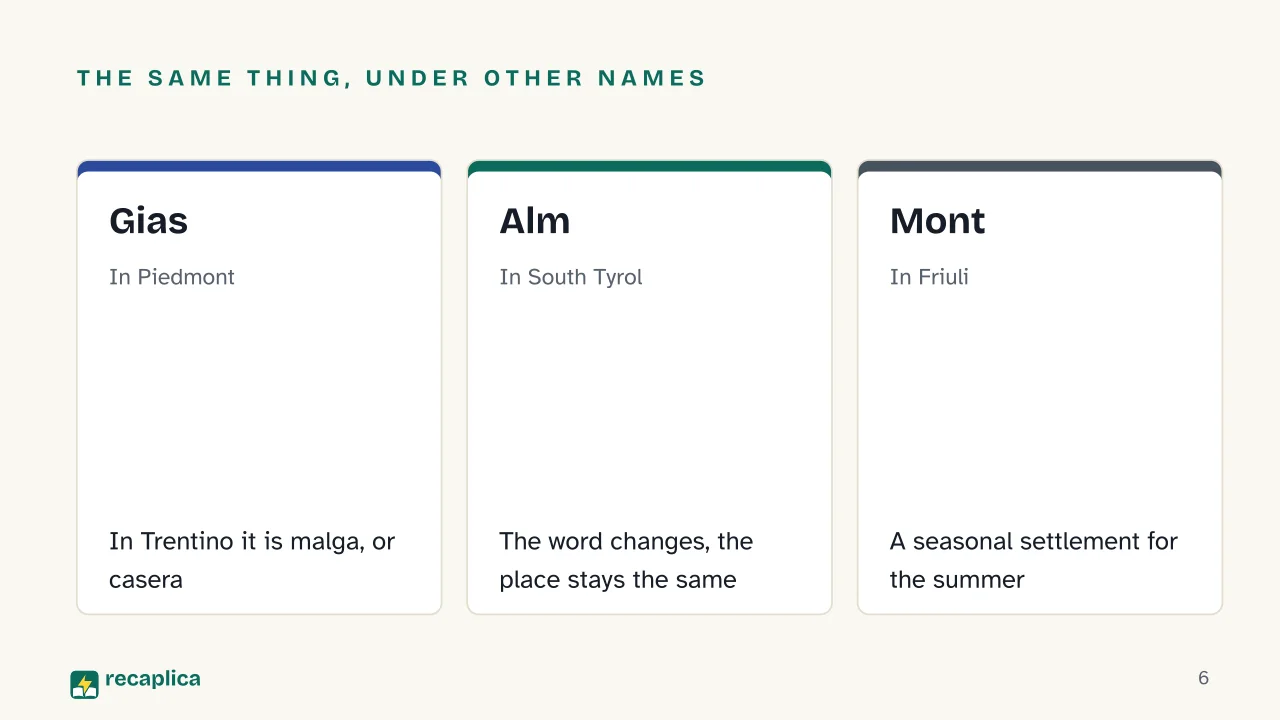  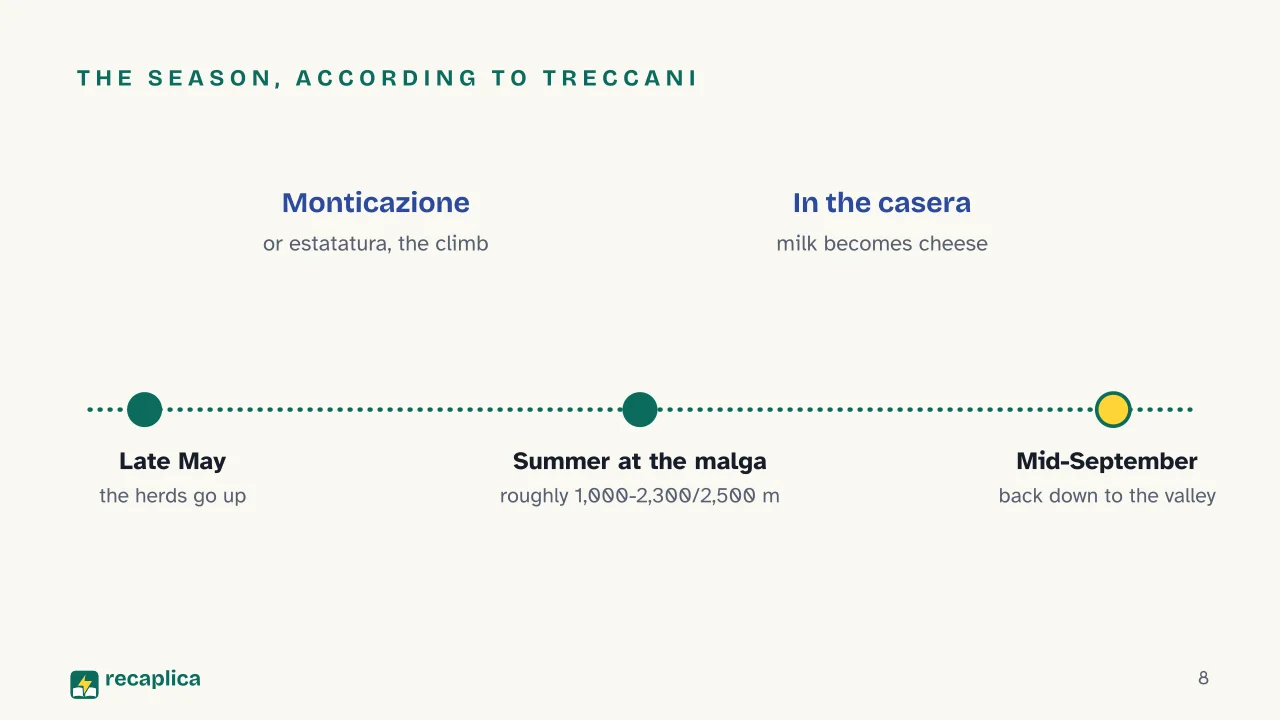 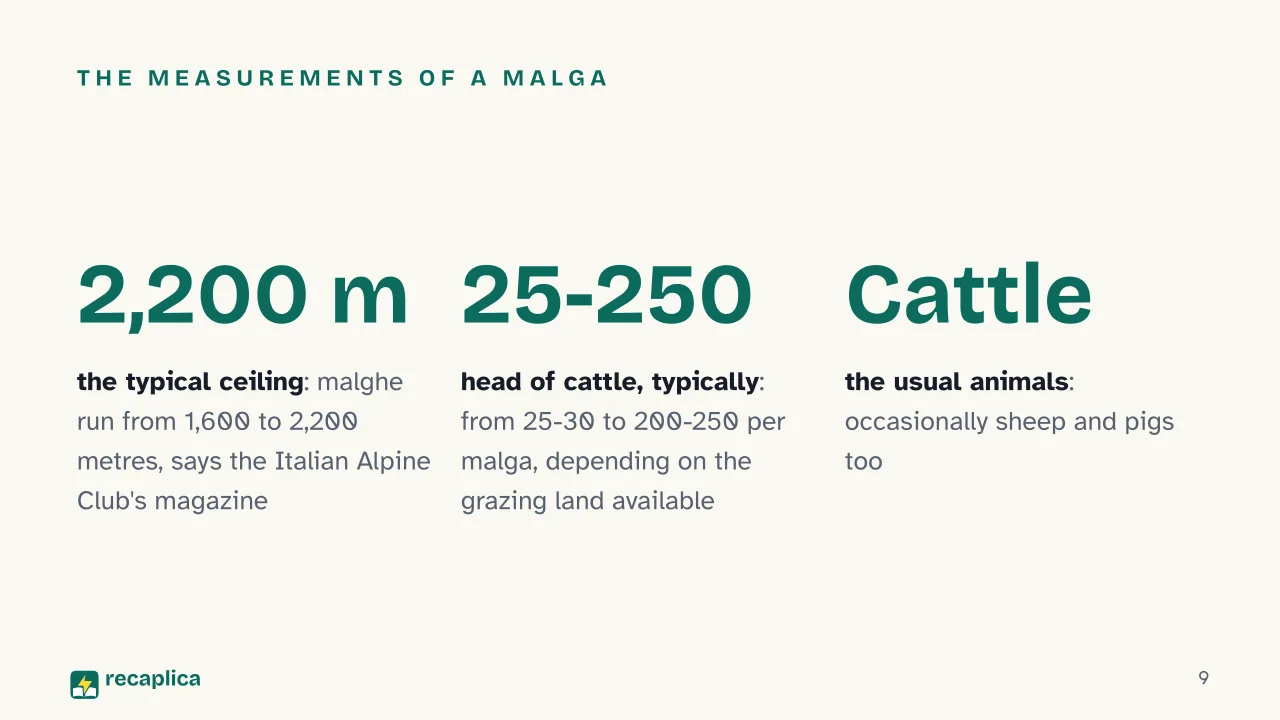   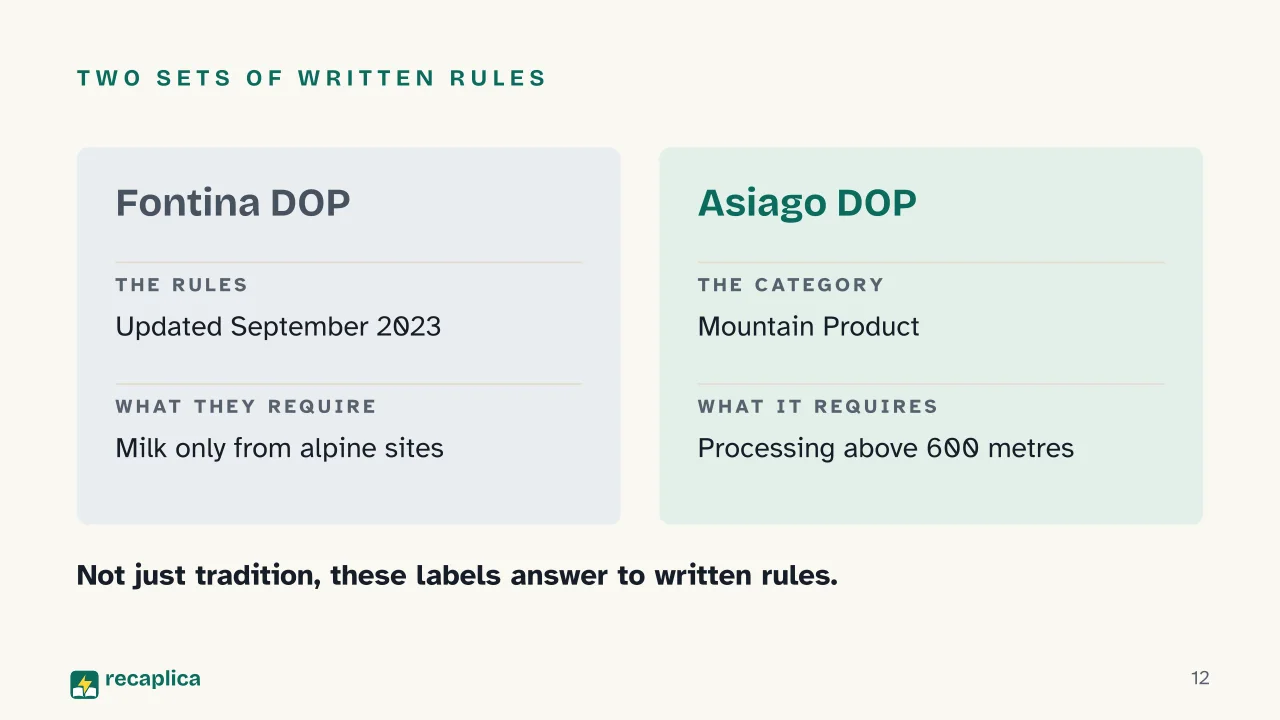 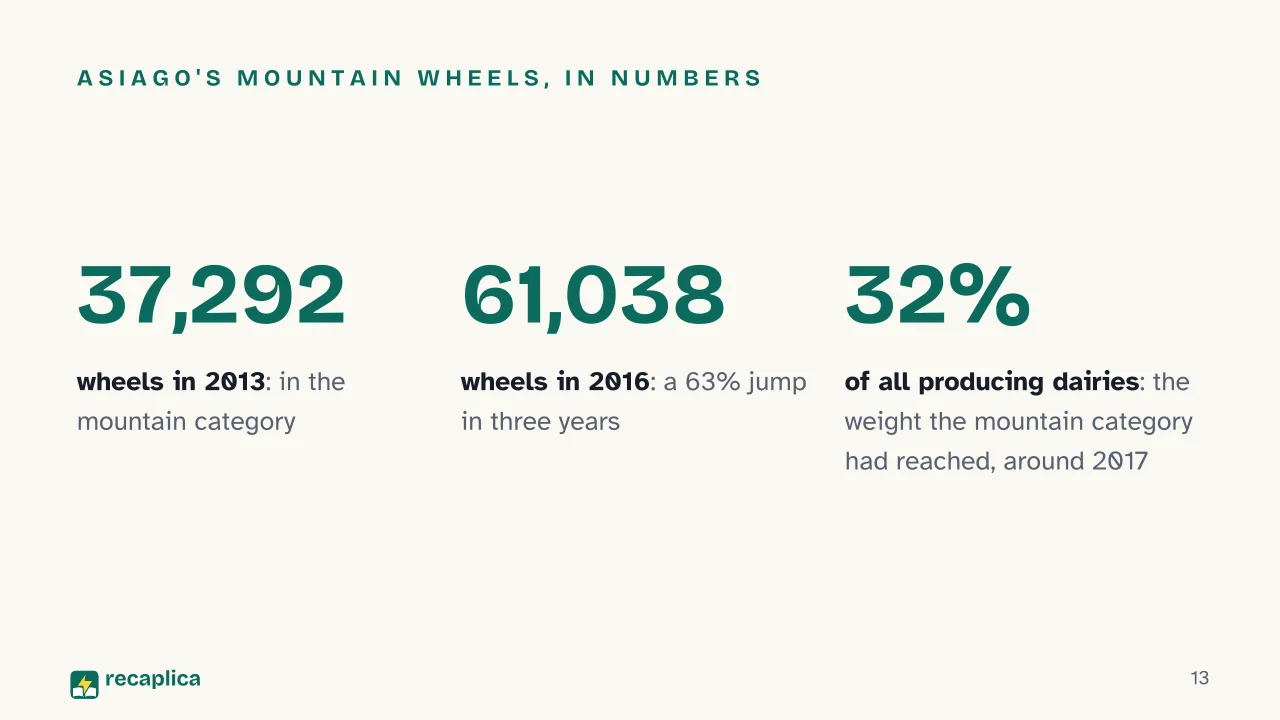  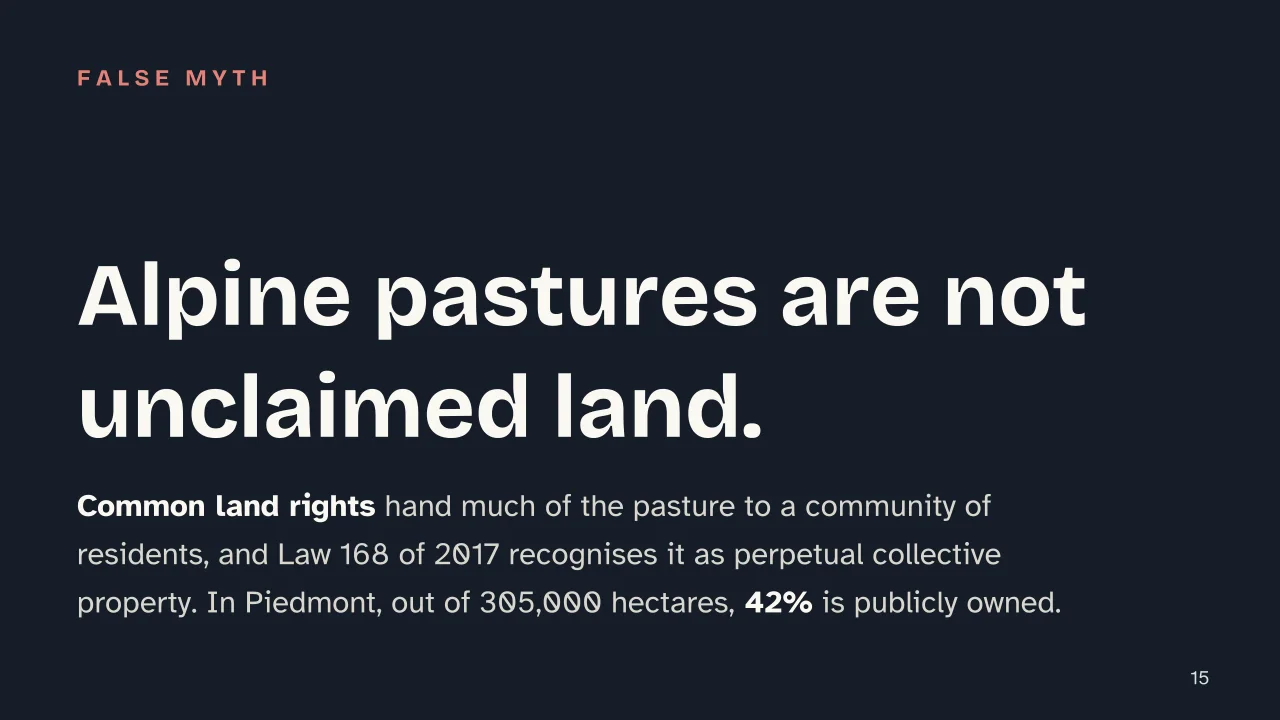 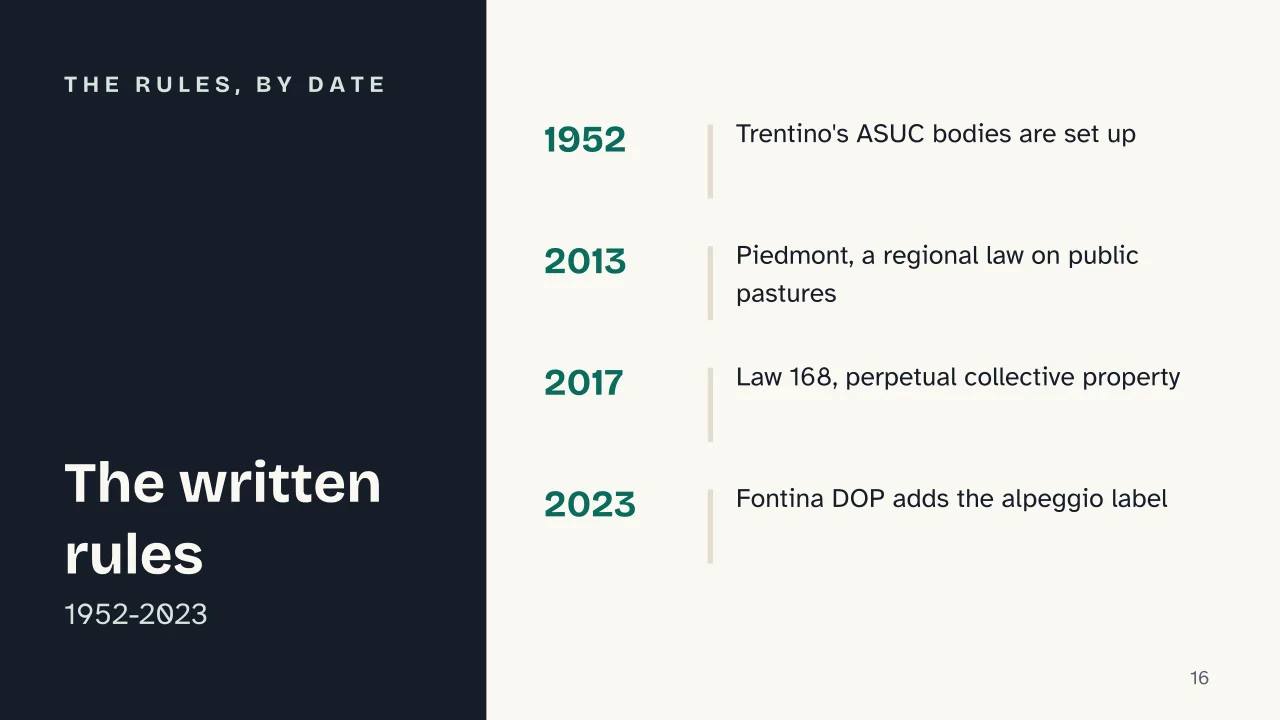 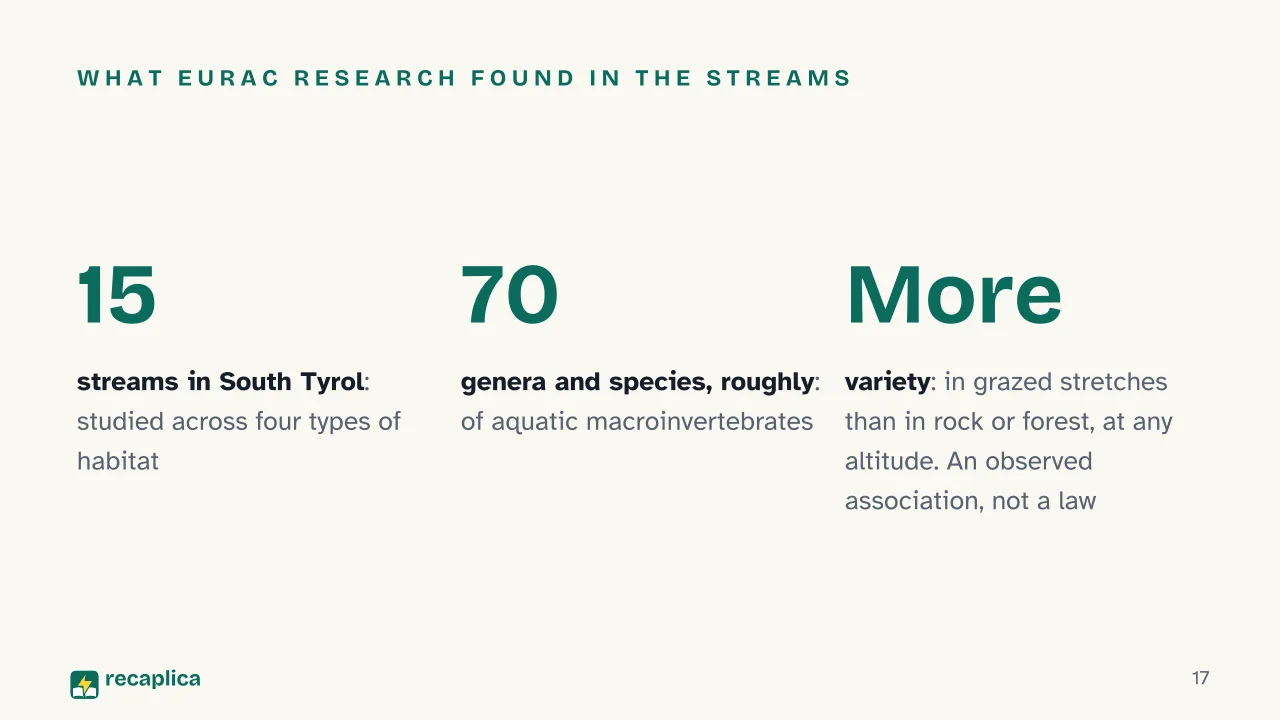 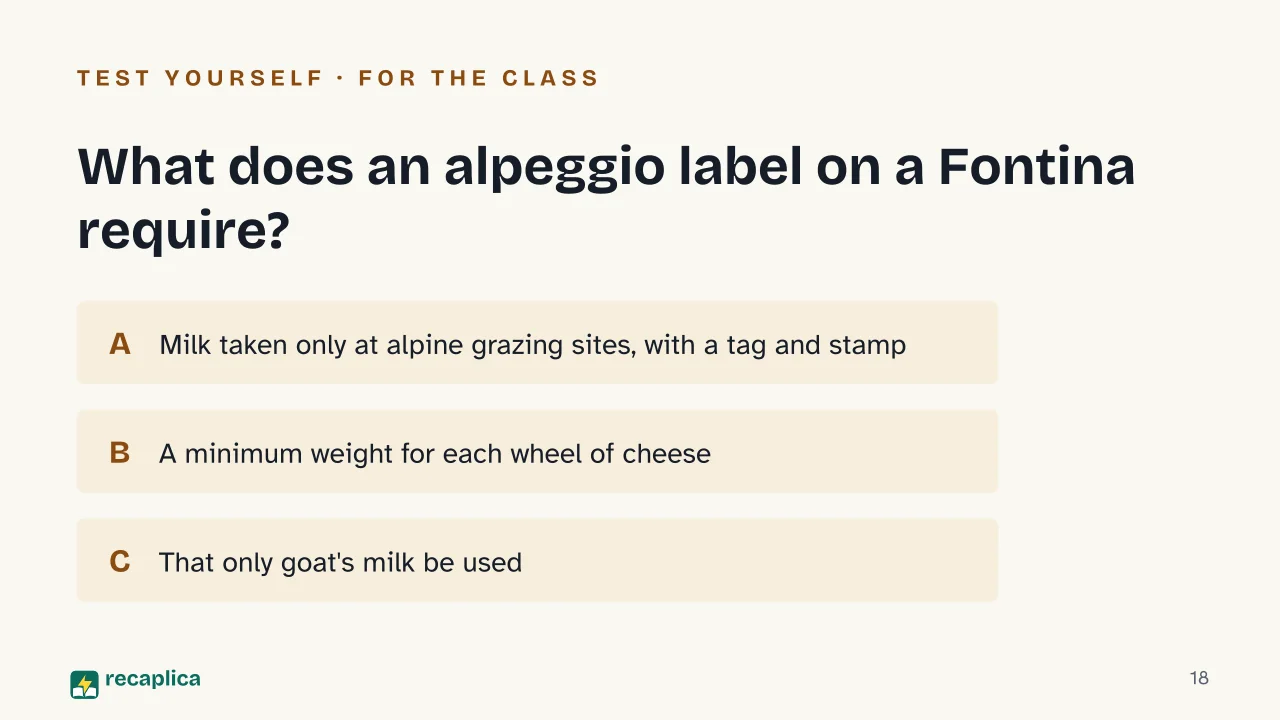  Common myths
Mind mapDrag the background to move around and the nodes to reposition them; use − and + to collapse and expand branches. 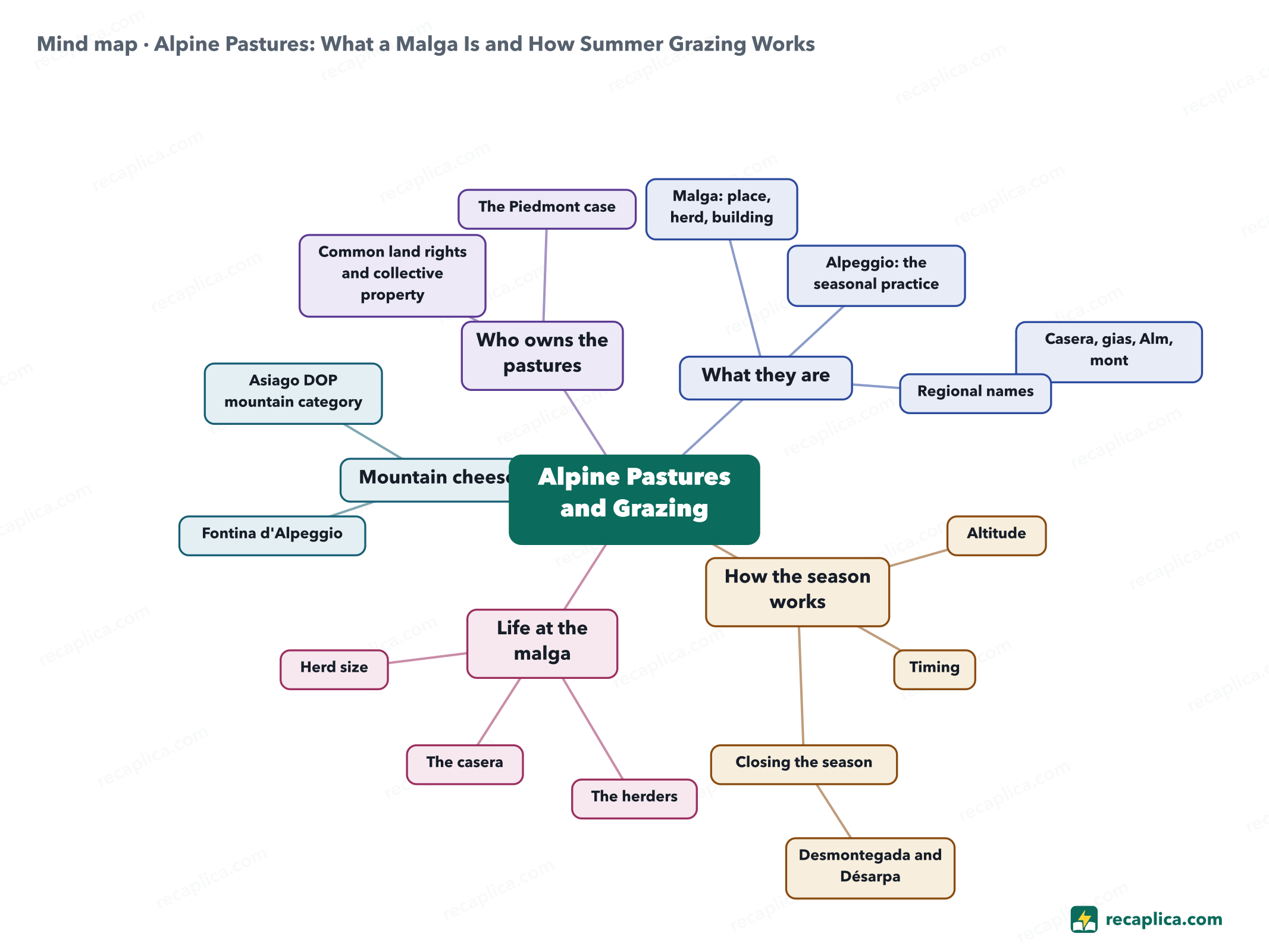
Quiz: test yourselfAnswer the questions to check what you have learned: you get instant feedback and a short explanation. Grade 0/10 0/5
FlashcardsTap the card to flip it and check whether you remember the answer, then move to the next one. 1 / 7 Explain it in your own wordsThe ultimate test: if you can explain it in simple words, you've truly understood it. Write your explanation, then compare it with the Recap. Your explanation is saved only on this device.
Frequently asked questionsWhat's the difference between a malga and alpeggio?A malga is the alpine pasture, the herd driven up to it, and the building where people live and work the milk during summer; alpeggio is the seasonal practice itself, the act of taking livestock up to graze in the mountains, roughly between 1,000 and 2,300-2,500 metres. What does transhumance mean in this context?It's the seasonal move of livestock from the valley floor up to mountain pastures, usually between late May and mid-September; the Italian technical terms are monticazione and estatatura. Why is some cheese labelled "alpine" or "d'alpeggio"?Because the production rules for that protected name reserve the label for milk milked at alpine grazing sites during summer. For Fontina, the rules updated in September 2023 require the milk to come exclusively from those sites, identified with a green casein tag and a dedicated producer stamp. What is the Desmontegada?It's the traditional festival that, in Trentino, marks the end of the grazing season, when the herd parades back down to the valley; in Valle d'Aosta the same festival is called Désarpa. Who owns malghe and alpine pastures?It depends. Many pastures are publicly owned (42% of the total in Piedmont) or belong to communities of residents through common land rights, a status recognised by law as collective property, distinct from individual private ownership. Every Recap goes through an independent review before publication. |