Skip to content
recaplica

    One moment: security check

    Cloudflare wants to make sure you're not a robot. Tick the box below and your search will continue on its own.

    IT
    recaplica Yellow Fever Vaccine: When It's Needed and How It Works
    © 2026 Recaplica · recaplica.com — All rights reserved
    Home › Civics

    Yellow Fever Vaccine: When It's Needed and How It Works

    By Recaplica Newsroom · Updated on September 27, 2026

    This Recap is about health. It explains what research and regulators say: it is not medical advice, nor a supplement or training programme. For decisions about yourself, talk to a doctor; if you are under 18, to your parents too. Legal notes

    What to print

    Page numbers appear when printing with default margins.

    Slides

    Choose a cut

    Flash10 slidesThe essential thread, to present in classFull16 slidesEvery chapter and the deeper detail

    Both come with speaker notes.

    Telegram channel
    recaplica Clear in 30 seconds, yours in 10 minutes.
    In 30 seconds Key points Figures Deep dive Slides Myths Mind map Quiz Flashcards FAQ

    In 30 seconds quick read

    The yellow fever vaccine is a live-attenuated vaccine that the World Health Organization describes as safe and affordable, giving lifelong protection with a single dose. It doesn't apply the same way to every traveler: some countries treat it as an entry requirement tied to the International Health Regulations, while others simply recommend it for travelers heading to parts of South America and Africa where the virus circulates. Common side effects are mild, though sources also document rare, more serious reactions. Vaccinated travelers get a certificate that becomes valid on the tenth day after the shot; under U.S. and international rules its validity now extends for life. Whether and when to get vaccinated is still a decision for an authorized clinic, made case by case.

    Key Points

    • The yellow fever vaccine is a live-attenuated vaccine, typically given as a single dose, that the WHO and CDC say gives lifelong protection with no routine booster needed.
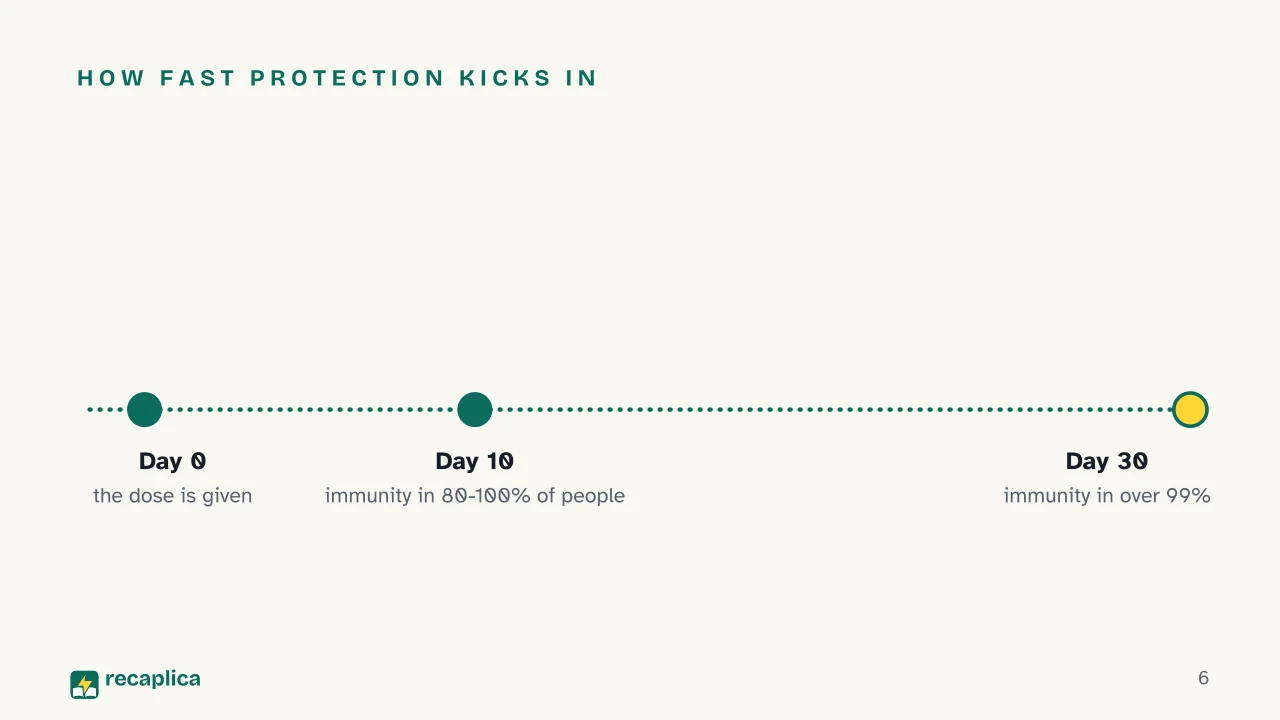
    • Immunity builds quickly, the WHO reports it develops in 80-100% of people within 10 days of vaccination and in over 99% within 30 days.
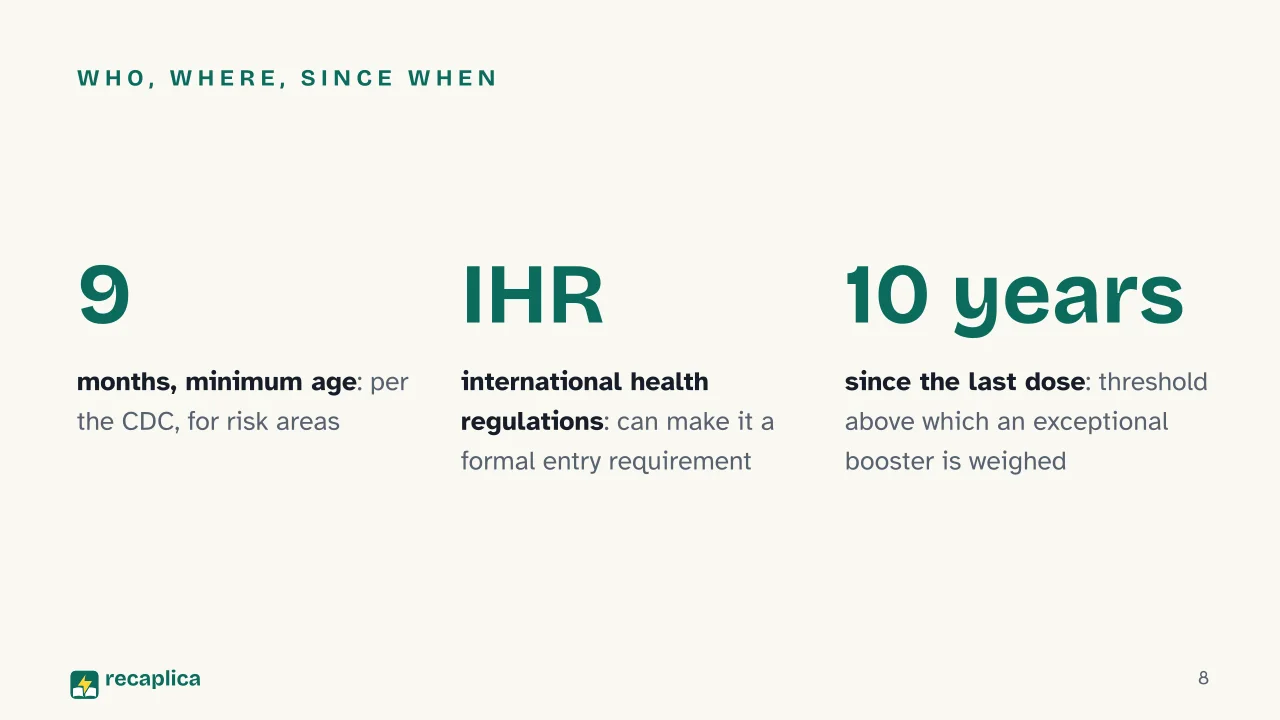
    • The CDC recommends it for travelers aged 9 months and older heading to certain areas of South America and Africa where the virus is present; elsewhere it can become a formal entry requirement under the International Health Regulations.
    • Common side effects are mild (headache, low-grade fever, muscle aches in 10-30% of vaccinees, per the CDC), but rare, more serious reactions exist, including anaphylaxis and post-vaccination neurologic or viscerotropic disease.
    • Pregnancy, breastfeeding, age above 60, and a weakened immune system don't automatically rule out the vaccine, but call for a case-by-case evaluation at an authorized clinic.
    • The vaccination certificate becomes valid on the tenth day after the shot and, under current international rules, stays valid for the vaccinated person's lifetime.

    Key figures

    • 9 months the minimum age from which the CDC recommends the vaccine for travelers heading to yellow-fever-risk areas of South America and Africa (guidance updated May 2026) Source: CDC
    • 2025 the year Italy last updated its list of clinics authorized to administer the yellow fever vaccine (decree dated July 28, 2025, published in the Official Gazette on September 19, 2025) Source: Italian Ministry of Health (Official Gazette)

    Deep Dive

    What type of vaccine it is, and how it works

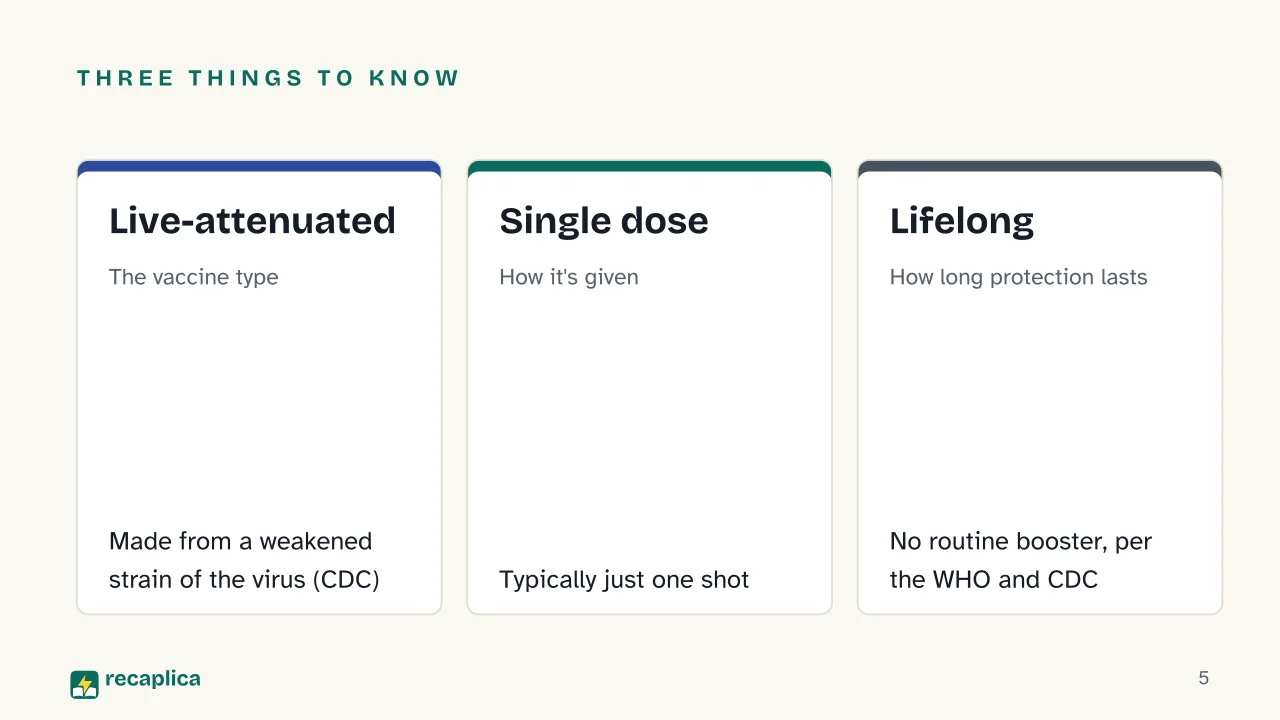
    The yellow fever vaccine belongs to the live-attenuated family: according to the CDC’s Yellow Book, every yellow fever vaccine in production is made from a weakened strain of the virus, capable of triggering the immune system without causing the disease itself. Typically a single shot is enough, and that’s one of the points institutional sources emphasize most: the WHO calls the vaccine “safe, affordable” and capable of giving “lifelong protection with a single dose,” with no periodic boosters needed like other travel vaccines.

    Immunity isn’t instant, but it builds fast. Per the WHO, within 10 days of vaccination 80-100% of people already have protective antibodies, and that share climbs above 99% within 30 days. That’s why it’s worth getting vaccinated with some lead time before departure, rather than the day before boarding a flight.

    When it’s actually needed: requirement, recommendation, age

    Not every traveler needs the same approach. The CDC recommends the vaccine for people aged 9 months and older heading to certain areas of South America and Africa where the yellow fever virus circulates between animals and people. In parallel, the International Health Regulations let individual countries demand, as a formal entry requirement, proof that vaccination has taken place — a requirement that depends on the destination country, not just the traveler’s personal risk, somewhat like the requirements for other documents needed to enter a foreign country.

    SituationWhat the sources say
    Risk area (South America, Africa)The CDC recommends it from age 9 months
    Country that requires it on entryA formal requirement tied to the International Health Regulations
    Last dose over 10 years ago, new high-risk tripThe CDC allows a booster, as an exception
    None of the aboveThe vaccine isn’t indicated by the sources consulted

    Practical example: someone planning a trip to an area the CDC flags as a yellow fever risk is covered by the health recommendation even if the destination country doesn’t formally require the vaccine for entry.

    For the full picture of country-by-country rules, and the broader set of vaccines that can matter for travel, see the guide to travel vaccinations, of which this Recap covers one specific case.

    The side effects, from most common to rarest

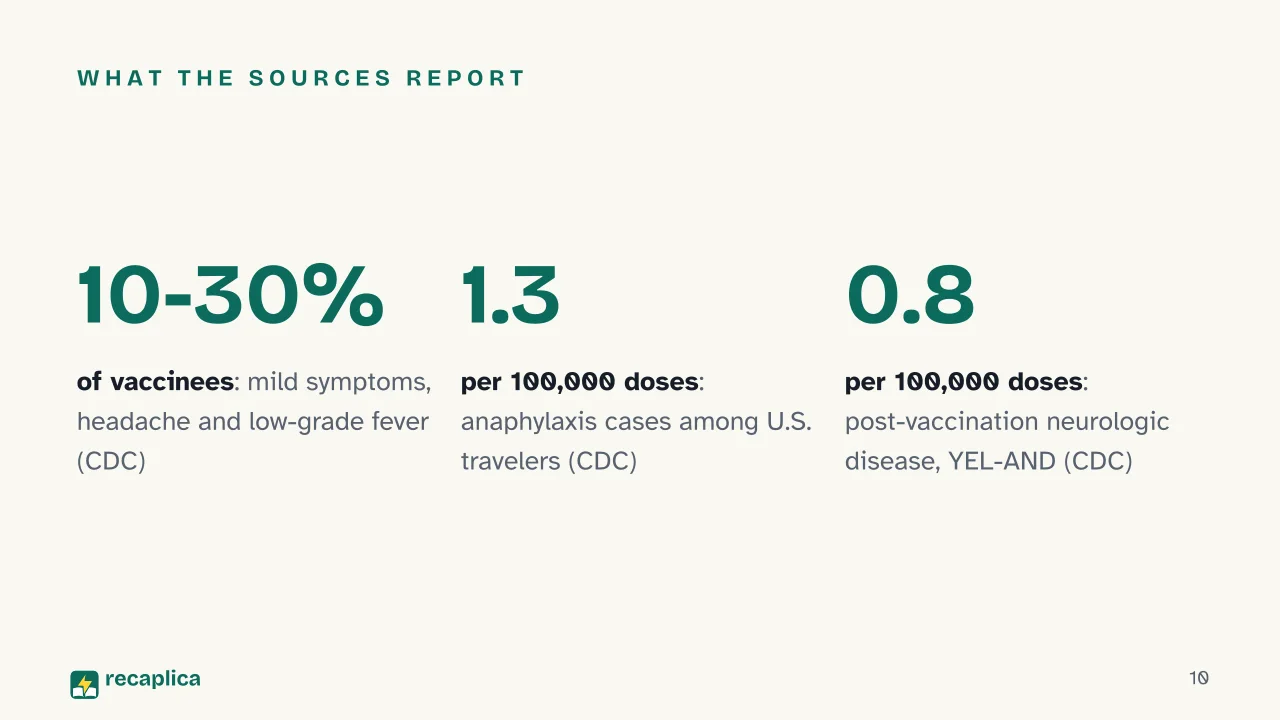
    Like any vaccine, the yellow fever vaccine carries documented side effects, with very different frequencies. The CDC reports that 10-30% of vaccinees have mild systemic symptoms, such as headache, low-grade fever, and muscle aches, starting within a few days of the shot and lasting 5-10 days.

    More serious reactions are far rarer. Anaphylaxis occurs at about 1.3 cases per 100,000 doses given to U.S. travelers, per the CDC. The same source documents two rare conditions specific to this vaccine: vaccine- associated neurologic disease (known as YEL-AND), with an incidence of 0.8 cases per 100,000 doses that rises to 2.2 per 100,000 above age 60, and vaccine-associated viscerotropic disease (YEL-AVD), with an incidence of 0.3 cases per 100,000 doses and a high fatality rate, about 43%, when it occurs.

    Precisely because these reactions are rare but serious, the CDC asks healthcare providers to vaccinate only people actually at risk of yellow fever exposure, and to weigh contraindications and precautions carefully before every shot.

    Situations that call for an authorized clinic’s evaluation

    Some conditions call for extra care, without automatically ruling the vaccine out. The CDC lists age under 6 months as a contraindication, while the WHO more broadly advises against vaccination under 9 months: the thresholds differ because they follow different logic, a broader WHO precaution and a stricter CDC contraindication, and the two should be read together, not as alternatives.

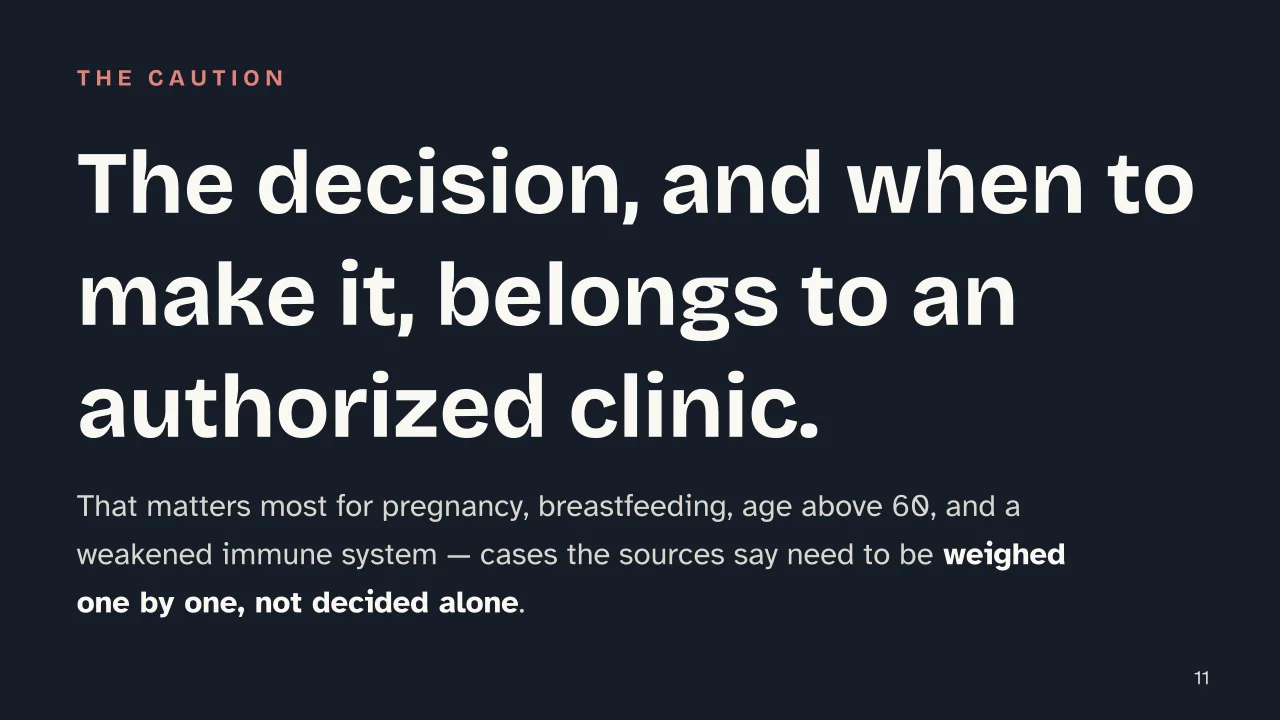
    For pregnancy, sources don’t converge on one blanket ban that applies in every case: the WHO advises against it in general, except during active outbreaks, while the CDC lists it among the precautions to weigh case by case, not among the absolute contraindications; the same goes for breastfeeding. Above age 60, both the WHO and CDC call for carefully weighing the risk-benefit ratio, partly because the incidence of post-vaccination neurologic disease documented by the CDC is higher in that age group. Also excluded are people with severe immunodeficiency, including some HIV infections with heavily compromised immune systems, and anyone with a severe allergy to egg proteins or other vaccine components, including gelatin.

    In none of these cases does the evaluation fall to the individual traveler: an authorized international vaccination clinic, together with the treating physician, decides whether and when to vaccinate.

    The vaccination certificate: when it’s valid and how long it lasts

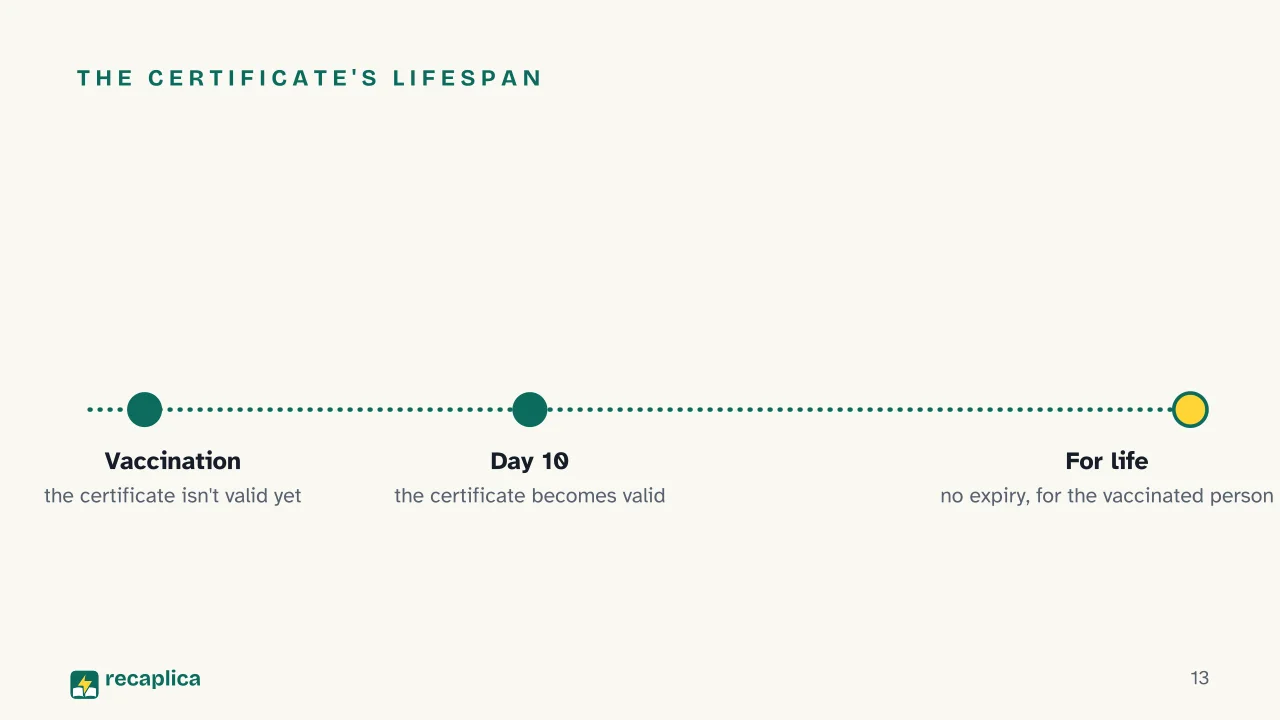
    The yellow fever vaccination certificate isn’t valid from the day of the shot itself. Under the Italian Ministry of Health circular reported by the Parma medical board, the validity period begins on the tenth day following vaccination, and from that point on, under current rules, it lasts for the vaccinated person’s lifetime — a change from the past, when certificate validity was capped at a set number of years, later extended by international rules to cover the vaccinated person’s entire life.

    For recognition, the certificate has to meet three specific requirements: follow the WHO-approved model, be issued by a legally authorized vaccination clinic, and carry that clinic’s official stamp. In Italy the list of authorized clinics is published by the Ministry of Health, and was last updated by a decree dated July 28, 2025, published in the Official Gazette on September 19, 2025.

    Where to get it, and what it costs

    In Italy, yellow fever vaccination only happens at the authorized clinics listed by the Ministry of Health, not at a general practice or pharmacy. The vaccine sits in a cost category that isn’t covered for free and stays at the requester’s expense: the exact price isn’t uniform nationwide and varies by provider, so for a reliable figure it’s best to check directly with the nearest authorized clinic, which can also give guidance on booking lead times worth weighing against the immunity timeline described above.

    What this article doesn’t cover

    This Recap explains how the yellow fever vaccine works and reports the public guidance from the institutional sources consulted: it doesn’t replace an individual medical evaluation, doesn’t indicate the right dose for a specific case, and doesn’t decide on its own whether a traveler should get vaccinated. For any decision about an actual trip, the right reference point stays an authorized international vaccination clinic.

    Slide deck

    Slides ready to download and make your own in PowerPoint or Google Slides, with speaker notes. Pick the Flash cut or the Full one.
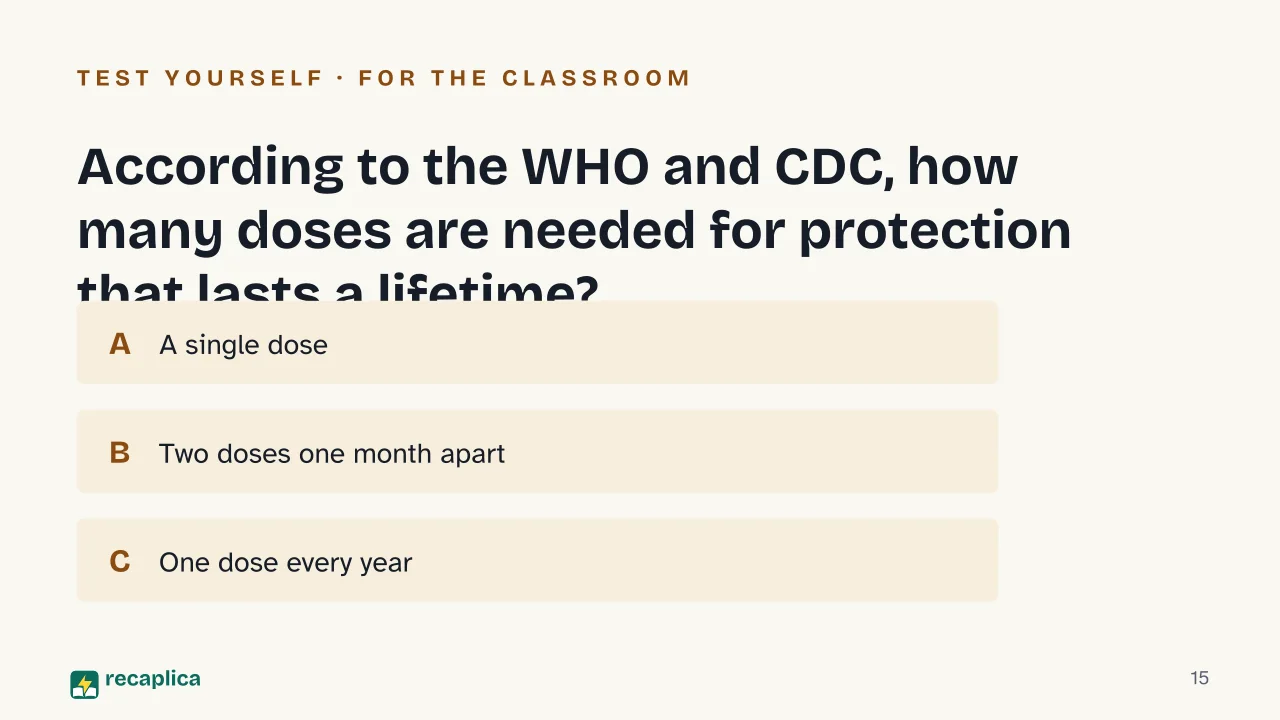
    Slide 1 of the presentation on Yellow Fever Vaccine: Yellow Fever VaccineSlide 2 of the presentation on Yellow Fever Vaccine: Does the yellow fever vaccine apply to every traveler?Slide 3 of the presentation on Yellow Fever Vaccine: What we'll coverSlide 4 of the presentation on Yellow Fever Vaccine: Chapter 01: How the vaccine worksSlide 5 of the presentation on Yellow Fever Vaccine: Three things to know: Live-attenuated, Single dose, LifelongSlide 6 of the presentation on Yellow Fever Vaccine: How fast protection kicks inSlide 7 of the presentation on Yellow Fever Vaccine: Chapter 02: When it's actually neededSlide 8 of the presentation on Yellow Fever Vaccine: Who, where, since whenSlide 9 of the presentation on Yellow Fever Vaccine: Chapter 03: The side effectsSlide 10 of the presentation on Yellow Fever Vaccine: What the sources reportSlide 11 of the presentation on Yellow Fever Vaccine: The decision, and when to make it, belongs to an authorized clinic.Slide 12 of the presentation on Yellow Fever Vaccine: Chapter 04: The certificateSlide 13 of the presentation on Yellow Fever Vaccine: The certificate's lifespanSlide 14 of the presentation on Yellow Fever Vaccine: Is the yellow fever vaccine free?Slide 15 of the presentation on Yellow Fever Vaccine: According to the WHO and CDC, how many doses are needed for protection that lasts a lifetime?Slide 16 of the presentation on Yellow Fever Vaccine: Now, time to review
    Flash10 slidesThe essential thread, to present in classFull16 slidesEvery chapter and the deeper detail

    Common myths

    • ✗ Myth Once vaccinated against yellow fever, you need a periodic booster, like with other travel vaccines.

      ✓ Reality The WHO and CDC agree that a single dose gives protection that lasts a lifetime, with no routine boosters. The CDC recommends an extra dose only for specific groups (including travelers whose last dose was at least 10 years earlier and are heading to a higher-risk setting, women who were pregnant when first vaccinated, stem cell transplant recipients, and people who are HIV-infected) — not as a general rule for everyone vaccinated.

    • ✗ Myth The yellow fever vaccination certificate expires after a few years, like it used to.

      ✓ Reality International rules now extend the certificate's validity to the vaccinated person's lifetime, replacing the earlier time-limited rule. Under the Italian Ministry of Health circular, the certificate becomes valid on the tenth day after vaccination and doesn't expire from that point on.

    • ✗ Myth The yellow fever vaccine is always off-limits during pregnancy.

      ✓ Reality Sources don't describe a blanket ban that applies in every case. The WHO advises against it in general, except during active outbreaks; the CDC simply calls for a case-by-case evaluation. Either way, the decision belongs to an authorized clinic working with the physician managing the pregnancy, not to self-assessment.

    Mind map

    Drag the background to move around and the nodes to reposition them; use − and + to collapse and expand branches.
    Customize
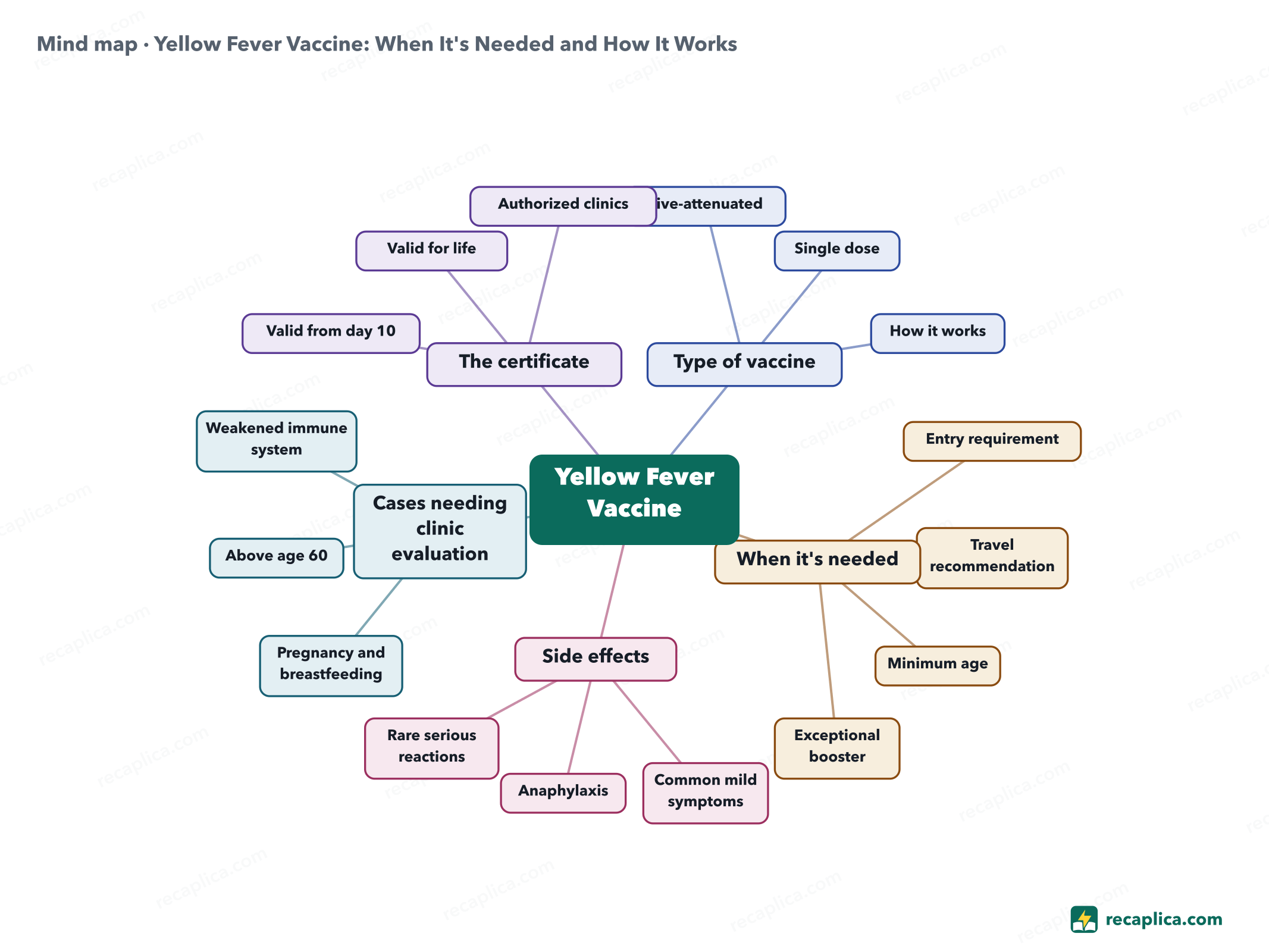
    Mind map: Yellow Fever Vaccine: When It's Needed and How It Works
    • Yellow Fever Vaccine
      • Type of vaccine
        • Live-attenuated Made from a weakened strain of the virus.
        • Single dose Typically just one shot is needed.
        • How it works Triggers antibodies without causing the disease.
      • When it's needed
        • Entry requirement Some countries require it under the IHR.
        • Travel recommendation Risk areas of South America and Africa.
        • Minimum age The CDC sets it at 9 months.
        • Exceptional booster Only for higher-risk settings, not the rule.
      • Side effects
        • Common mild symptoms Headache, low-grade fever, muscle aches.
        • Anaphylaxis Rare, about 1.3 cases per 100,000 doses.
        • Rare serious reactions Post-vaccination neurologic or viscerotropic disease.
      • Cases needing clinic evaluation
        • Pregnancy and breastfeeding A case-by-case call, not an outright ban.
        • Above age 60 Risk-benefit needs careful weighing.
        • Weakened immune system Includes some forms of HIV infection.
      • The certificate
        • Valid from day 10 Not valid before that point.
        • Valid for life For the vaccinated person, under current rules.
        • Authorized clinics Only they can issue it with an official stamp.

    Quiz: test yourself

    Answer the questions to check what you have learned: you get instant feedback and a short explanation.

    Grade 0/10 0/5
    1 What type of vaccine is the yellow fever vaccine?

    The CDC's Yellow Book, written for healthcare providers, describes every yellow fever vaccine in production as a live-attenuated vaccine, made from a weakened strain of the virus.

    2 According to the WHO and CDC, how many doses are needed for lasting protection against yellow fever?

    Both the WHO and CDC report that a single dose gives protection that lasts a lifetime, with no routine booster needed; the U.S. ACIP recommendation to that effect dates to February 2015.

    3 True or false: anaphylaxis is the most common reaction after the yellow fever vaccine.

    False. The CDC reports that 10-30% of vaccinees have mild systemic symptoms (headache, low-grade fever, muscle aches); anaphylaxis is far rarer, about 1.3 cases per 100,000 doses among U.S. travelers.

    4 Which travelers does the CDC recommend get the yellow fever vaccine?

    The CDC recommends the vaccine for people aged 9 months and older who travel to or live in areas of South America and Africa with a yellow fever risk, not for all international travelers.

    5 When does the yellow fever vaccination certificate become valid, under the Italian circular?

    The Ministry of Health circular reported by the Parma medical board states that the certificate's validity period begins on the tenth day following the shot.

    Answers: 1-A · 2-A · 3-B · 4-A · 5-B

    Flashcards

    Tap the card to flip it and check whether you remember the answer, then move to the next one.

    1 / 8

    Explain it in your own words

    The ultimate test: if you can explain it in simple words, you've truly understood it. Write your explanation, then compare it with the Recap.

    Your explanation is saved only on this device.

    The yellow fever vaccine is a live-attenuated vaccine that the World Health Organization describes as safe and affordable, giving lifelong protection with a single dose. It doesn't apply the same way to every traveler: some countries treat it as an entry requirement tied to the International Health Regulations, while others simply recommend it for travelers heading to parts of South America and Africa where the virus circulates. Common side effects are mild, though sources also document rare, more serious reactions. Vaccinated travelers get a certificate that becomes valid on the tenth day after the shot; under U.S. and international rules its validity now extends for life. Whether and when to get vaccinated is still a decision for an authorized clinic, made case by case.

    Frequently asked questions

    Is the yellow fever vaccine mandatory for travel?

    It depends on the destination country. The International Health Regulations let individual countries require proof of vaccination from people entering their territory; where that requirement doesn't apply, the CDC still recommends the vaccine for travelers aged 9 months and older heading to risk areas of South America and Africa. The exact requirement for a given country needs to be checked against that country's official sources.

    How long does yellow fever vaccine protection last?

    According to the WHO and CDC, a single dose gives protection that lasts a lifetime, with no routine booster needed. The CDC recommends an extra dose only for specific groups, not as a general rule — travelers who received their last dose at least 10 years earlier and are heading to a higher-risk setting based on activity, trip length, location, or season; women who were pregnant when first vaccinated; people who received a hematopoietic stem cell transplant after their last dose; people who are HIV-infected; and laboratory workers who routinely handle wild-type yellow fever virus.

    What are the side effects of the yellow fever vaccine?

    The most common ones are mild — the CDC reports systemic symptoms such as headache, low-grade fever, and muscle aches in 10-30% of vaccinees, starting within a few days and lasting 5-10 days. Rare but serious reactions also exist, including anaphylaxis (about 1.3 cases per 100,000 doses) and two documented post-vaccination conditions, one neurologic and one viscerotropic, the latter rare but with a high fatality rate when it occurs.

    When does the yellow fever vaccination certificate become valid?

    On the tenth day after the shot, according to the Italian Ministry of Health circular reported by the Parma medical board. The certificate is only valid if it follows the WHO-approved model, is issued by a legally authorized vaccination clinic, and carries that clinic's official stamp.

    Where can I get vaccinated, and who decides whether the vaccine is right for me?

    Yellow fever vaccination has to happen at an authorized clinic — a general practice or pharmacy typically won't administer it. An authorized clinic, together with a treating physician, evaluates whether the vaccine is appropriate case by case, particularly for anyone pregnant or breastfeeding, over age 60, or with a weakened immune system. This Recap explains how the vaccine works but doesn't replace an individual evaluation with a healthcare professional.

    Sources

    • Yellow fever — fact sheet, World Health Organization (WHO)
    • Yellow Book, "Yellow Fever" chapter — CDC (Centers for Disease Control and Prevention)
    • Yellow Fever Vaccine Information for Healthcare Providers — CDC
    • Yellow fever, guidance on administration and certification — Ordine dei Medici e degli Odontoiatri di Parma (Italian Ministry of Health circular)
    • Authorization of yellow fever vaccination clinics 2025 — Italian Ministry of Health, Official Gazette (Serie Generale n. 218, September 19, 2025)
    • Extension to life on yellow fever vaccination — amendment to Annex 7 of the International Health Regulations, WHO

    Every Recap goes through an independent review before publication.

    Every evening, the day's new Recaps on our Telegram channel. Join the channel →

    Keep learning

    • Civics Travel Vaccinations: What's Required to Enter a Country Some countries ask travelers to prove they've been vaccinated against a specific disease before entry: no single body hands down one list for everyone. The World Health Organization sets the legal framework through the International Health Regulations, but each country decides for itself what to require. Public health bodies typically sort travel vaccinations into three groups — routine, risk-based, and entry requirements — with yellow fever and meningitis ACWY as concrete examples of the last group. Timing matters as much as the shot itself: the CDC recommends booking weeks ahead, since some vaccines need multiple doses and immunity doesn't kick in overnight. For any specific destination, current requirements live on official sources such as national foreign-ministry travel advisories or the CDC's destination pages, not in a fixed list. Read the Recap →
    • Science Phone Addiction: What It Is and What Happens to Teens' Brains Phone addiction, which many studies call problematic smartphone use, means excessive phone use that slips out of a person's control; it isn't listed in the DSM, psychiatry's diagnostic manual. A 2019 meta-analysis puts it at roughly one in four of the young people studied, and finds an association — not a proven cause — with anxiety, depressive symptoms, and worse sleep. A 2024 review reports that in people with this behavior the brain's reward system, a circuit involving dopamine and serotonin, is less active. The same review names teenagers as the age group most at risk but doesn't say why; the American Psychological Association, writing about social media, notes that the brain regions behind self-control aren't fully developed until adulthood. Studies measure nomophobia, discomfort at being without a phone, separately and with a questionnaire; it isn't a diagnosis either. Read the Recap →
    • Science How the Immune System Works: Barriers, Cells, and Memory The immune system isn't a single organ — it's a network of barriers, cells and organs scattered across the whole body. Skin and mucous membranes form the outer wall, stopping most invaders before they get anywhere. Anything that gets past this wall runs into innate immunity, fast but generic, and then adaptive immunity, slower but aimed at that one invader specifically. Adaptive immunity also leaves something behind: memory, which is why a second encounter with the same pathogen gets a much quicker response. Read the Recap →

    recaplica

    Clear in 30 seconds, yours in 10 minutes.

    Recaps Mind maps Request a Recap Telegram channel Mind map maker Our method About Privacy & cookies Legal notes & terms of use

    © 2026 Recaplica · A project by Curi S.r.l. — VAT IT05472000750

    Statistics, only if you say so

    To learn which Recaps help most we would use Google Analytics, with aggregate, anonymous data. It starts only with your OK, and you can change your mind anytime. Privacy policy