|
recaplica
Travel Vaccinations: What's Required to Enter a Country | ||||||||||||
| © 2026 Recaplica · recaplica.com — All rights reserved | ||||||||||||
Travel Vaccinations: What's Required to Enter a CountryWhat to print Page numbers appear when printing with default margins. SlidesChoose a cut Flash10 slidesThe essential thread, to present in classFull16 slidesEvery chapter and the deeper detailBoth come with speaker notes. In 30 seconds quick readSome countries ask travelers to prove they've been vaccinated against a specific disease before entry: no single body hands down one list for everyone. The World Health Organization sets the legal framework through the International Health Regulations, but each country decides for itself what to require. Public health bodies typically sort travel vaccinations into three groups — routine, risk-based, and entry requirements — with yellow fever and meningitis ACWY as concrete examples of the last group. Timing matters as much as the shot itself: the CDC recommends booking weeks ahead, since some vaccines need multiple doses and immunity doesn't kick in overnight. For any specific destination, current requirements live on official sources such as national foreign-ministry travel advisories or the CDC's destination pages, not in a fixed list. Key Points
Key figures
Deep DiveAnyone planning a trip abroad eventually asks whether they’ll need a specific vaccine to enter their destination country. There’s no fixed list to check: it comes down to a framework of international rules that each state applies in its own way. Who decides what’s neededAccording to the WHO, the International Health Regulations (IHR) are an instrument of international law that provides the global legal framework for managing health risks capable of spreading across national borders. It’s the text that lets signatory countries require travelers to prove they’ve been vaccinated against a given disease as a condition of entry. The WHO sets the legal framework; which vaccination proof to require from travelers is a choice each individual country makes within that framework. Every state that signs on to the IHR must also designate national authorities responsible for the rules and maintain surveillance capacity over public health risks, according to the WHO. The arrangement mirrors other international agreements: a treaty sets shared obligations, and each state applies them according to its own circumstances. Three levels, not one single ruleHealth authorities such as Italy’s Istituto Superiore di Sanità sort travel vaccinations into three categories. Routine vaccinations are the ones already part of a traveler’s home vaccination schedule, regardless of destination. Risk-based vaccinations are added according to the specific risk of the trip, the destination, and the length of stay: examples commonly cited include hepatitis A, Japanese encephalitis, rabies, tuberculosis, typhoid fever, and cholera, alongside others assessed case by case. Required vaccinations, finally, are the ones a country demands as a condition of entry. As examples of required vaccinations, health authorities point to yellow fever for travelers heading to parts of equatorial Africa and South America, and meningitis ACWY for those entering Saudi Arabia. In both cases it’s an entry requirement tied to the specific destination.
Why it pays to move weeks ahead of timeThe CDC recommends booking an appointment with a healthcare provider or travel health specialist at least 4-6 weeks before departure. Among the reasons, the CDC notes that some vaccines require multiple doses spaced out over time, so it’s worth starting the process as soon as the itinerary is set. For the yellow fever vaccine, the WHO reports that immunity develops in 80-100% of people vaccinated within 10 days, and in over 99% within 30 days; a single dose, according to the WHO, then provides lifelong immunity, with no booster needed. That’s why showing up the day before a flight isn’t enough: the body needs days to build protection, on top of the time needed to get an appointment in the first place. The way the immune system builds that protection is the same memory mechanism behind any vaccination, not something specific to yellow fever. The CDC also notes that whenever yellow fever vaccination is recommended or required for a destination, it must be given at a center authorized to administer it, not by any general practitioner: in Italy, that role belongs to the network of international vaccination centers.
Where to find current requirements for your destinationA vaccine list covering every country in the world goes out of date fast: rules change, and a list read once can turn out wrong the following year. That’s why health authorities point travelers to national foreign-ministry travel advisories — Italy’s Ministry of Foreign Affairs, for instance, runs Viaggiare Sicuri, a service that updates health recommendations for each destination. The same ministry also handles other services useful to travelers, from consulates to emergency assistance. Other useful references are the country-by-country pages published by the US CDC, built specifically for people preparing an international trip, and the nearest travel health clinic, which can assess each traveler’s specific case based on their vaccination history and planned itinerary. None of these sources replaces the others: they complement each other, and the starting point is always the exact destination of the trip. Slide deckSlides ready to download and make your own in PowerPoint or Google Slides, with speaker notes. Pick the Flash cut or the Full one.     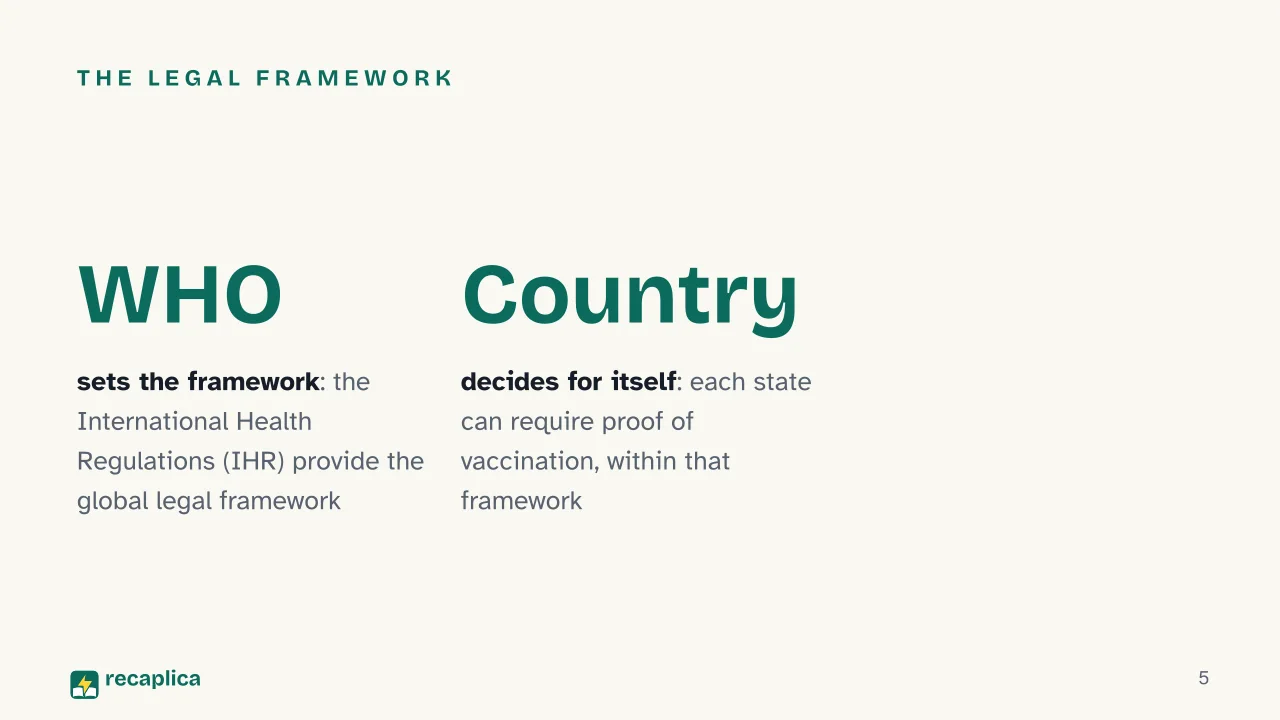 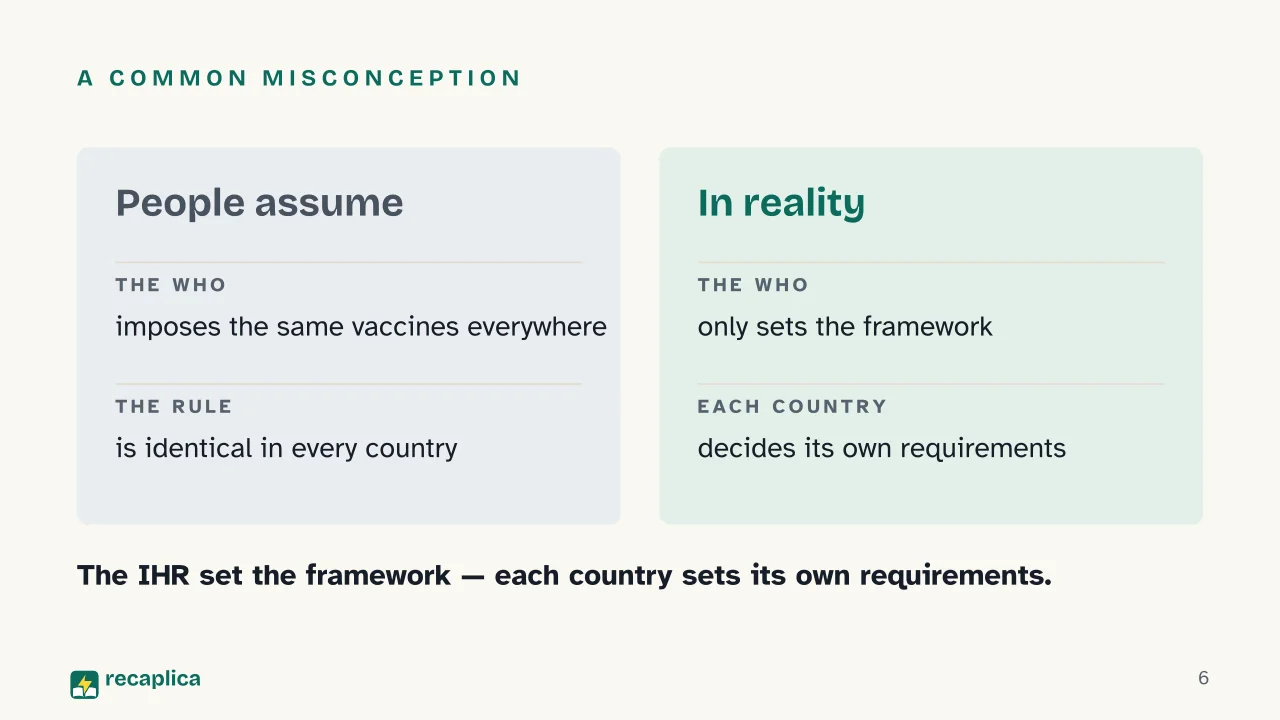  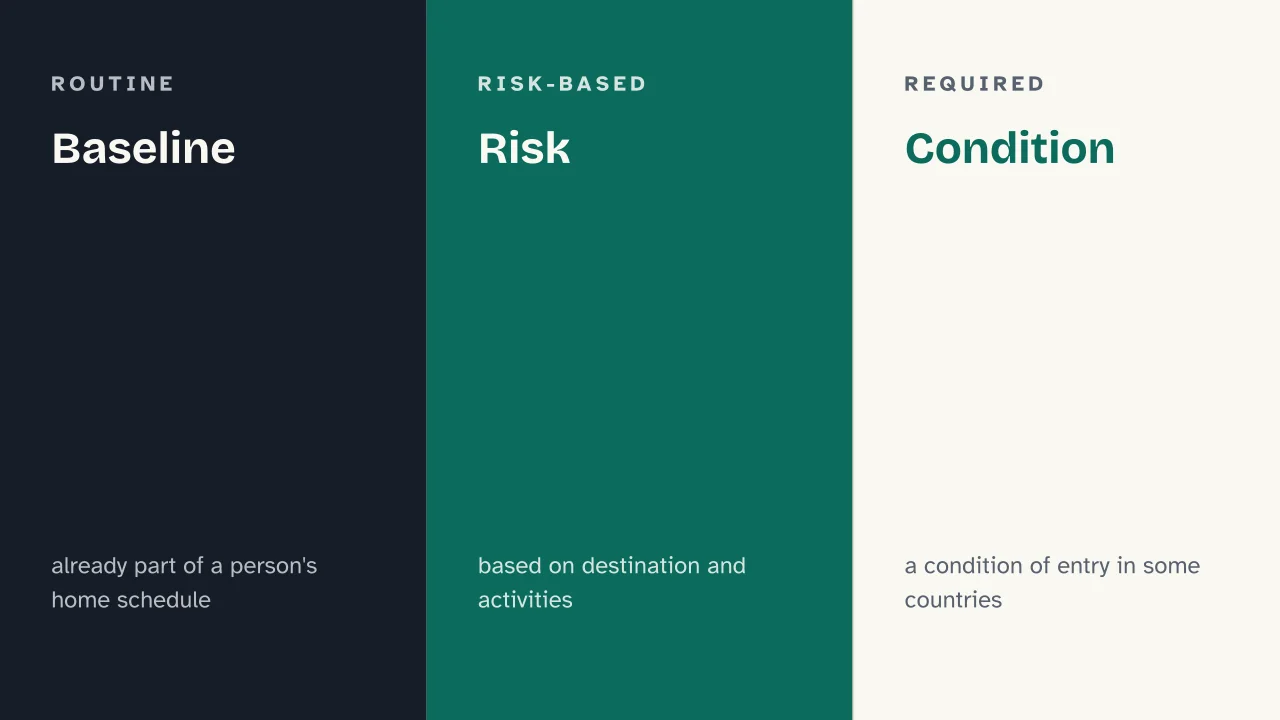 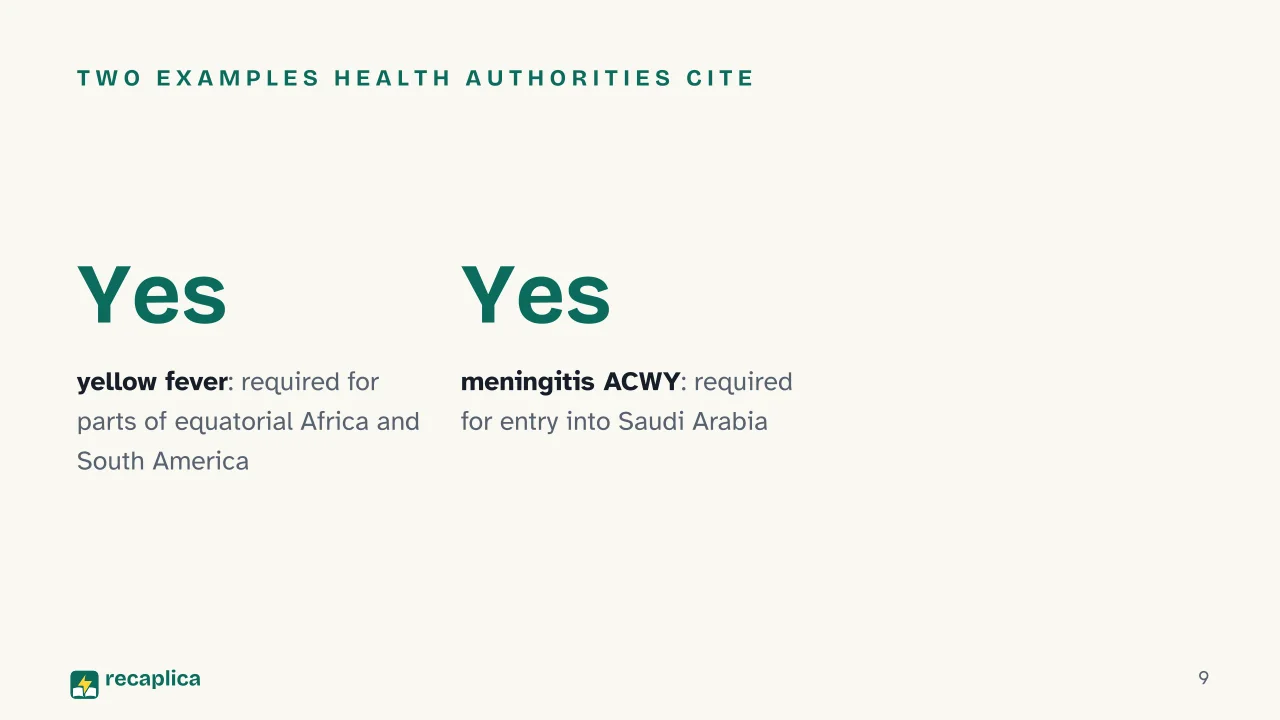  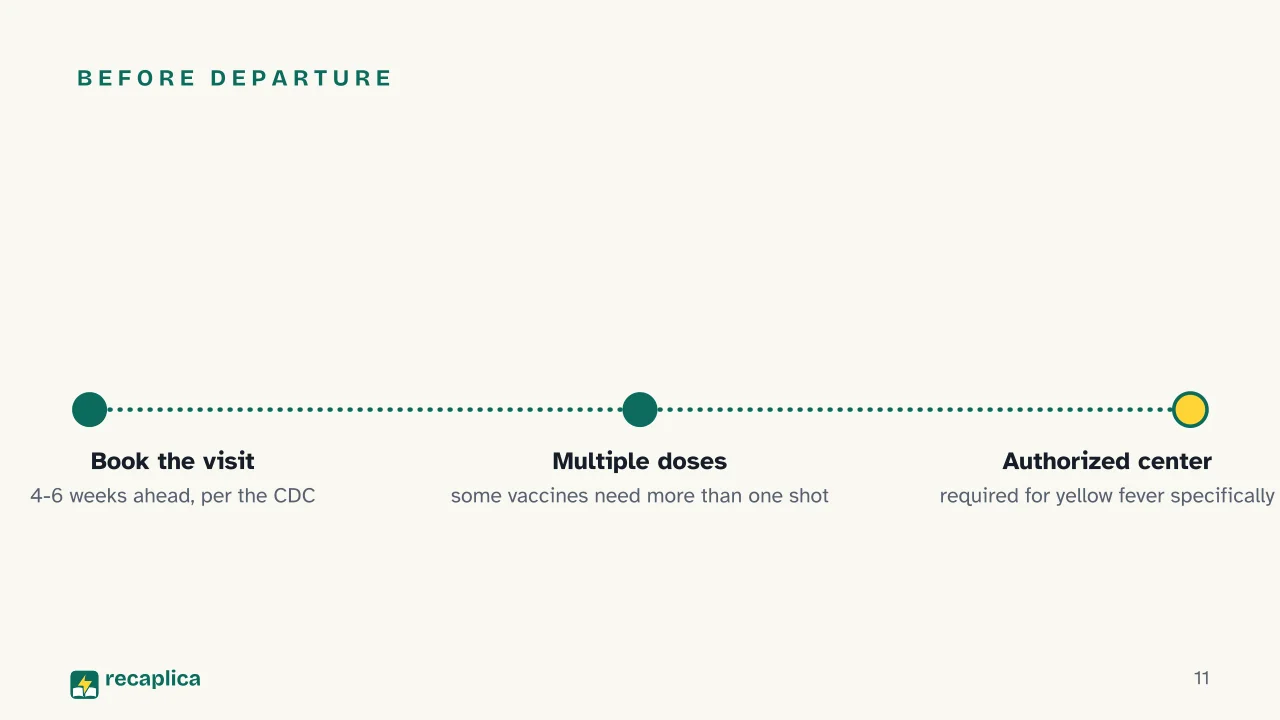 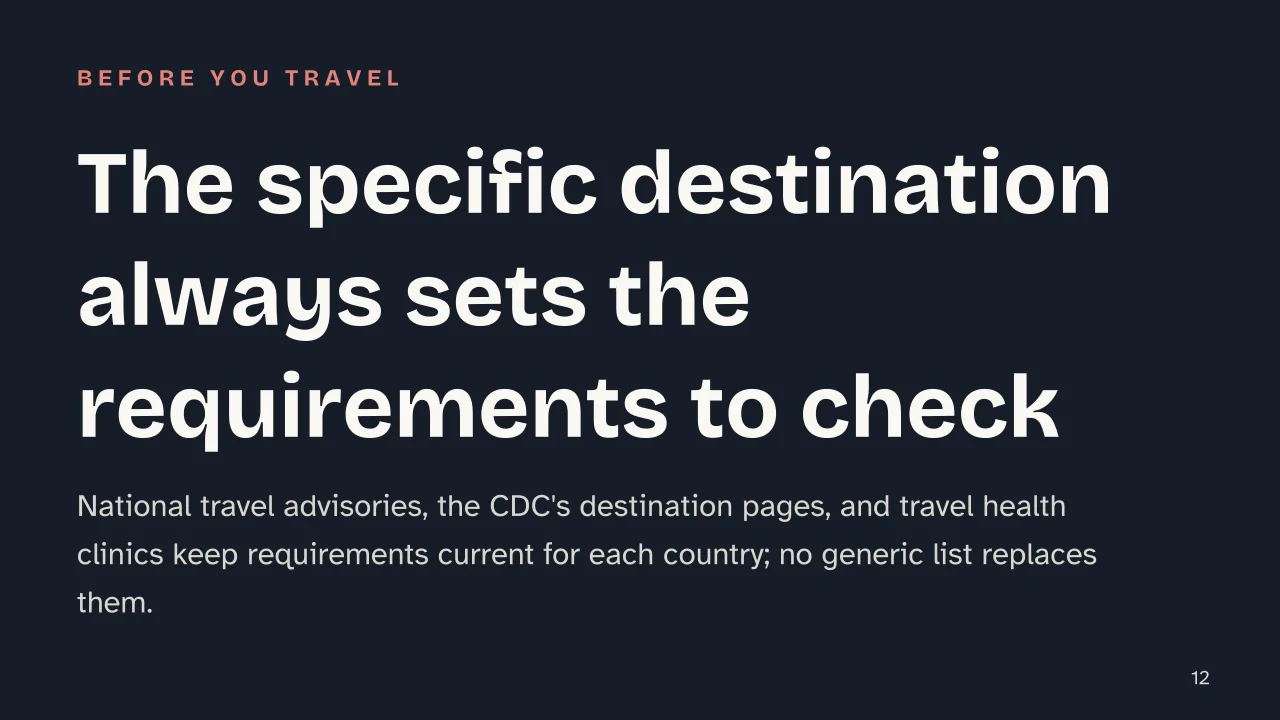  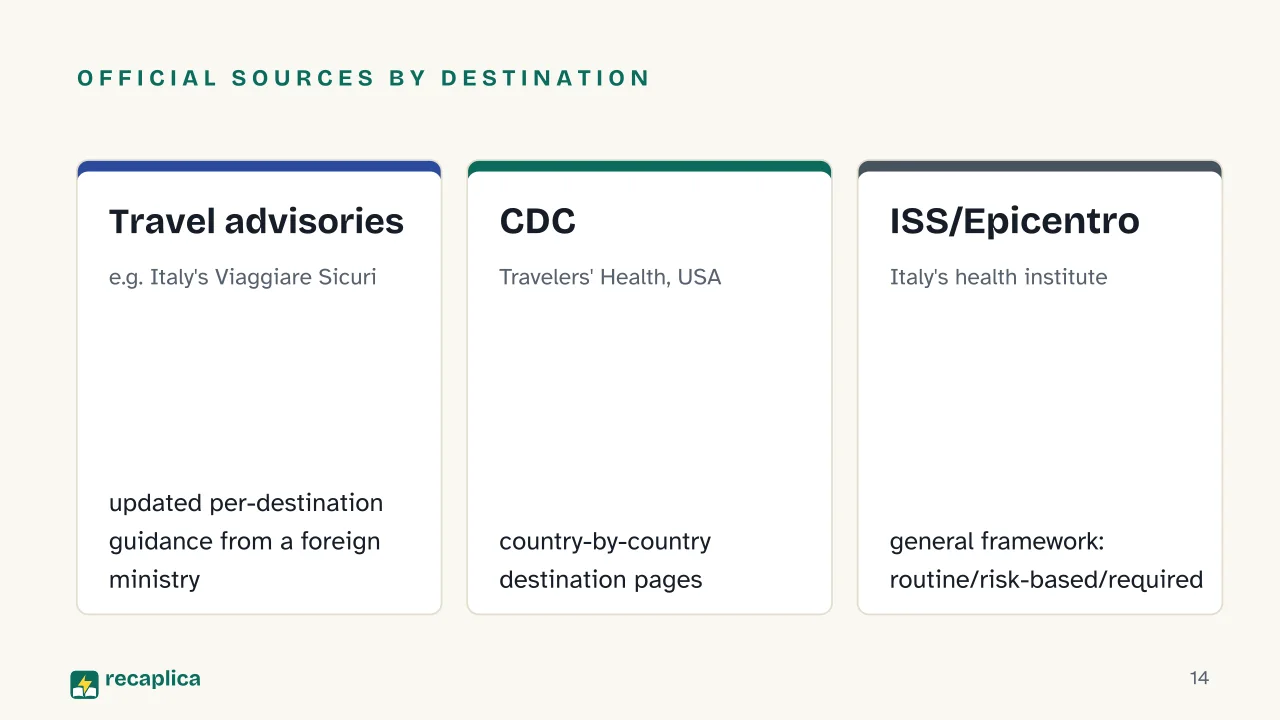 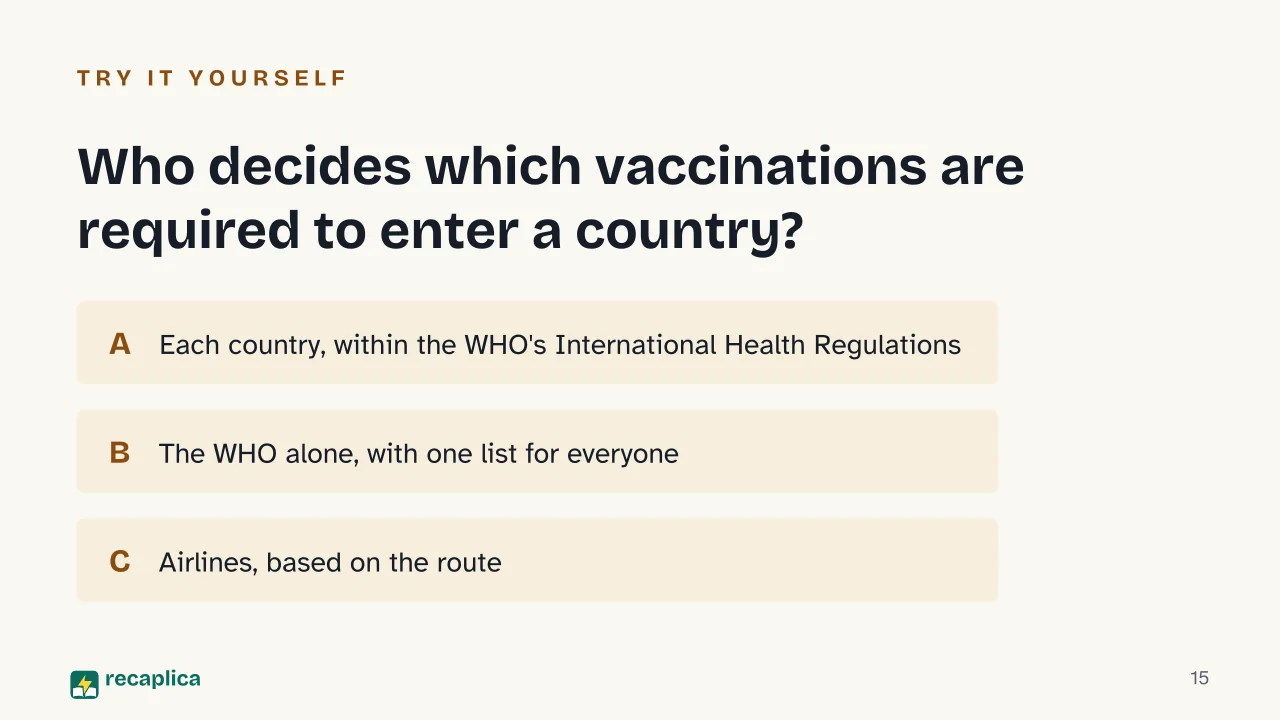  Common myths
Mind mapDrag the background to move around and the nodes to reposition them; use − and + to collapse and expand branches. 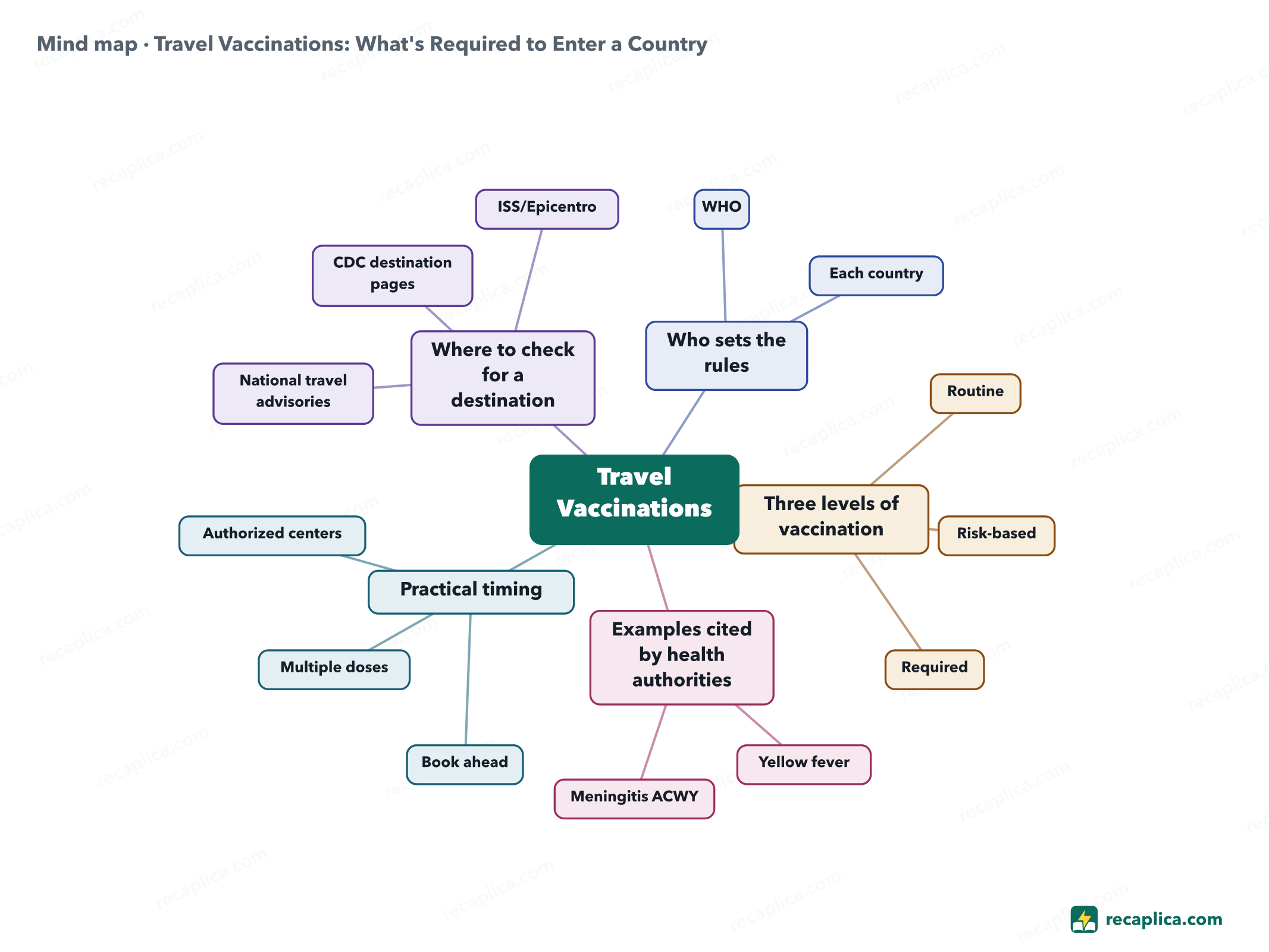
Quiz: test yourselfAnswer the questions to check what you have learned: you get instant feedback and a short explanation. Grade 0/10 0/5
FlashcardsTap the card to flip it and check whether you remember the answer, then move to the next one. 1 / 7 Explain it in your own wordsThe ultimate test: if you can explain it in simple words, you've truly understood it. Write your explanation, then compare it with the Recap. Your explanation is saved only on this device.
Frequently asked questionsAre travel vaccinations a legal requirement?It depends on the country and the vaccine. The WHO's International Health Regulations allow individual states to require proof of vaccination as a condition of entry, but they don't apply it uniformly: common examples are yellow fever for parts of equatorial Africa and South America, and meningitis ACWY for Saudi Arabia. Where can I find the vaccinations required for my destination country?The CDC publishes destination pages with country-by-country requirements, and many national foreign ministries run their own travel advisory services — Italy's Viaggiare Sicuri is one example. A travel health clinic or your regular doctor can also assess your specific case. How far ahead of departure should I sort out vaccinations?The CDC recommends booking a travel health visit at least 4-6 weeks ahead, partly because some vaccines require multiple doses spaced out over time. For yellow fever specifically, the WHO notes that full immunity can take up to 10-30 days to develop. Who decides whether a vaccine is required to enter a country?The individual country, not the WHO directly. The International Health Regulations set the legal framework that lets states require proof of vaccination from travelers, but the choice of which vaccines to require stays with each country. What is the international certificate of vaccination?It's the documentary proof some countries can request at entry for certain vaccines, such as yellow fever; it's issued by authorized international vaccination centers. The specific requirements and paperwork should always be checked against official sources for your destination. Every Recap goes through an independent review before publication. |