|
recaplica
Potty Training: When to Start and How It Works | |||||||||||||||
| © 2026 Recaplica · recaplica.com — All rights reserved | |||||||||||||||
Potty Training: When to Start and How It WorksWhat to print Page numbers appear when printing with default margins. SlidesChoose a cut Flash10 slidesThe essential thread, to present in classFull18 slidesEvery chapter and the deeper detailBoth come with speaker notes. In 30 seconds quick readThere's no fixed age at which a child must stop wearing diapers: the pediatric organizations and health services consulted here describe a wide window, roughly from 18 months to 3-4 years, and put the emphasis on individual readiness — physical, cognitive, and emotional — rather than the calendar. The sources agree on one more point: pushing a child who isn't ready doesn't speed up the process, and is instead linked to more potty refusal and more bedwetting episodes. On one detail, though, the sources diverge: the UK's NHS holds that parents don't need to wait for explicit signals from the child before starting, while the AAFP, the AAP, and Rome's Bambino Gesù pediatric hospital lean more on readiness signs as a guide for choosing the right moment. Key Points
Key figures
Deep DiveWhy there’s no single right ageAnyone searching for “what age do you potty train” is often hoping for one precise number. The pediatric organizations and health services covering the topic don’t give one: they describe a wide window instead, inside which variation between one child and another is the norm, not the exception. The American Family Physician, the peer-reviewed journal of the American Academy of Family Physicians, reports that more than two-thirds of U.S. children reach the physiologic, cognitive, and emotional development necessary between 18 and 30 months — a full year-long range, not a single month. The UK’s NHS narrows the indicative window slightly to 18 months through 2.5 years, while the American Academy of Pediatrics describes an average between ages 2 and 3, noting that most children reach bowel and bladder control by age 4. Rome’s Bambino Gesù pediatric hospital puts it plainly: “there’s no fixed rule, and no precise age” for taking a child out of diapers. Within this picture, differences tied to sex also appear: according to the AAFP, girls tend to show readiness signs before boys (on average 24-26 months versus 29 months), and the median age at which full daytime continence is reached is 32.5 months for girls and 35 months for boys. Even after that milestone, the process isn’t always finished: 40% of children continue to have nighttime bedwetting episodes after they’ve stopped needing a diaper during the day. Readiness signs, according to the sources (with one difference to note)More than the date on the calendar, the sources consulted emphasize the signals the child sends. The AAFP lists several in a dedicated table: staying dry for two hours at a time or during naps, being able to walk to and from the bathroom, being able to put on and take off clothes (a skill about 90% of children reach by 30 months), showing discomfort with a soiled diaper, and in some cases asking to wear “big kid” underwear. Rome’s Bambino Gesù pediatric hospital distinguishes indirect signs — curiosity about the bathroom, wanting to act “like a big kid,” being able to walk independently — from direct signs, such as sensing the urge in advance or staying dry for 3-4 hours in a row. On this point, though, the sources don’t all say the same thing. The NHS takes a more permissive stance: it states plainly that parents don’t need to wait for their child to show signs or ask to use a potty before starting, adding that some children communicate on their own when they’re wet or need changing, while others don’t — “and that’s completely normal,” according to the source. The AAFP, the AAP, and Bambino Gesù, by contrast, give more weight to signs as a guide for choosing when to start. It’s a nuance, not a flat contradiction: all the sources agree on the breadth of the time window, but they aren’t aligned on how much it’s worth waiting for an explicit green light from the child before beginning.
How the process unfoldsThe reference most cited by the AAFP is the “child-oriented” approach pediatrician T. Berry Brazelton devised in 1962: following the child’s own pace instead of imposing a schedule from the outside. In a 1997 study that followed children trained with this method, 61% were toilet trained by 36 months and 98% by 48 months. The AAFP also cites an alternative method, developed by Azrin and Foxx, described as an intensive approach aiming to complete training in a single day, based on principles of operant conditioning — but the same journal is unambiguous in stating that “no training method is superior to another.” The NHS lays out a practical sequence of steps: letting the child know that they’ll be starting to use a potty or toilet, switching to pants during the day while keeping a diaper for naps and nighttime, building a regular routine, praising attempts regardless of outcome, and letting the child take on more independence over time (wiping themselves, pulling their own pants up). Rome’s Bambino Gesù pediatric hospital describes a similarly gradual introduction: first the child sits on the potty dressed, then without a diaper, building familiarity one step at a time. The same source suggests using thinner or cloth diapers during the transition phase: super-absorbent diapers on the market, it explains, tend to mask the sensation of wetness, making it harder for a child to connect that feeling with the need to use the potty.
What happens if you force the processThe four sources converge on one point: forcing a child who isn’t ready doesn’t speed up the process, and can make it more complicated. The AAP puts it most directly, listing “power struggles, begging, pleading, rewarding, and punishing” as factors that keep a child from managing their own toileting, rather than teaching them faster. It adds that the process involves “the body and the mind” together, and that a child can succeed, but in their own time. The AAFP quantifies some of these risks. Refusing to use the potty for bowel movements (stool toileting refusal) is observed in up to 20% of children during the process, and requires intervention in a quarter of those cases; this behavior is associated with higher rates of stool withholding and involuntary fecal soiling (encopresis). A study of 112 children with bladder dysfunction, cited by the AAFP, found an association between starting training before 24 months or after 36 months and more cases of bedwetting; the AAFP also reports, more generally, that starting after age three and a half is linked to more potty refusal. One interesting detail: the same journal notes that asking a child to use the potty more than three times a day before 27 months isn’t in itself associated with complications like constipation or refusal — the problem, then, doesn’t appear to be the frequency of requests, but insisting when the child isn’t yet showing readiness signs. Accidents, regressions, and moments to avoidThe sources describe accidents and regressions as a normal part of the process, not an exception to correct with strictness. The NHS advises against getting angry or upset when it happens, cleaning up together and moving on, noting that “every child learns at their own pace.” Bambino Gesù takes the same line: children “shouldn’t be scolded for wetting accidents, since it means they haven’t yet reached sufficient maturity,” and points to the family pediatrician as someone available to discuss any setbacks. Several sources also note that major changes in family life — a house move, the birth of a sibling, other stressful situations — can interrupt progress already made. The AAP recommends postponing the start of the process during this kind of event, and the NHS notes that they may call for a temporary pause or more patience than expected. Situations that need a tailored approachThe general-audience sources describe a process built around typical development. The AAFP notes explicitly that children with Down syndrome, cerebral palsy, or autism require individualized approaches, often involving occupational or developmental therapists. The same source reports that encopresis — the involuntary passing of stool outside the potty, in a context where control would be expected — affects between 1% and 4% of school-age children, with an incidence three to six times higher in boys. For any specific concern about timing, methods, or difficulties during an individual child’s process, the sources themselves point to the family pediatrician as the reference point, not a generic timetable meant to apply to everyone. Slide deckSlides ready to download and make your own in PowerPoint or Google Slides, with speaker notes. Pick the Flash cut or the Full one.     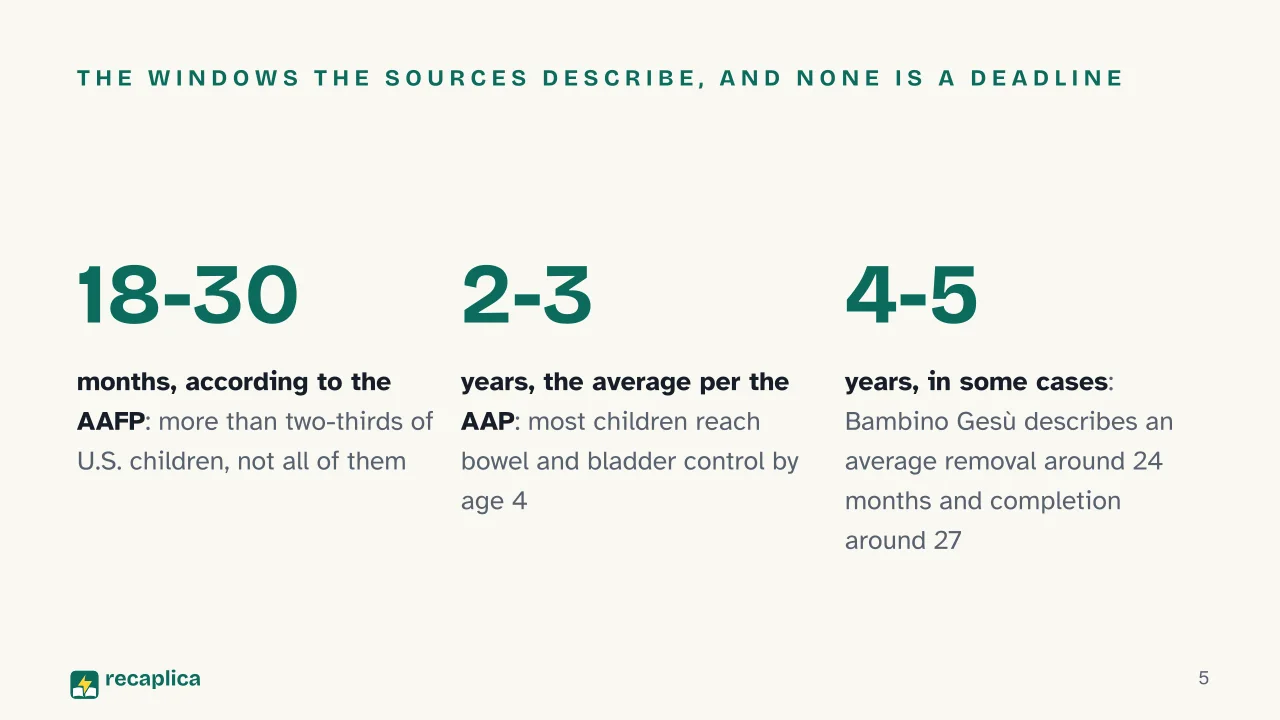   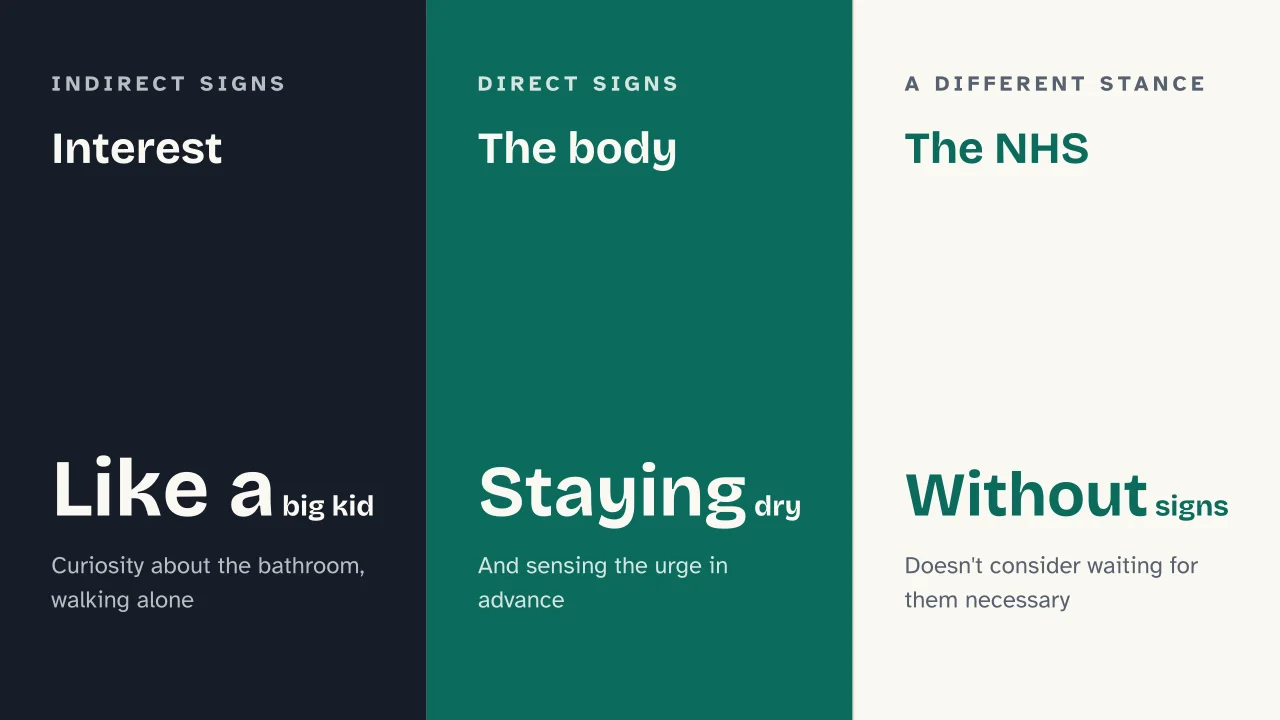 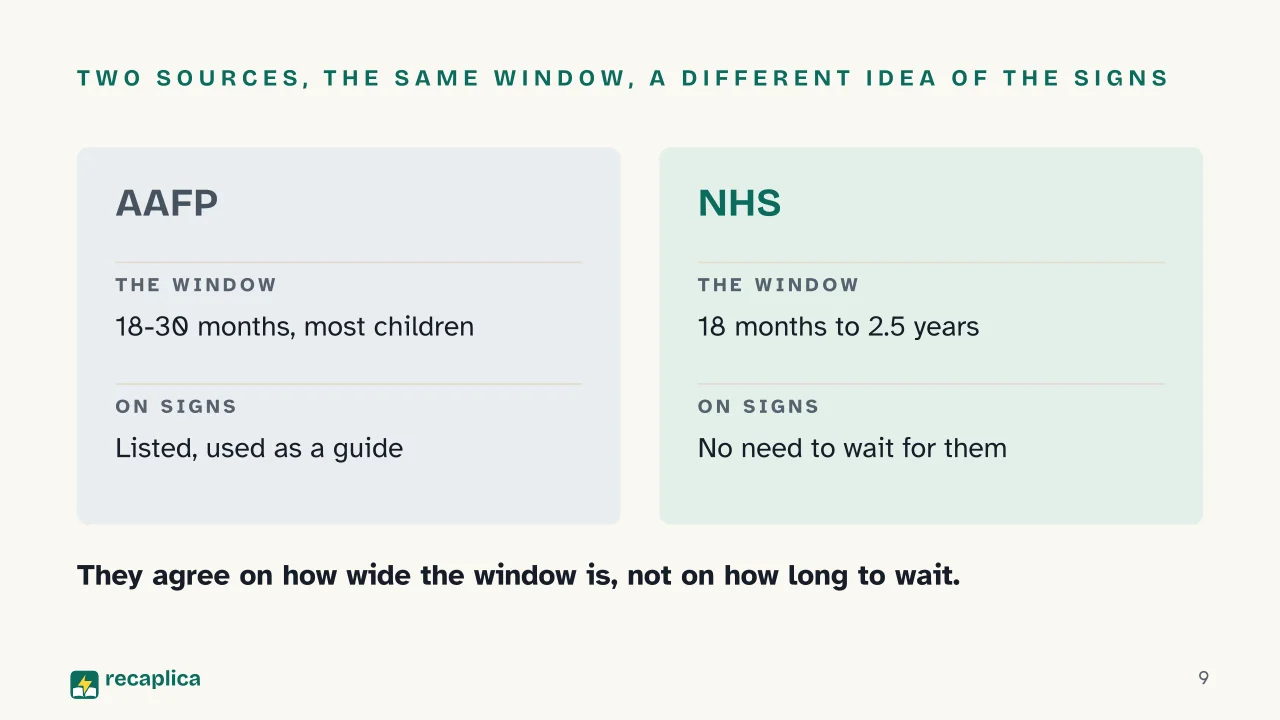  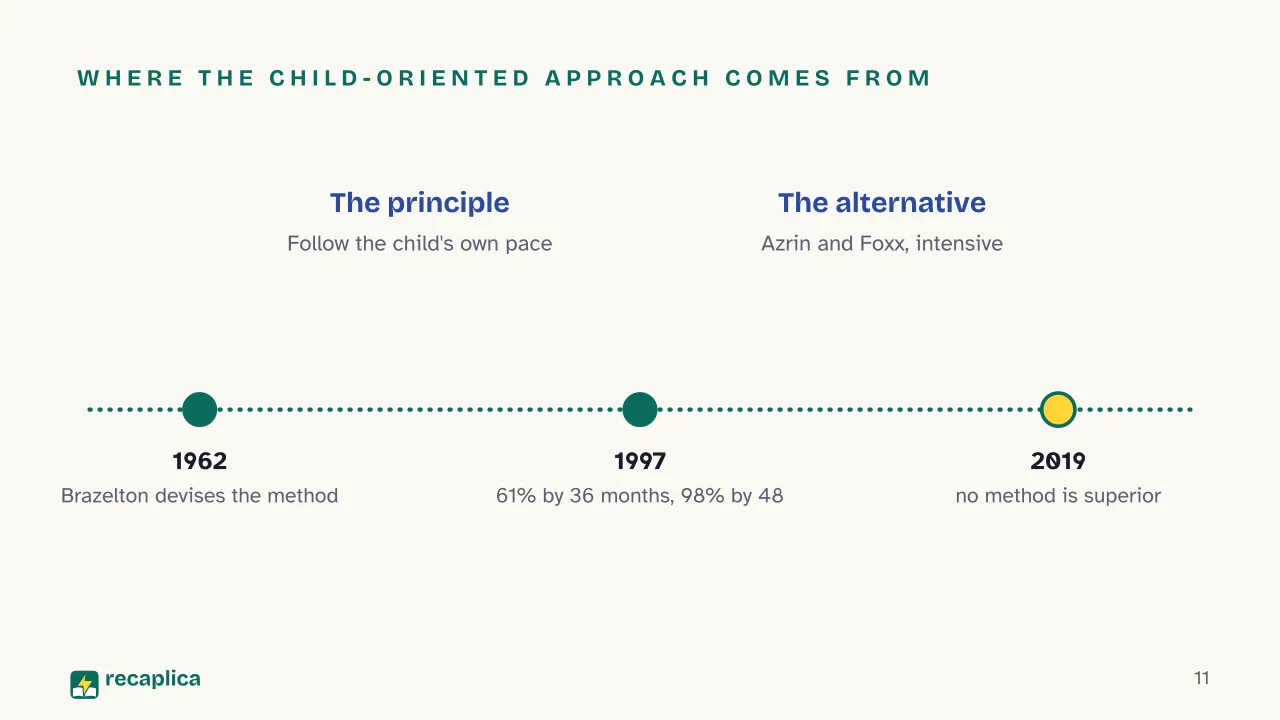  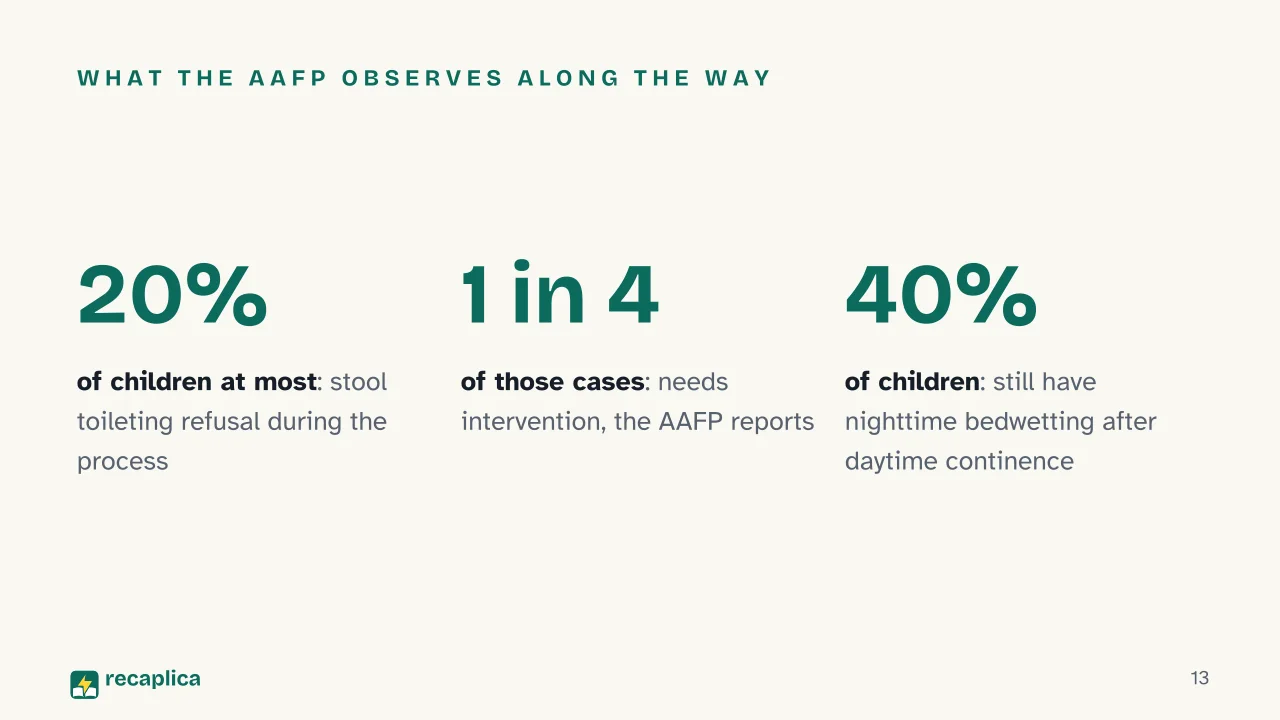  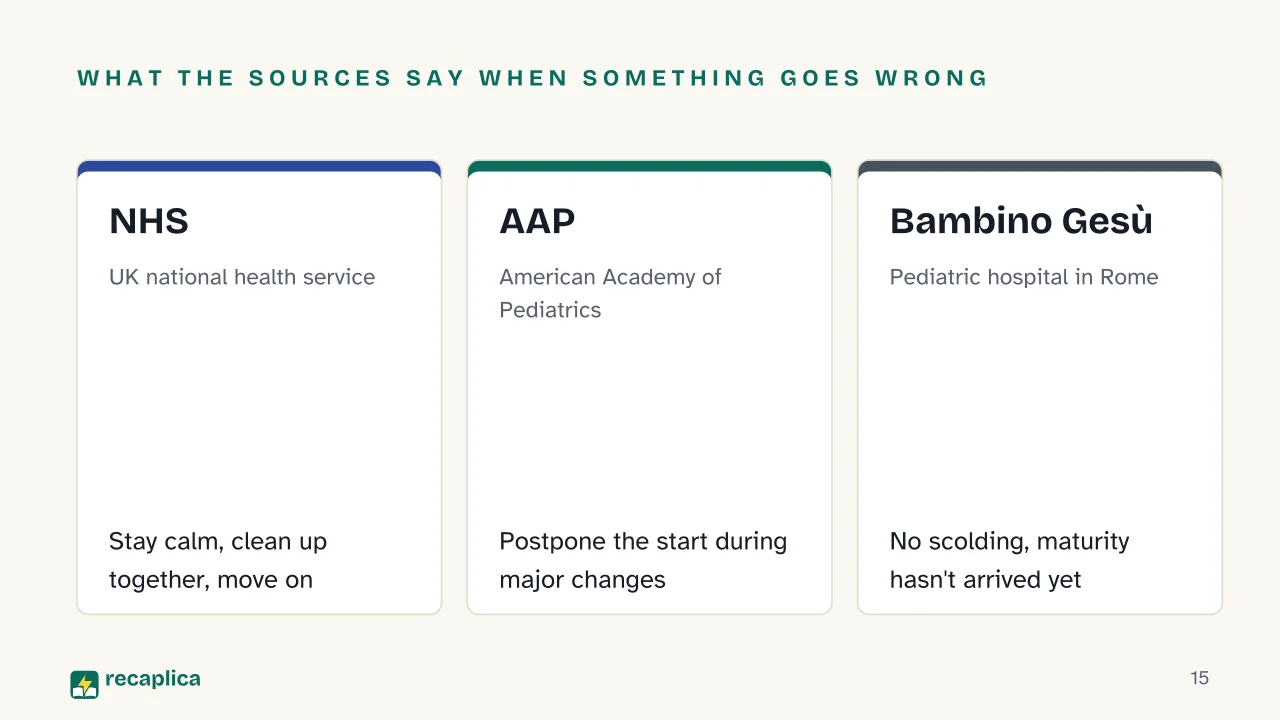 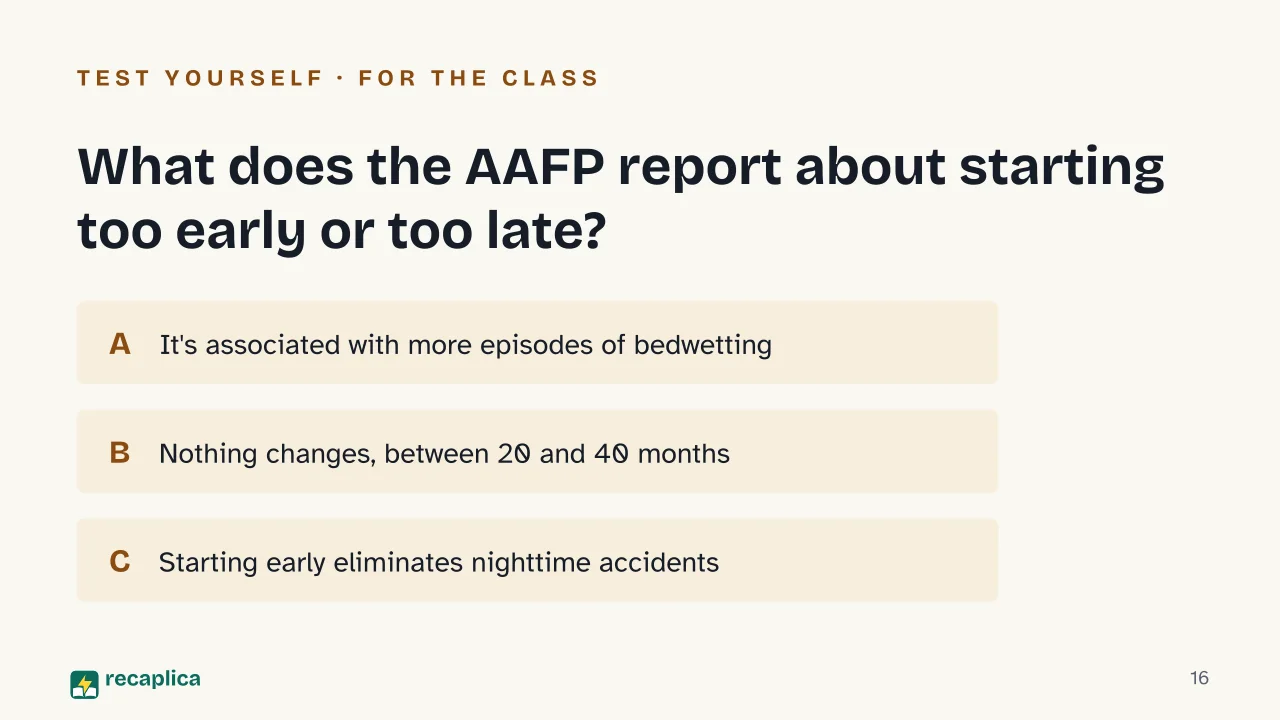 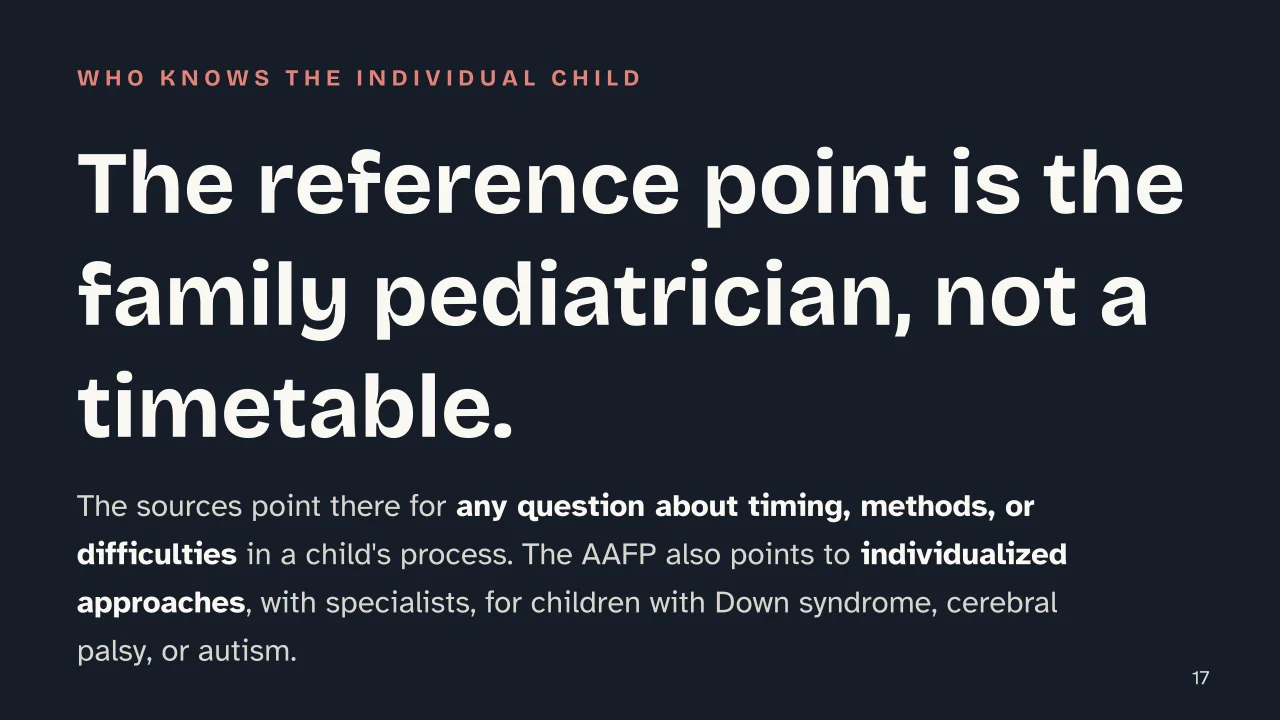  Common myths
Mind mapDrag the background to move around and the nodes to reposition them; use − and + to collapse and expand branches. 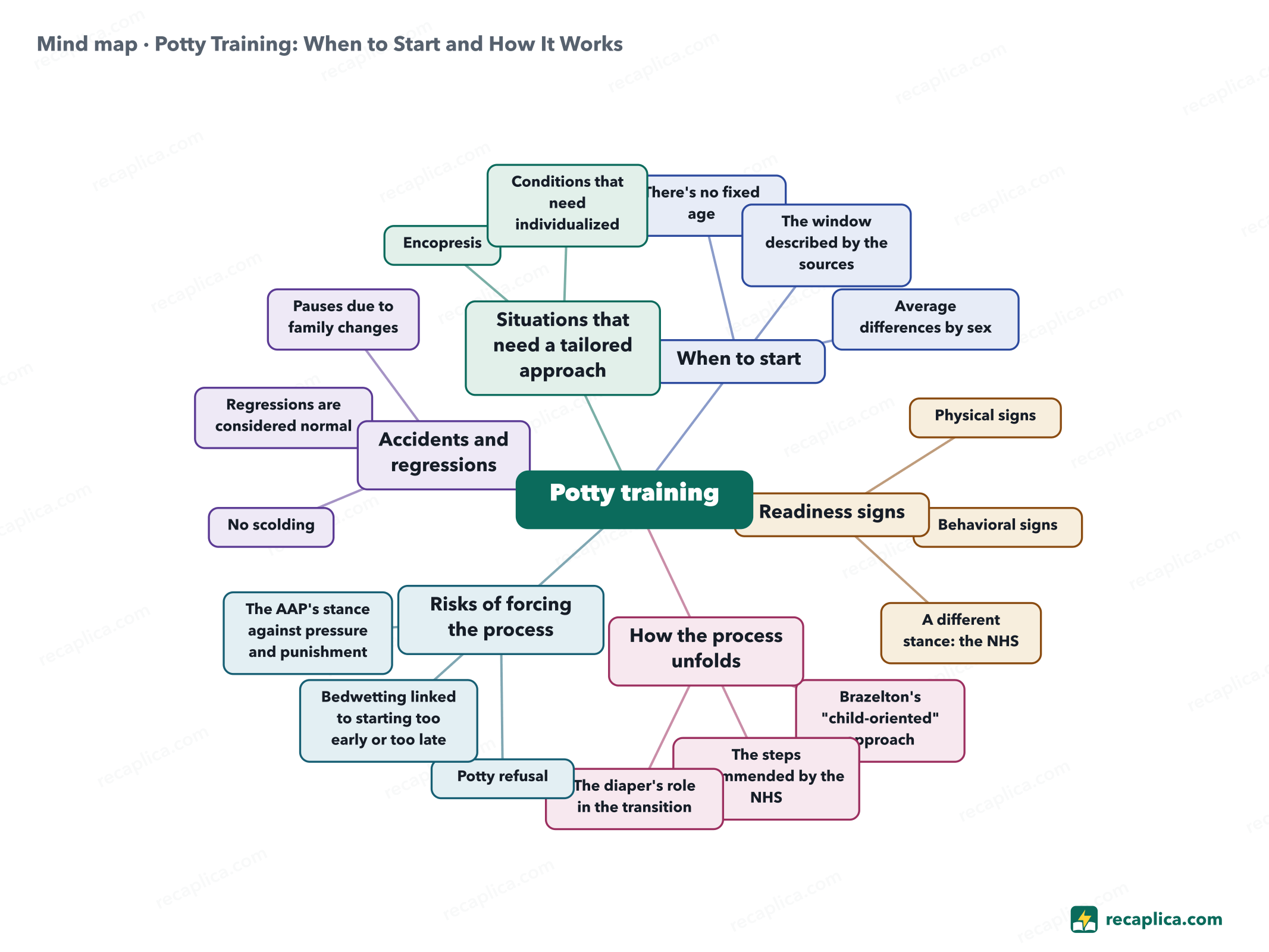
Quiz: test yourselfAnswer the questions to check what you have learned: you get instant feedback and a short explanation. Grade 0/10 0/5
FlashcardsTap the card to flip it and check whether you remember the answer, then move to the next one. 1 / 8 Explain it in your own wordsThe ultimate test: if you can explain it in simple words, you've truly understood it. Write your explanation, then compare it with the Recap. Your explanation is saved only on this device.
Frequently asked questionsWhen do children usually start potty training?The sources consulted give different but overlapping windows: the NHS points to 18 months to 2.5 years, the AAFP to 18-30 months for most U.S. children, the AAP to an average between ages 2 and 3, noting that most children reach bowel and bladder control by age 4, and Rome's Bambino Gesù pediatric hospital to an average diaper removal around 24 months and completion around 27 months, with a process that in some cases arrives at 4-5 years. None of the sources gives one fixed age for everyone. What signs indicate that a child is ready?Among the most commonly cited signs are staying dry for a couple of consecutive hours or through a nap, sensing the urge to pee or poop in advance, being able to walk to the bathroom, being able to take clothes off and put them back on independently, and showing discomfort with a soiled diaper. The NHS, however, is more permissive on this point: it holds that parents can start even without the child showing explicit signs. Does forcing a child speed up the process?The sources indicate the opposite. The AAP identifies pressure, pleading, excessive rewards, and punishment as factors that hinder the process, not speed it up. The AAFP links starting too early or too late to more episodes of bedwetting, and starting after age three and a half to more potty refusal for bowel movements. Is it normal for a three-year-old to still be in diapers?Yes, according to the sources consulted it falls within normal variation. The AAP notes that most children reach bowel and bladder control by age 4 (so not all of them earlier), and Rome's Bambino Gesù pediatric hospital indicates the process can be completed only at 4-5 years in some cases. The AAFP also reports that 40% of children continue to have nighttime bedwetting even after achieving daytime continence. Who can offer a specific evaluation for an individual child?The general guidance gathered in this Recap doesn't replace an individual evaluation: for questions about timing, readiness signs, or any difficulties during a specific child's process, the right source remains the child's pediatrician, who knows the individual medical history and can advise on how to proceed case by case. Every Recap goes through an independent review before publication. |