Skip to content
recaplica

    One moment: security check

    Cloudflare wants to make sure you're not a robot. Tick the box below and your search will continue on its own.

    IT
    recaplica Capetian Dynasty: Who Were the Kings Who Built Medieval France
    © 2026 Recaplica · recaplica.com — All rights reserved
    Home › History

    Capetian Dynasty: Who Were the Kings Who Built Medieval France

    By Recaplica Newsroom · Updated on September 23, 2026

    What to print

    Page numbers appear when printing with default margins.

    Slides

    Choose a cut

    Flash10 slidesThe essential thread, to present in classFull15 slidesEvery chapter and the deeper detail

    Both come with speaker notes.

    Telegram channel
    recaplica Clear in 30 seconds, yours in 10 minutes.
    In 30 seconds Key points Figures Deep dive Slides Myths Mind map Quiz Flashcards FAQ

    In 30 seconds quick read

    The Capetian dynasty ruled France from 987 to 1328, starting when an assembly of nobles elected Hugh Capet king. At first his real power covered a tiny territory, roughly 1,000 square kilometers between Paris and Orléans: the rest of the kingdom belonged to powerful feudal lords. Over the next two centuries the Capetian kings grew the Crown's holdings through alliances, marriages and war, culminating in Philip II Augustus's victory at Bouvines in 1214. Louis IX brought the dynasty to its religious and institutional peak, while Philip IV the Fair clashed openly with the papacy. When the direct line died out in 1328, the throne passed to the Valois, a branch of the same family.

    Key Points

    • An assembly of nobles elected Hugh Capet king of France in 987; he did not inherit the throne.
    • His direct domain was tiny, about 1,000 square kilometers between Paris and Orléans: travel outside it and he risked being kidnapped.
    • Louis VI consolidated royal power by fighting rebellious nobles and forging an alliance with the Church.
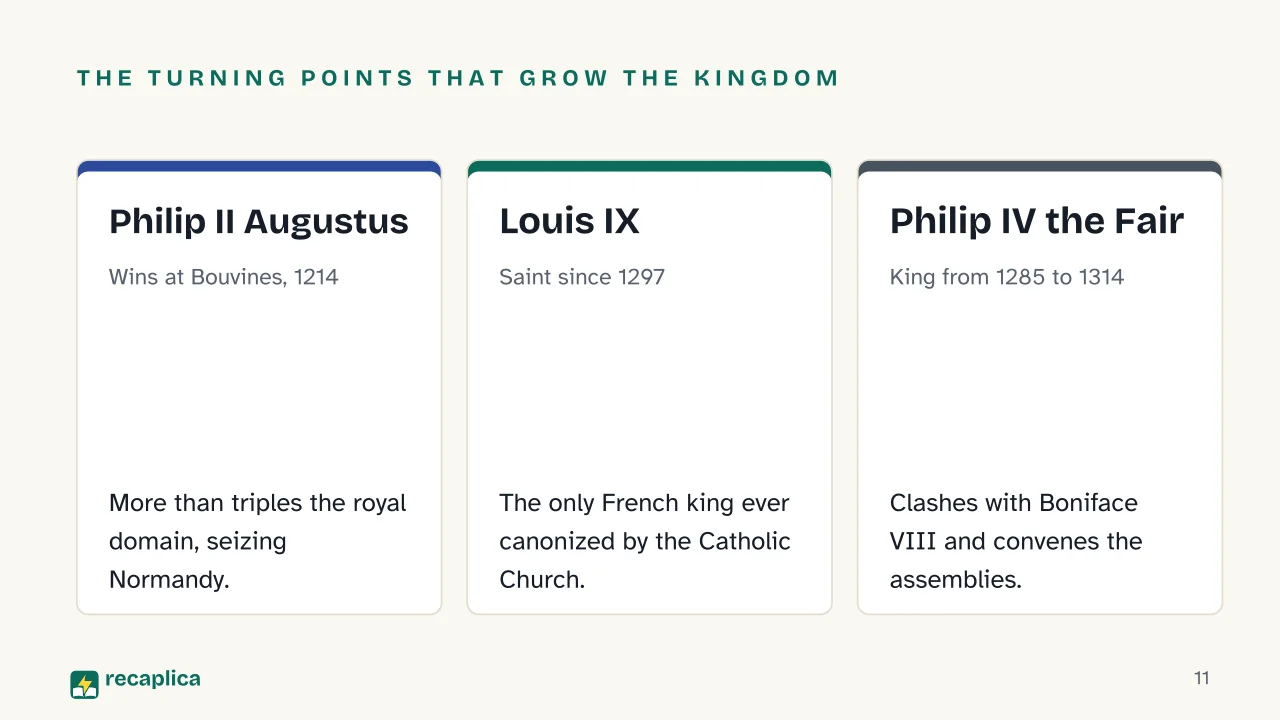
    • Philip II Augustus won at Bouvines in 1214 and more than tripled the Crown's domain by seizing Normandy.
    • Louis IX, canonized in 1297, is the only French king ever declared a saint by the Catholic Church.
    • The direct Capetian line ended in 1328, but the dynasty carried on through the Valois and later the Bourbons, who still sit on the thrones of Spain and Luxembourg today.

    Key figures

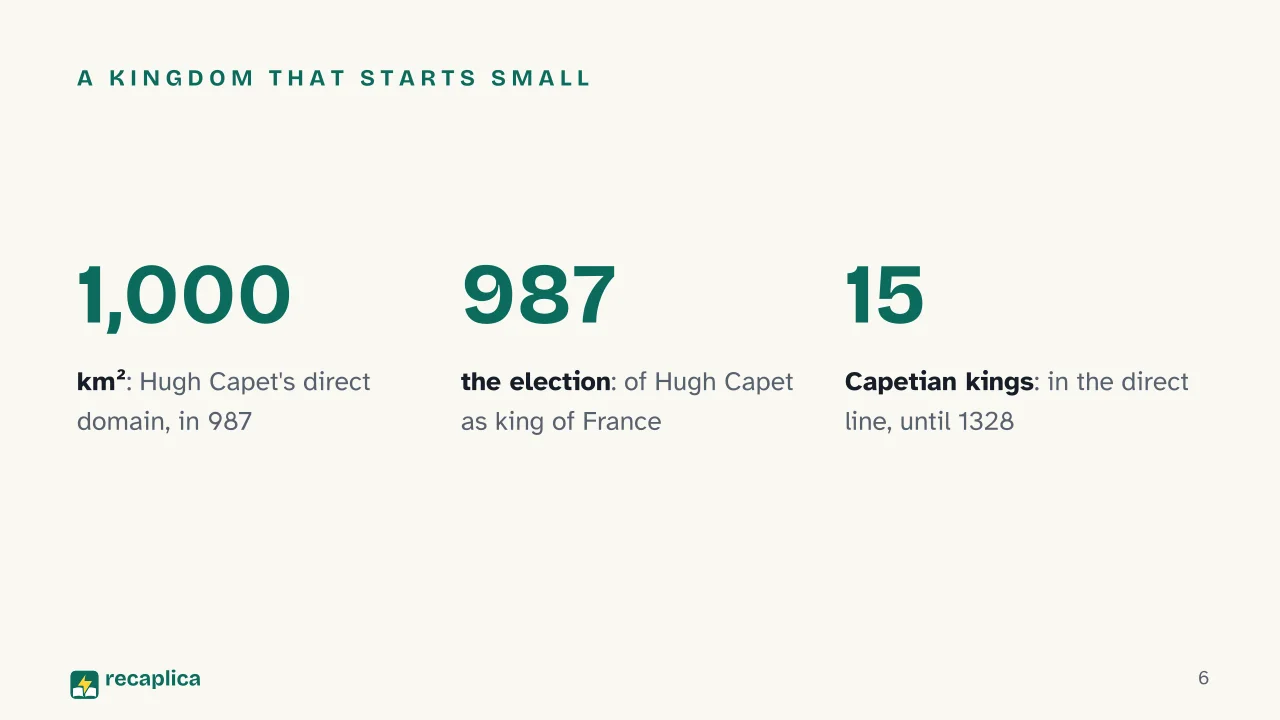
    • 1,000 km² The size of Hugh Capet's direct domain in 987, between Paris and Orléans: everything else in the kingdom belonged to powerful feudal lords. Source: New World Encyclopedia
    • 1214 The year of the Battle of Bouvines, where Philip II Augustus defeated a coalition led by King John of England and more than tripled the Crown's domain. Source: Encyclopedia.com
    • 1297 The year the Catholic Church canonized Louis IX, the only French king ever declared a saint. Source: Encyclopedia.com

    Deep Dive

    An election, not an inheritance

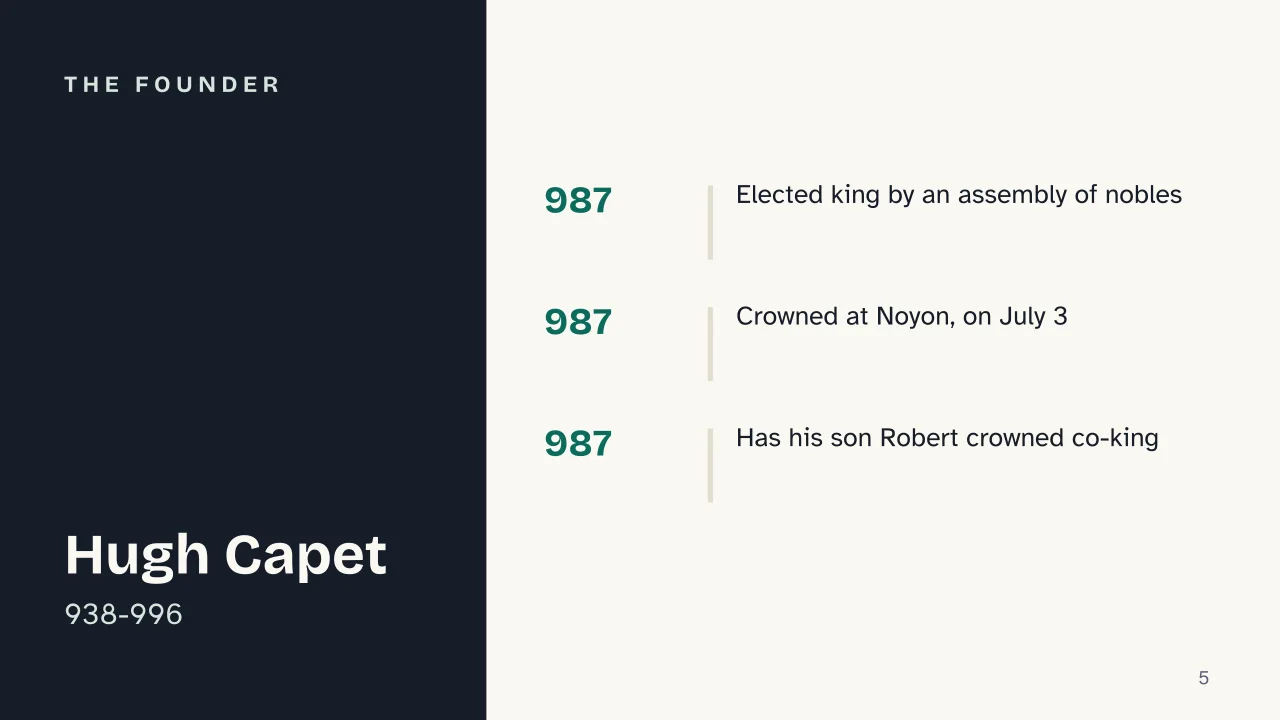
    In 987 the last Carolingian king, Louis V, died without an heir capable of holding the throne. A group of nobles, guided in large part by Archbishop Adalberon and Gerbert of Aurillac, gathered to choose a new king. Their choice fell on Hugh Capet, head of a family of great feudal lords tied to the Île-de-France. He was crowned at Noyon, in Picardy, on July 3, 987.

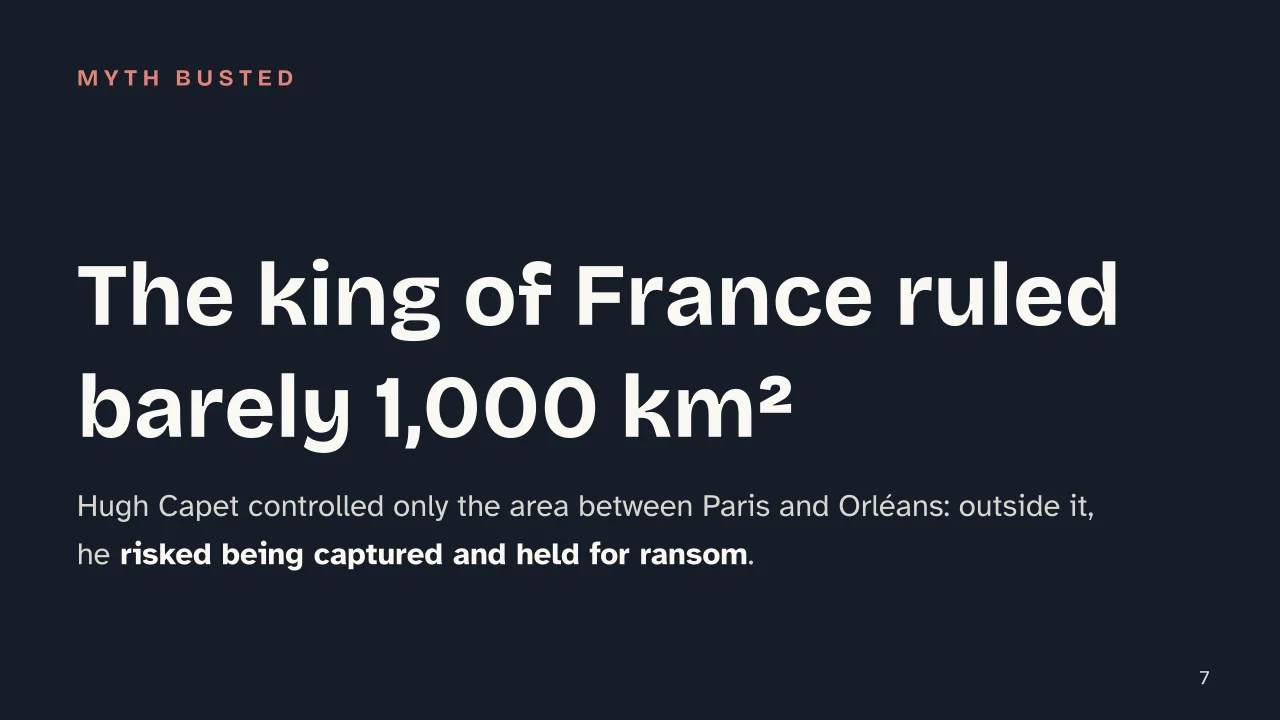
    The kingdom he inherited existed more on paper than in practice. The domain Hugh Capet actually controlled, without having to ask any other lord’s permission, measured about 1,000 square kilometers: a strip of land between Paris and Orléans.

    Real-world example: to picture the scale, that territory was roughly the size of the urban area of present-day Los Angeles. Step outside that perimeter, and a Capetian king in 987 risked being captured and held for ransom by his own vassals.

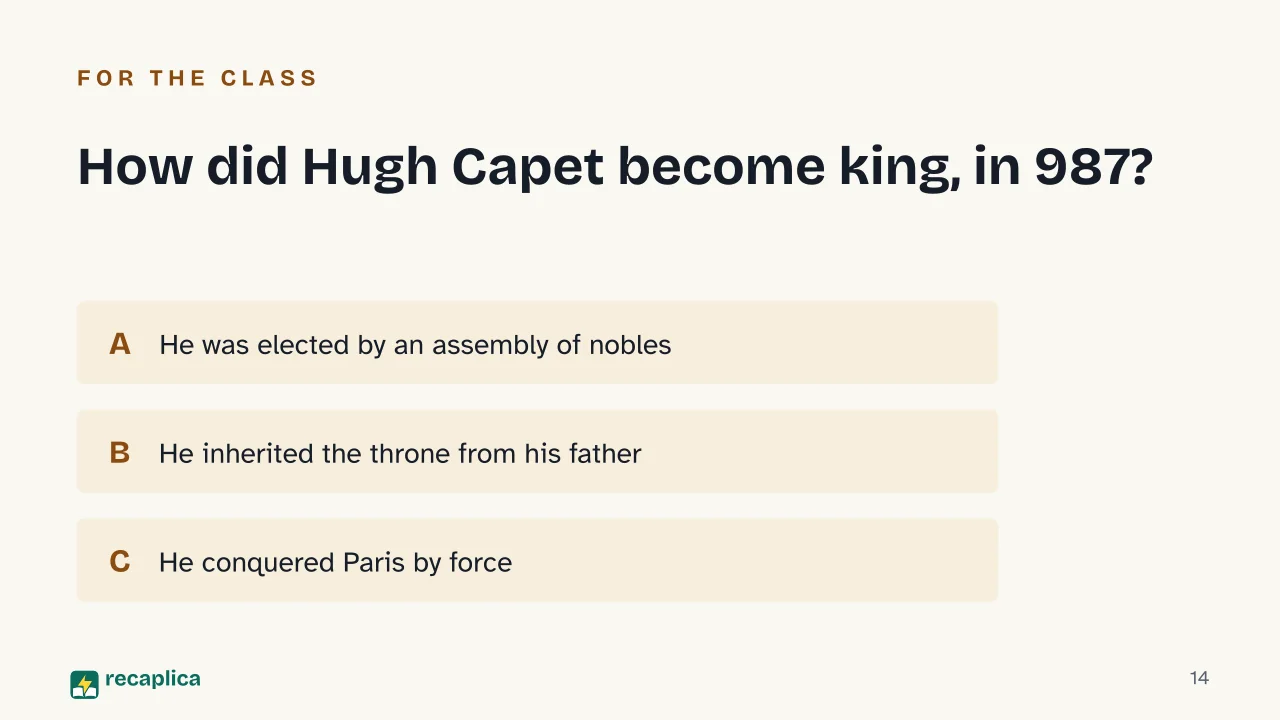
    Hugh Capet moved quickly to secure the throne for his family: he persuaded the great lords to crown his son Robert as co-king while he himself was still alive, in a ceremony held on Christmas Day, 987. No written rule called for it; it was a political invention, repeated by his successors, that made the crown effectively hereditary while it remained, on paper, elective.

    The slow work of Louis VI

    A century after Hugh Capet, the royal domain had grown very little: under Louis VI it still amounted to little more than the Île-de-France, the Laonnais and the Orléanais. What changed was how it was governed. Louis VI was the first Capetian to systematically bring the feudal lords within his own territory under control, often by force of arms, and to build the Crown’s prestige on their defeat.

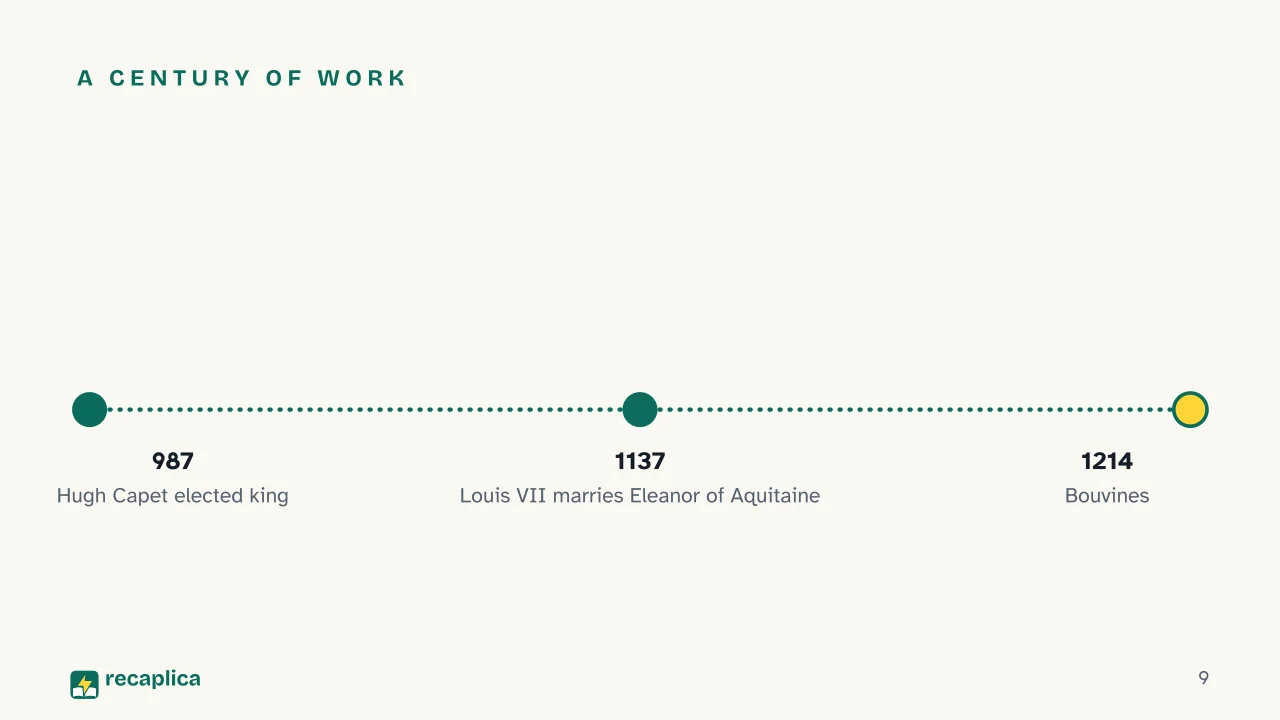
    He also sought protection elsewhere. He freed bishoprics and abbeys from the grip of predatory lords, endowed them generously, encouraged Church reform and struck an alliance with the papacy — a partnership Hugh Capet himself had already sensed the value of, a century earlier, by favoring the Cluniac monastic reform. In 1137 came a move that would matter for generations: Louis VI married his son and heir, the future Louis VII, to Eleanor of Aquitaine. The marriage tied one of France’s richest territories to the Crown.

    Readers curious how a feudal estate actually worked in this period can look at Manorialism: How the Medieval Manor Economy Worked, the economic system that underpinned every lord’s power, Capetian kings included, before they learned to administer their own domain directly.

    Philip Augustus and the turning point at Bouvines

    The decisive leap came with Philip II, known as Augustus. He declared the French holdings of King John of England forfeit and occupied Normandy and all the English lands north of the Loire. With Normandy in Capetian hands, the Crown of France reached the English Channel for the first time, while John lost easy access to his own continental fiefs.

    John tried to reverse the situation by assembling a coalition of allies. Philip Augustus crushed it at Bouvines, on July 27, 1214: a battle that ruined John and tipped the balance of power in Europe in France’s favor for over a century. By the end of his reign, Philip Augustus had more than tripled the Crown’s direct domain compared with what he had inherited.

    KingKey momentWhy it matters
    Hugh CapetElected in 987Founds the dynasty, domain of about 1,000 km²
    Louis VISon’s marriage, 1137Consolidates the royal domain, allies with the Church
    Philip II AugustusBouvines, 1214More than triples the Crown’s domain
    Louis IXCanonized in 1297Only French king ever declared a saint
    Philip IV the FairKing from 1285 to 1314Clash with Boniface VIII, birth of the Estates-General

    Louis IX, the king who became a saint

    Born in 1214 and dead in 1270 in Tunis, Louis IX led the Capetian kingdom to its peak of religious prestige. In 1247 he sent his own inspectors across the kingdom to gather subjects’ complaints against royal officials, reinforcing in the public’s eyes the idea that the king’s justice stood above that of local lords. He gave the kingdom a fairer tax system and a uniform coinage, and further tightened the Crown’s grip on the great lords.

    He also led two crusades. The first, between 1248 and 1254, targeted Egypt and the Holy Land: his troops captured Damietta on June 5, 1249, but later suffered heavy setbacks at El Mansurah. The second crusade, in 1270, was diverted toward Tunisia, where Louis IX died of fever before reaching his objective.

    In 1297 the Catholic Church canonized him: he remains the only French king ever declared a saint.

    Philip the Fair and the clash with the pope

    Philip IV, known as the Fair, reigned from 1285 to 1314. He claimed the right to tax the clergy within his own kingdom, triggering a long, bitter dispute with Pope Boniface VIII. To rally public opinion behind his position, Philip IV convened assemblies of representatives from the three estates of the realm — nobility, clergy and commoners — later known as the Estates-General.

    A dynasty that never quite ends

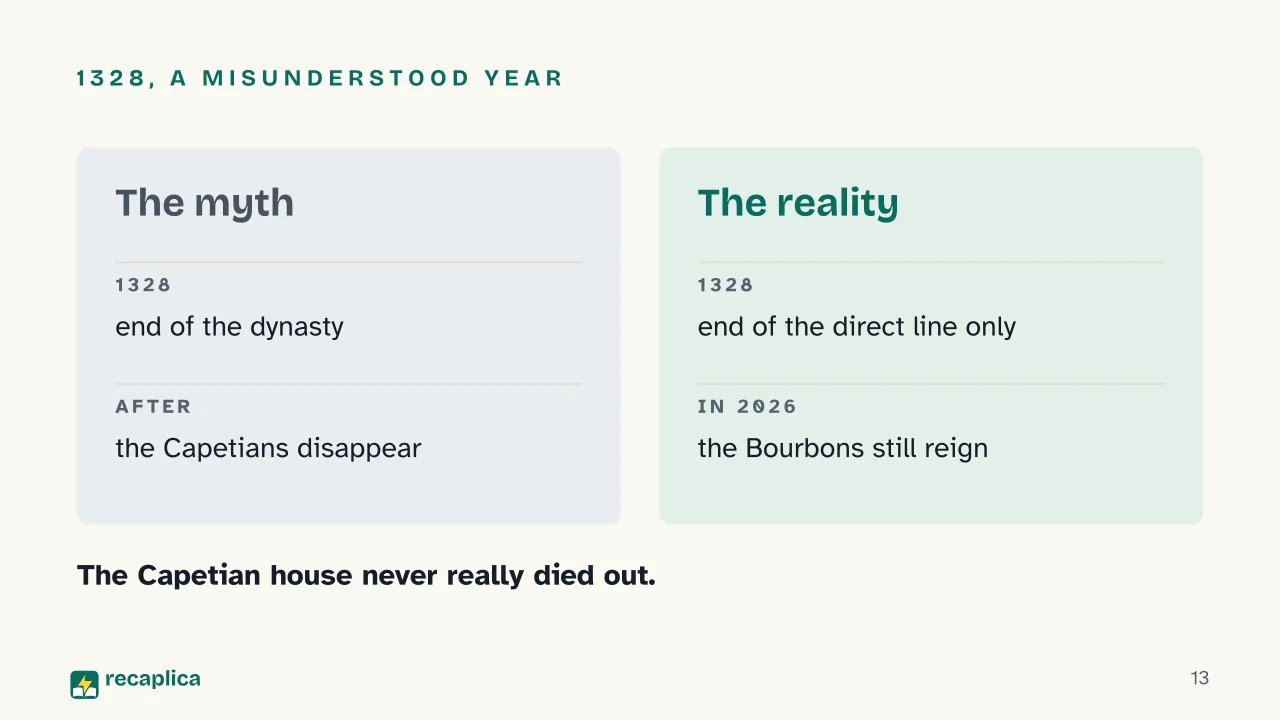
    In 1328 Charles IV died without a direct male heir, ending the father-to-son line that had begun with Hugh Capet three and a half centuries earlier. The crown passed to the Valois, a cadet branch of the same Capetian house: not a new dynasty, but another branch of the same family. The Valois would go on to lead France into an era completely different from the medieval one, that of the Renaissance.

    Through its cadet branches, direct descendants of Hugh Capet still sit, in 2026, on the thrones of Spain and Luxembourg. Readers looking for the wider picture this story fits into, feudalism, the crusades, the Church’s role in politics, will find it useful to revisit The Middle Ages: A Thousand-Year Summary of Feudalism and Crusades, the backdrop against which the whole Capetian story unfolded.

    Slide deck

    Slides ready to download and make your own in PowerPoint or Google Slides, with speaker notes. Pick the Flash cut or the Full one.
    Slide 1 of the presentation on Capetian Dynasty: The Capetian DynastySlide 2 of the presentation on Capetian Dynasty: How much of France did the king actually rule in 987?Slide 3 of the presentation on Capetian Dynasty: Where we're headedSlide 4 of the presentation on Capetian Dynasty: Chapter 01: The beginningSlide 5 of the presentation on Capetian Dynasty: The founderSlide 6 of the presentation on Capetian Dynasty: A kingdom that starts smallSlide 7 of the presentation on Capetian Dynasty: The king of France ruled barely 1,000 km²Slide 8 of the presentation on Capetian Dynasty: Chapter 02: ConsolidationSlide 9 of the presentation on Capetian Dynasty: A century of workSlide 10 of the presentation on Capetian Dynasty: Chapter 03: ExpansionSlide 11 of the presentation on Capetian Dynasty: The turning points that grow the kingdom: Philip II Augustus, Louis IX, Philip IV the FairSlide 12 of the presentation on Capetian Dynasty: Chapter 04: The legacySlide 13 of the presentation on Capetian Dynasty: 1328, a misunderstood yearSlide 14 of the presentation on Capetian Dynasty: How did Hugh Capet become king, in 987?Slide 15 of the presentation on Capetian Dynasty: Continue on Recaplica
    Flash10 slidesThe essential thread, to present in classFull15 slidesEvery chapter and the deeper detail

    Common myths

    • ✗ Myth When Hugh Capet became king of France in 987, he already ruled a territory as large as modern France.

      ✓ Reality His direct domain measured only about 1,000 square kilometers, confined to the area between Paris and Orléans; venture outside it and he risked capture and ransom. A century later, under Louis VI, the royal domain still amounted to little more than the Île-de-France, the Laonnais and the Orléanais: expanding the territory took generations of kings, not a single stroke in 987.

    • ✗ Myth The French crown passed from father to son by hereditary right from the very start of the Capetian dynasty.

      ✓ Reality An assembly of nobles elected Hugh Capet after the last Carolingian king died; he inherited nothing. He had his son Robert crowned co-king while he himself was still alive, on December 25, 987, to secure the throne for his family — a dynastic maneuver, not a written rule from day one.

    • ✗ Myth The Capetian dynasty ends in 1328 with Charles IV.

      ✓ Reality Only the direct line, father to son, ends in 1328: the crown then passed to the Valois, a cadet branch of the same Capetian house. Capetian offshoots kept sitting on European thrones long after the Middle Ages — as of 2026, direct descendants of Hugh Capet still occupy the thrones of Spain and Luxembourg, through the House of Bourbon.

    Mind map

    Drag the background to move around and the nodes to reposition them; use − and + to collapse and expand branches.
    Customize
    Mind map: Capetian Dynasty: Who Were the Kings Who Built Medieval France
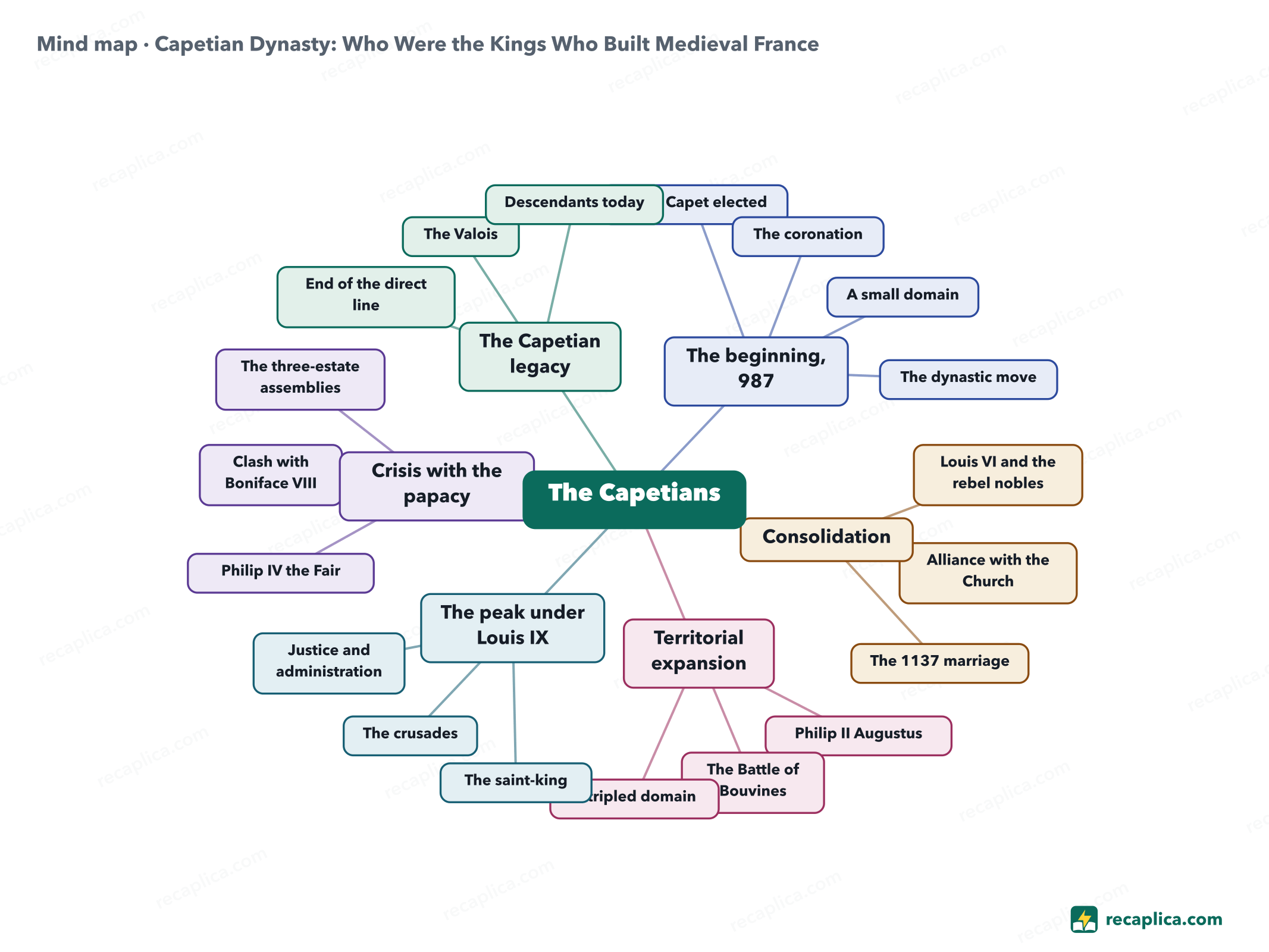
    • The Capetians
      • The beginning, 987
        • Hugh Capet elected Chosen by an assembly of nobles after the last Carolingian king died
        • The coronation Ceremony at Noyon, Picardy, on July 3, 987
        • A small domain About 1,000 square kilometers between Paris and Orléans
        • The dynastic move Son Robert crowned co-king that same year
      • Consolidation
        • Louis VI and the rebel nobles The Crown's first real grip on its own domain
        • Alliance with the Church Support for bishoprics, abbeys and church reform
        • The 1137 marriage Louis VII marries Eleanor of Aquitaine
      • Territorial expansion
        • Philip II Augustus Seizes Normandy and English lands north of the Loire
        • The Battle of Bouvines July 27, 1214, against King John's coalition
        • A tripled domain The Crown more than triples its direct territory
      • The peak under Louis IX
        • The saint-king Canonized by the Catholic Church in 1297
        • The crusades Damietta in 1249, then the Tunisia expedition in 1270
        • Justice and administration Royal inspectors in 1247, uniform coinage and taxation
      • Crisis with the papacy
        • Philip IV the Fair King from 1285 to 1314
        • Clash with Boniface VIII Over the right to tax the clergy
        • The three-estate assemblies Later known as the Estates-General
      • The Capetian legacy
        • End of the direct line 1328, Charles IV dies without a male heir
        • The Valois A cadet branch of the same Capetian house
        • Descendants today Cadet branches on the thrones of Spain and Luxembourg

    Quiz: test yourself

    Answer the questions to check what you have learned: you get instant feedback and a short explanation.

    Grade 0/10 0/5
    1 In what year was Hugh Capet elected king?

    Hugh Capet was elected in 987, after the death of the last Carolingian king.

    2 How large was Hugh Capet's direct domain?

    His real, direct power stopped at about 1,000 square kilometers: outside that area he depended on the goodwill of the other great lords.

    3 True or false: Hugh Capet inherited the French throne from his father.

    False: an assembly of nobles elected Hugh Capet. He was the one who later had his son Robert crowned while still alive, securing the throne for his descendants.

    4 What happened at Bouvines in 1214?

    The victory at Bouvines ruined King John and let Philip II Augustus more than triple the Crown's domain.

    5 What happened to the Capetian dynasty in 1328?

    Charles IV died without a male heir, ending only the direct line: the throne passed to the Valois, a branch of the same house.

    Answers: 1-A · 2-A · 3-B · 4-A · 5-A

    Flashcards

    Tap the card to flip it and check whether you remember the answer, then move to the next one.

    1 / 8

    Explain it in your own words

    The ultimate test: if you can explain it in simple words, you've truly understood it. Write your explanation, then compare it with the Recap.

    Your explanation is saved only on this device.

    The Capetian dynasty ruled France from 987 to 1328, starting when an assembly of nobles elected Hugh Capet king. At first his real power covered a tiny territory, roughly 1,000 square kilometers between Paris and Orléans: the rest of the kingdom belonged to powerful feudal lords. Over the next two centuries the Capetian kings grew the Crown's holdings through alliances, marriages and war, culminating in Philip II Augustus's victory at Bouvines in 1214. Louis IX brought the dynasty to its religious and institutional peak, while Philip IV the Fair clashed openly with the papacy. When the direct line died out in 1328, the throne passed to the Valois, a branch of the same family.

    Frequently asked questions

    Who were the Capetians?

    The dynasty that ruled France from 987 to 1328, starting with the election of Hugh Capet and giving the kingdom 15 kings before handing the throne to the Valois.

    Where does the name Capetian dynasty come from?

    From Hugh Capet, the nobleman elected king in 987 who founded the dynasty.

    When did the Capetian dynasty end?

    The direct line, father to son, ended in 1328. The dynasty continued through cadet branches: first the Valois, then the Bourbons, who in 2026 still reign in Spain and Luxembourg.

    Which Capetian kings are mentioned most often in history books?

    Hugh Capet (the founder), Philip II Augustus (the victory at Bouvines in 1214), Louis IX (the only sainted king, canonized in 1297) and Philip IV the Fair (the clash with Pope Boniface VIII).

    What was the royal domain in Capetian France?

    The territory the king controlled directly, as opposed to the fiefs held by his great vassals. Under the early Capetians it was tiny, limited to a few areas around Paris and Orléans, and it grew only over the following centuries through alliances, marriages and war.

    Sources

    • Capetians – Encyclopedia.com
    • Louis VI – Encyclopedia.com
    • Philip II (Augustus) – Encyclopedia.com
    • Louis IX – Encyclopedia.com
    • Philip IV – Encyclopedia.com
    • Hugh Capet – New World Encyclopedia
    • Hugh Capet – Catholic Encyclopedia (New Advent)
    • France, Capetian Kings – Foundation for Medieval Genealogy

    Every Recap goes through an independent review before publication.

    Every evening, the day's new Recaps on our Telegram channel. Join the channel →

    Keep learning

    • History Martin Luther and the Protestant Reformation: A Summary Martin Luther was a German Augustinian monk who, according to tradition, nailed 95 theses against the sale of indulgences to the door of the Castle Church in Wittenberg in 1517. The act opened a religious process that lasted decades, later known as the Protestant Reformation, which led to Luther's excommunication and to a new Christian doctrine that took hold mainly in Germany and in the Scandinavian and Baltic countries. The clash with Emperor Charles V only ended in 1555 with the Peace of Augsburg, which split the territory of the Empire between Catholics and Lutherans. Read the Recap →
    • History Italian City-State: What It Was, How It Began, and How It Changed The Italian city-state was the form of self-government with which, starting in the late 11th century, many cities in northern and central Italy ran their own affairs, pulling free of direct control by bishops and feudal lords. It began as a government of consuls elected by an assembly of heads of household, then shifted to a foreign official called the podestà, and from the mid-13th century saw the institutions of the popolo take shape alongside it, organized by guild and led by the captain of the people. Through the 13th and 14th centuries, conflict between leading families and the popolo wore this balance down and opened the way to city lordships, the signorie. Venice followed a different path from the start, with an elected doge and its own system of councils. Read the Recap →
    • History Manorialism: what it is and how the early medieval manor worked Manorialism was how large landed estates were organised in Carolingian Europe between the 8th and 9th centuries. The manor (or curtis) split into two parts: the demesne, farmed directly for the lord, and tenant land worked by peasant families in exchange for dues. Labour obligations, known as corvée, tied the two halves together. Historians now trace this model back to the Roman-era great estates. It is an economic system, distinct from feudalism, which is a political relationship between a lord and a vassal. Read the Recap →

    recaplica

    Clear in 30 seconds, yours in 10 minutes.

    Recaps Mind maps Request a Recap Telegram channel Mind map maker Our method About Privacy & cookies Legal notes & terms of use

    © 2026 Recaplica · A project by Curi S.r.l. — VAT IT05472000750

    Statistics, only if you say so

    To learn which Recaps help most we would use Google Analytics, with aggregate, anonymous data. It starts only with your OK, and you can change your mind anytime. Privacy policy