Industrial Revolution: What Changed and Why
In 30 seconds quick read
The Industrial Revolution is the shift from an economy of fields, workshops and muscle power to one of machines, factories and coal. It begins in Britain in the last decades of the eighteenth century and runs its course through the first thirty years of the nineteenth, starting with spinning and reaching almost every sector. It is not one invention but a chain of them: spinning machines, the steam engine made economical by James Watt, coal, iron, the railway. The result is an unprecedented rise in wealth alongside cities that grow within a few decades and working conditions that are brutal. A second wave, between the 1860s and the early 1900s, brings electricity and the internal combustion engine and shifts the centre of industry towards Germany and the United States.
Key Points
- It was not a sudden break: the shift falls between the end of the eighteenth century and the first thirty years of the nineteenth, and it involves Britain, Belgium and parts of France and Germany.
- It began in Britain because several conditions were already in place at once: a large unified home market, capital accumulated through capitalist agriculture and colonial trade, cheap raw materials, good transport and institutions that left room for private enterprise.
- The first machines were textile machines, and they appeared where the work was heaviest, in spinning: Hargreaves's spinning jenny (1764) and Arkwright's water frame (1768) both came before Watt's patent.
- Watt did not invent the steam engine, he made it economical to run. The separate condenser, patented on 5 January 1769, cut coal consumption by two thirds and took steam out of the mines and into factories.
- The factory system gathered workers under one roof and split owners of machinery from those who sold their labour: 13-15 hour days, low pay, children working from the age of four or five.
- Cities grew at rates never seen before: between 1801 and 1851 Manchester went from 35,000 to 353,000 people, and between 1801 and 1911 the urban share of England and Wales rose from a third to four fifths of the population.
Key figures
- 50,000 hours against 300 the work needed to spin roughly 50 kilograms of cotton by hand, against the work needed on Crompton's spinning mule Source: Treccani, Storia della civiltà europea
- 353,000 the population of Manchester in 1851, against 35,000 in 1801: the town multiplied tenfold in fifty years Source: Treccani
- two thirds less the coal burned by engines fitted with Watt's separate condenser, patented on 5 January 1769 Source: Science Museum
Deep Dive
Not one invention, but a different way of producing
Anyone looking for the start date of the Industrial Revolution will not find one, because there isn’t one. The term describes a transformation of productive and social structures brought about by new technologies: a long process that begins in Britain in the last decades of the eighteenth century and plays out over the first thirty years of the nineteenth. Some accounts stretch the first phase across the whole first half of the century, which gives you a sense of how blurred the boundary is.
Before, wealth was made mainly in fields and workshops, using the strength of arms, animals, water and wind. After, it is made in factories, by machines fed on coal, in quantities no workshop could have approached. In between there is no sudden discovery, but a chain of technical innovations and a setting able to take them up.
Why Britain
Every textbook asks this question, and the answer is not a single cause but a set of conditions that in the eighteenth century coincided only there.
There was a large unified national market, meaning broad demand with no internal customs barriers. There was capital to invest, built up through agriculture organised along capitalist lines and through colonial trade. Over the course of the eighteenth century British imports and exports increased fivefold, and re-exports rose ninefold. There were cheap raw materials, a transport network that was excellent for the time, a level of urbanisation that was already high. And there were institutions that left room for private enterprise, alongside advanced scientific research and a new entrepreneurial outlook.
Remove any one of these and the chain does not start: that is why Belgium, France and Germany followed at a distance, and the rest of Europe much later.
The dates line up in a way that helps place everything. While spinning mills and machines were multiplying in Britain, France was going through the French Revolution: two different revolutions, one economic and one political, dismantling the Europe of the old regime from opposite sides within the same thirty years.
Spinning: the bottleneck gives way
The first machines of the Industrial Revolution were not locomotives. They were machines for spinning thread, and there is a reason for that: spinning on its own took up around half of the working time needed to make a piece of cloth. That was where the gain in productivity could be largest.
In 1764 James Hargreaves built a spinning jenny that worked eight spindles at once. In 1768 Richard Arkwright built a frame driven by water power rather than by arms. In 1778 Samuel Crompton combined the two ideas in the spinning mule. All of these arrive before or around Watt’s decisive patent: a detail to keep in mind whenever steam is treated as the starting point.
The leap in productivity can be measured. Spinning roughly 50 kilograms of cotton by hand took 50,000 hours of work; on the mule it took around three hundred.
Weaving, by contrast, held out much longer. Edmund Cartwright mechanised it in 1785, but the power loom only really took hold around the middle of the nineteenth century, and in Britain mechanical cotton weaving won out over handloom weaving only after 1830. Manchester, which would become the capital of the cotton industry, grew alongside these machines.
The engine that stopped wasting heat
The problem with the steam engines then in use is one you can grasp without knowing any thermodynamics. Steam was condensed inside the very cylinder in which it had just done its work: to do that you had to cool the cylinder, and for the next stroke you had to heat it up again. Rather like keeping a room warm with the window open, and feeding the fire to compensate.
While repairing a model of a Newcomen engine, James Watt saw how much steam was being lost that way. His answer was to add a separate chamber, kept permanently cool, in which the steam could condense without cooling the rest of the engine. The patent, dated 5 January 1769, was titled “a new method of lessening the consumption of steam and fuel in fire-engines”: a title that says precisely what was at stake.
The effect was that engines with the separate condenser burned two thirds less coal. That is not a marginal gain: it is the difference between a machine that only makes sense where coal is right at hand, which meant at the pithead, and a machine you could install anywhere power was needed. In 1774 Watt moved to Birmingham and went into partnership with the investor Matthew Boulton to build them on an industrial scale, and he went on refining them until 1781.
Practical example: a mill driven by a water wheel has to sit on a watercourse with the right flow, and it stops when the river runs dry or freezes. A mill driven by steam can be built next to the coal mine, the port or the market, and it works all year. That, more than raw power, is what redrew the industrial map.
Coal, iron, rails
Around the textile machines grew the other half of the system, the half that supplied energy and materials.
The figures give the order of magnitude. Between 1700 and 1800 coal extraction in Britain went from three to fifteen million tonnes, while metal production rose from 20,000 to a million tonnes a year. Energy and metal pulled each other along: more machines needed more iron, more iron needed more coal, and every improvement in one sector made the next one in the other worth making.
Then came transport. In 1807 Robert Fulton ran his steamboat; in 1819 came the first Atlantic crossing under steam. On land, George Stephenson built his locomotive in 1814 and in 1825 the first British railway line opened. The telegraph appears in the same phase.
The economic result shows up in the national accounts: gross domestic product, the value of everything produced in a year (what we now call GDP), tripled between 1810 and 1850.
Cities grow at rates never seen before
The most visible consequence is there in the census returns.
| City | 1801 | 1851 |
|---|---|---|
| Manchester | 35,000 | 353,000 |
| Birmingham | 46,000 | 111,000 |
London, with half a million inhabitants in 1700 and almost a million by 1800, was already the largest city in Europe. What was new was the speed: in the first half of the nineteenth century it was not at all unusual for an urban centre to expand by 30% in ten years, and in certain decades a few towns exceeded 60%.
By 1845 the population living in towns in England and Wales was already the majority. Across the century, between 1801 and 1911 the urban share rose from a third to four fifths of the total: in absolute terms, from 3.5 to 32 million people.
Inside the factories
The factory system organises production on a large scale by gathering workers in a single place, with a sharp division between those who own the machinery and those who sell their labour for a wage.
Conditions were harsh in ways that are hard to picture now: days of 13 to 15 hours, low wages, still lower pay for women and children, children put to work at four or five, no safety net in case of unemployment.
The response came from below and at first took the most direct route, Luddism, the destruction of the machines. Then it organised itself better, into strikes, friendly societies, trade unions and eventually socialist parties.
The first laws followed decades later. The British Factory Act of 1833 banned work below the age of nine, limited children aged 9 to 13 to nine hours a day and those aged 13 to 18 to twelve, prohibited night work for children, required two hours of daily schooling and age certificates, and appointed four factory inspectors. By 1836 their reports were already recording breaches, and further acts were needed in 1844, 1847, 1867 and 1901. In 1847 the working day for women was brought down to ten hours.
The second wave
Between the 1860s-1870s and the first decade of the twentieth century a second phase arrives, resting on different technical foundations: electrical machinery in the 1880s, the internal combustion engine in the 1890s.
The scale of firms changes too. Companies become enormous, trusts and cartels form (agreements between large firms to carve up markets and prices) and banks grow in weight, to the point where people speak of finance capitalism: this is the phase in which capital raised through stocks and the stock market becomes an ordinary tool for building firms on a continental scale. Protective tariffs come back.
And the geography changes. Industrialisation reaches Germany, northern Italy, Austria-Hungary, Russia, Japan and the United States; Germany and the United States end up overtaking Britain, which had started first.
What it left behind
In material terms, an unprecedented rise in wealth, distributed very unevenly: the upper classes and the capitalist middle class were the main beneficiaries.
In political terms, the consequence shows up later. Industrial countries competing with one another needed raw materials and markets to sell into, and they went looking for both through colonial expansion: this is the age of imperialism, which runs on into the First World War.
The way we live now, with big cities, wage labour, working hours, unions and goods made far from where they are used, is largely what those decades left us. It did not end in the nineteenth century: it just moved to other sectors.
Common myths
-
✗ Myth The Industrial Revolution was the steam engine.
✓ Reality Steam is the symbol, not the trigger. The first machines that really changed how things were made were spinning machines and they came earlier: Hargreaves's jenny in 1764 and Arkwright's water frame in 1768, while Watt's decisive patent dates from 1769. And the steam engine already existed: what Watt did was make it economical to run, by adding the separate condenser. Without the conditions around them, from the market to the capital to the transport network, those machines would have stayed mechanical curiosities.
-
✗ Myth It was a fast revolution, as the name suggests.
✓ Reality The name misleads. The shift spreads over decades: from the last years of the eighteenth century to the first thirty years of the nineteenth for the first phase, then a second wave that only begins in the 1860s-1870s and runs to the first decade of the twentieth century. For long stretches machines and hand work existed side by side, so much so that in Britain mechanical cotton weaving only won out over handloom weaving after 1830, while whole European countries stayed agricultural.
-
✗ Myth Factories brought prosperity to everyone straight away.
✓ Reality Wealth grew strikingly, but it concentrated in the upper classes and the capitalist middle class. Factory workers faced days of 13 to 15 hours, low wages, no cover for unemployment and children at work from the age of four or five. The first protections arrived decades late and did not bite immediately: by 1836, three years after the Factory Act of 1833, inspectors' reports were already recording breaches.
Mind map
Drag the background to move around and the nodes to reposition them; use − and + to collapse and expand branches.
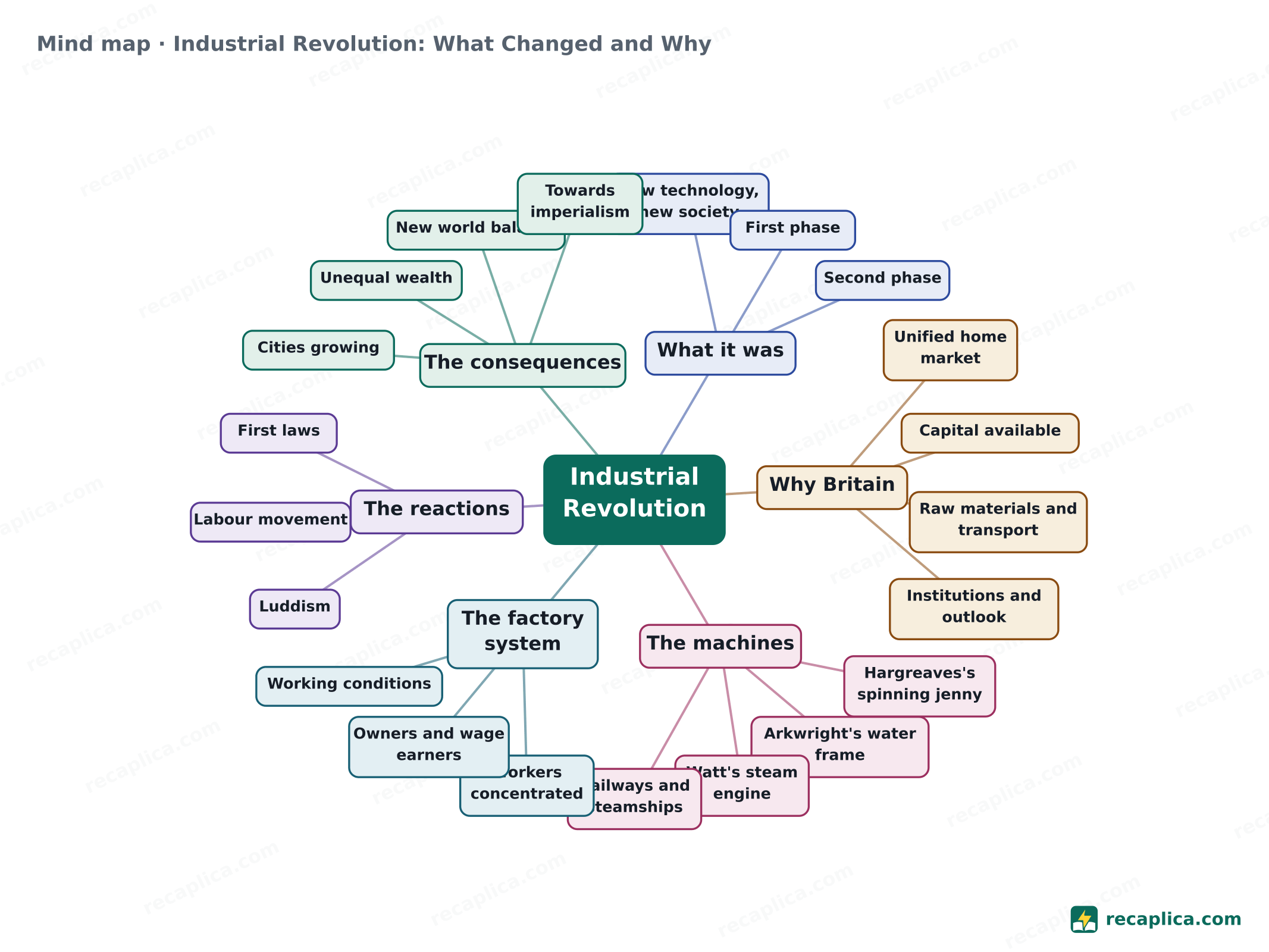
- Industrial Revolution
- What it was
- New technology, new society How things were made and how society was arranged changed together.
- First phase Late eighteenth century to the first thirty years of the nineteenth, in Britain.
- Second phase From the 1860s to the first decade of the twentieth century.
- Why Britain
- Unified home market Broad demand with no internal barriers.
- Capital available Built up through capitalist agriculture and colonial trade.
- Raw materials and transport Low costs and an excellent network of links.
- Institutions and outlook Room for private enterprise, advanced scientific research.
- The machines
- Hargreaves's spinning jenny 1764, eight spindles instead of one.
- Arkwright's water frame 1768, water power instead of arms.
- Watt's steam engine Separate condenser patented in 1769, two thirds less coal.
- Railways and steamships Stephenson's locomotive in 1814, first British line in 1825.
- The factory system
- Workers concentrated Large-scale production under a single roof.
- Owners and wage earners Those who own the machines and those who sell their labour.
- Working conditions Days of 13-15 hours, low pay, children from the age of 4-5.
- The reactions
- Luddism Machine-breaking, the first form of workers' protest.
- Labour movement Strikes, friendly societies, trade unions, socialist parties.
- First laws Factory Act of 1833, ten-hour day for women in 1847.
- The consequences
- Cities growing Manchester from 35,000 to 353,000 people between 1801 and 1851.
- Unequal wealth A striking increase, concentrated in the upper classes.
- New world balance Germany and the United States overtake Britain.
- Towards imperialism The race for raw materials and export markets.
- What it was
Quiz: test yourself
Answer the questions to check what you have learned: you get instant feedback and a short explanation.
Flashcards
Tap the card to flip it and check whether you remember the answer, then move to the next one.
Explain it in your own words
The ultimate test: if you can explain it in simple words, you've truly understood it. Write your explanation, then compare it with the Recap.
The Industrial Revolution is the shift from an economy of fields, workshops and muscle power to one of machines, factories and coal. It begins in Britain in the last decades of the eighteenth century and runs its course through the first thirty years of the nineteenth, starting with spinning and reaching almost every sector. It is not one invention but a chain of them: spinning machines, the steam engine made economical by James Watt, coal, iron, the railway. The result is an unprecedented rise in wealth alongside cities that grow within a few decades and working conditions that are brutal. A second wave, between the 1860s and the early 1900s, brings electricity and the internal combustion engine and shifts the centre of industry towards Germany and the United States.
Frequently asked questions
When did the Industrial Revolution start?
There is no start date, because it is a process rather than an event. Standard histories place the break between the end of the eighteenth century and the first thirty years of the nineteenth, with Britain ahead of everyone else; some accounts stretch the first phase across the whole first half of the nineteenth century. A few dates help you get your bearings: Hargreaves's spinning jenny in 1764, Arkwright's water frame in 1768, Watt's patent on the separate condenser on 5 January 1769, Crompton's spinning mule in 1778, Stephenson's locomotive in 1814 and the first British railway line in 1825.
Why did the Industrial Revolution begin in Britain?
Because the conditions it needed were already there, all at the same time: a large unified national market, capital accumulated through capitalist-style agriculture and colonial trade, cheap raw materials, a very good transport network, an already high level of urbanisation and institutions that left room for private enterprise. No single one of these is enough on its own; what made the difference is that they coincided.
What were the main inventions of the Industrial Revolution?
In textiles, Hargreaves's spinning jenny (1764), Arkwright's water frame (1768), Crompton's spinning mule (1778) and Cartwright's mechanical weaving (1785). In power, the steam engine, which Watt improved from 1765 and refined until 1781. In transport, Fulton's steamboat (1807), the first Atlantic crossing under steam (1819), Stephenson's locomotive (1814) and the first British railway line (1825). In the second wave, electrical machinery in the 1880s and the internal combustion engine in the 1890s.
What were the social consequences of the Industrial Revolution?
Total wealth rose enormously, but it went mainly to the upper classes and the capitalist middle class. For factory workers it meant low wages, days of 13 to 15 hours, women and children paid even less, children put to work at four or five, and no protection against unemployment. Out of this came Luddism, strikes, friendly societies, trade unions and socialist parties, and from it came the first protective laws, starting with the Factory Act of 1833.
What is the difference between the first and second Industrial Revolution?
The first, between the late eighteenth century and the early decades of the nineteenth, rests on coal, steam, iron and textiles, and concerns Britain, Belgium and parts of France and Germany. The second, between the 1860s-1870s and the first decade of the twentieth century, rests on electricity and the internal combustion engine, produces enormous firms organised into trusts and cartels with banks weighing heavily behind them, and carries industrialisation into Germany, northern Italy, Austria-Hungary, Russia, Japan and the United States.