The Cold War: What It Was, Why It Started and How It Ended
In 30 seconds quick read
The Cold War was the confrontation between the United States and the Soviet Union that ran from the end of the Second World War to 1991. It is called "cold" because the two superpowers never fought each other directly: both had nuclear weapons, and an open clash would have been too destructive for either side to survive intact. Instead they competed through rival military alliances, economic aid used as political leverage, espionage, propaganda and wars fought elsewhere — in Korea and in Vietnam. Europe was split along a line Churchill called an "iron curtain" in 1946, and Berlin became the sharpest point of contact. The confrontation ended between 1989, when the Berlin Wall came down, and 25 December 1991, when Gorbachev resigned and the Soviet Union ceased to exist.
Key Points
- The phrase "cold war" is associated with the American journalist Walter Lippmann and describes, as Treccani puts it, a hostility that the nuclear risk made impossible to settle in a head-on war.
- On 12 March 1947 Truman asked Congress for $400 million in aid for Greece and Turkey and committed the United States to supporting peoples under threat: the Truman Doctrine, containment turned into policy.
- The Marshall Plan, announced on 5 June 1947 and approved in March 1948, sent over $12 billion to Western Europe; the Soviet Union refused it and blocked the countries it controlled from joining.
- Berlin was the permanent friction point: the Soviet blockade, imposed on 24 June 1948 and bypassed by an Allied airlift, was lifted on 11 May 1949; then came the Wall, from 13 August 1961 to 9 November 1989.
- Each bloc had its alliance: NATO was signed on 4 April 1949 by twelve countries, the Warsaw Pact on 14 May 1955, days after West Germany joined NATO.
- The closest brush with direct war was the Cuban missile crisis, from 14 to 28 October 1962, which ended in a bargain rather than a victory for either side.
Key figures
- over $12 billion Marshall Plan aid for rebuilding Western Europe, following the Economic Cooperation Act approved in March 1948 Source: Office of the Historian, U.S. Department of State
- 155 kilometres the length of the Berlin Wall, which surrounded West Berlin from 13 August 1961 to 9 November 1989 Source: Stiftung Berliner Mauer (Berlin Wall Foundation)
- at least 140 people killed or who died at the Berlin Wall between 1961 and 1989 because of the East German border regime; 91 were shot by border guards Source: Stiftung Berliner Mauer (Berlin Wall Foundation)
Deep Dive
Two winners, one continent to divide
In 1945 the Second World War ended with two countries far stronger than everyone else: the United States and the Soviet Union. They had fought on the same side, but they wanted different things for the Europe now in their hands. The Americans backed market economies and elected governments; the Soviets, who had paid the war’s highest human price, wanted a belt of friendly states along their western border, and got it through communist governments installed across the Eastern European territories occupied by the Red Army.
On 5 March 1946 Winston Churchill, no longer prime minister and in the United States in a private capacity, gave an address at Westminster College in Fulton, Missouri. He said that “from Stettin in the Baltic to Trieste in the Adriatic an iron curtain has descended across the Continent”, and listed the capitals that lay behind that line: Warsaw, Berlin, Prague, Vienna, Budapest, Belgrade, Bucharest, Sofia. In those cities, he added, communist parties had been raised to power far beyond their numbers. The image stuck, and it stayed the standard description of a divided Europe for the next forty years.
The name for the period arrived shortly after. Treccani traces it to the American journalist Walter Lippmann, who used “cold war” for a hostility that could no longer be settled by a head-on war: nuclear weapons had closed that road to both sides.
Meanwhile, in Washington, a diplomat named George Kennan was drafting the strategy the United States would follow. He set it out in 1947 in an article signed with the letter X in Foreign Affairs: the main element of American policy toward the Soviet Union must be a “long-term, patient but firm and vigilant containment of Russian expansive tendencies”. Kennan had in mind a containment that was mostly political and economic. By 1950 Paul Nitze’s military reading, written into the NSC-68 document, had won the argument.
1947-1948: money as foreign policy
Containment turned concrete in two closely spaced moves.
On 12 March 1947 Truman went before Congress and asked for $400 million in aid for Greece and Turkey, two countries under pressure. In the speech he declared it would be the policy of the United States to support free peoples resisting attempted subjugation by armed minorities or outside pressures. It was a sharp break with the American tradition of staying out of distant conflicts, and it became known as the Truman Doctrine.
On 5 June 1947, at Harvard, Secretary of State George Marshall announced a programme of aid for European reconstruction. Congress approved it with the Economic Cooperation Act of March 1948: over $12 billion for Western Europe. The Soviet Union refused to take part and kept the countries it controlled out of it, fearing that the aid would become a doorway for American economic influence in Eastern Europe.
Practical example: economic aid is never only economic aid. A wrecked country that receives machinery, raw materials and credit restarts sooner, and when it restarts it tends to resemble whoever financed it: the same supplier firms, the same trade links, the same interests. That is precisely why Moscow said no. The Marshall Plan worked as reconstruction and as a political boundary at the same time.
Anyone who has read how GDP works will recognise the logic: rebuilding productive capacity shifts a continent’s economic weight for years.
Berlin, where the two worlds touched
Germany had been split into four occupation zones, and so had Berlin — which happened to sit inside the Soviet zone. The capital therefore became the place where the two sides looked at each other from close range, every day.
On 24 June 1948 the Soviets closed land access to the western sectors of the city. Berlin then held two and a half million people spread across the four occupation zones, and those in the western sectors were cut off from supplies. The Allied response was not military: it was an airlift carrying food and coal from the sky, day and night. At the peak a plane landed at Tempelhof every 45 seconds. In September 1948 three hundred thousand West Berliners gathered at the ruins of the Reichstag to demand that the city not be abandoned.
Moscow lifted the blockade on 11 May 1949, without a shot being fired. Two weeks later the state of West Germany, the Federal Republic of Germany, was established; the German Democratic Republic followed on the other side soon after.
The German problem did not close there. Anyone wanting to leave East Germany could do so through Berlin, and many did: by August 1961 the Democratic Republic had lost a sixth of its population, at least four million people. On 13 August 1961 the government began sealing the border around West Berlin, first with barbed wire and in the following days with the wall itself: 155 kilometres of barrier around a city. It stood until 9 November 1989. Across those twenty-eight years at least 140 people died because of the border regime; 91 of them were shot by guards.
Two alliances, two blocs
On 4 April 1949 twelve countries signed the North Atlantic Treaty: the United States, Canada, Belgium, Denmark, France, Iceland, Italy, Luxembourg, the Netherlands, Norway, Portugal and the United Kingdom. The heart of the text is Article 5: an armed attack against one or more of them shall be considered an attack against them all, and each ally will take the action it deems necessary, including the use of armed force.
In May 1955 West Germany joined NATO. Moscow read the move as a German army reappearing inside the Western alliance and answered within days: the Warsaw Pact was signed on 14 May 1955.
| NATO | Warsaw Pact | |
|---|---|---|
| Founded | 4 April 1949 | 14 May 1955 |
| Members at founding | 12, including the US, Canada, the UK, France, Italy | 8: USSR, Albania, Bulgaria, Czechoslovakia, East Germany, Hungary, Poland, Romania |
| Stated principle | Collective defence (Article 5) | Collective defence, in answer to NATO |
| Additional function | Tying the US and Western Europe together militarily | Keeping Soviet political and military control over Eastern Europe |
| Fate | Still exists | Dissolved between March and July 1991 |
With the alliances came the nuclear arms race, and a paradox with it: the more both sides armed, the less they could use those weapons. Striking first meant absorbing a reprisal that would destroy the attacker too. That is the underlying reason the war stayed cold at the centre and turned hot at the edges — in Korea from 1950 to 1953, and in Vietnam, where the conflict ended in 1975.
Thirteen days in October
On 14 October 1962 an American U-2 reconnaissance aircraft photographed Soviet missile sites under construction in Cuba, an island just off the American coast. This is the moment the Cold War came closest to turning hot.
On 22 October President Kennedy announced a naval “quarantine” of the island: the word was chosen deliberately, because a “blockade” would have carried the technical meaning of an act of war. On the 26th a message from Khrushchev arrived proposing a way out; on the 27th a second one arrived with different terms, and that same day a U-2 was shot down over Cuba. On 28 October Khrushchev publicly announced that the missiles would be withdrawn.
Practical example: the deal that closed the crisis had two layers. The public one: the Soviets remove the missiles, the Americans pledge not to invade Cuba. The private one: the United States withdraws its Jupiter missiles from Turkey, which happened in April 1963 with no announcement. To the public of the time it looked like a clean American win; in substance it was an exchange.
The naval quarantine was lifted on 20 November 1962, once the Soviet Il-28 bombers had also been removed. Two lasting consequences followed: a direct line of communication between the White House and the Kremlin, which let the two capitals reach each other in hours rather than days, and the negotiations that led in 1963 to the nuclear test ban treaty.
How the line dissolved
Tension between the two superpowers eased during the 1980s. On 9 November 1989 the Berlin Wall was opened, and for the first time in twenty-eight years people could cross from one side of the city to the other without risking their lives.
The end of the Soviet Union came two years later, in a quick sequence. In August 1991 a group of hard-line communists opposed to reform attempted a coup against Gorbachev: it failed, but it damaged his authority beyond repair. Within days Ukraine and Belarus declared independence. In early December the leaders of Russia, Ukraine and Belarus met at Brest and created the Commonwealth of Independent States. On 25 December 1991 Gorbachev resigned as president of the Soviet Union, and the Soviet flag was lowered from the Kremlin and replaced by the Russian tricolour. Around the same time President Bush recognised the twelve independent republics and opened diplomatic relations with Russia, Ukraine, Belarus, Kazakhstan, Armenia and Kyrgyzstan; relations with Uzbekistan, Moldova, Azerbaijan, Turkmenistan and Tajikistan followed in February 1992, and with Georgia only that May, because a civil war was under way there.
The Warsaw Pact had already dissolved between March and July 1991, worn down through the 1980s by economic trouble and by political change among its members.
Forty-five years of confrontation never produced the battle everyone feared, but they reorganised the alliances, arsenals, borders and economies of half the planet. The line Churchill described in 1946 ended where it had been most visible, in the middle of Berlin.
To see where the situation of 1945 came from, follow the path through the First World War and the Second; for the economic side of the contest, the entries on inflation and recession explain the tools used to measure an economy’s health, which in those years were also a propaganda argument.
Common myths
-
✗ Myth The Cold War was a peaceful period, since no fighting took place.
✓ Reality It was cold between the United States and the Soviet Union, not in the rest of the world. The two superpowers backed opposite sides in real and bloody conflicts: the Korean War from 1950 to 1953 and the Vietnam War, which ended in 1975, are the best known. The term describes the relationship between Washington and Moscow, not the casualty count.
-
✗ Myth The Berlin Wall divided Germany in two.
✓ Reality The Wall ran around West Berlin, which sat entirely inside East German territory: 155 kilometres of barrier encircling a city, not a line cutting through the country. The inner German border was a separate thing, much further west. Berlin had been split into four occupation zones after 1945 and remained a political island inside the Eastern bloc.
-
✗ Myth The Cuban crisis ended because the Soviet Union backed down.
✓ Reality It ended in a trade. On 28 October 1962 Khrushchev publicly announced the withdrawal of the missiles from Cuba, but the United States had pledged not to invade the island and, under a clause kept secret, to remove its Jupiter missiles from Turkey, which it did in April 1963. The public half of the deal looked like an American win; the private half was a compromise.
Mind map
Drag the background to move around and the nodes to reposition them; use − and + to collapse and expand branches.
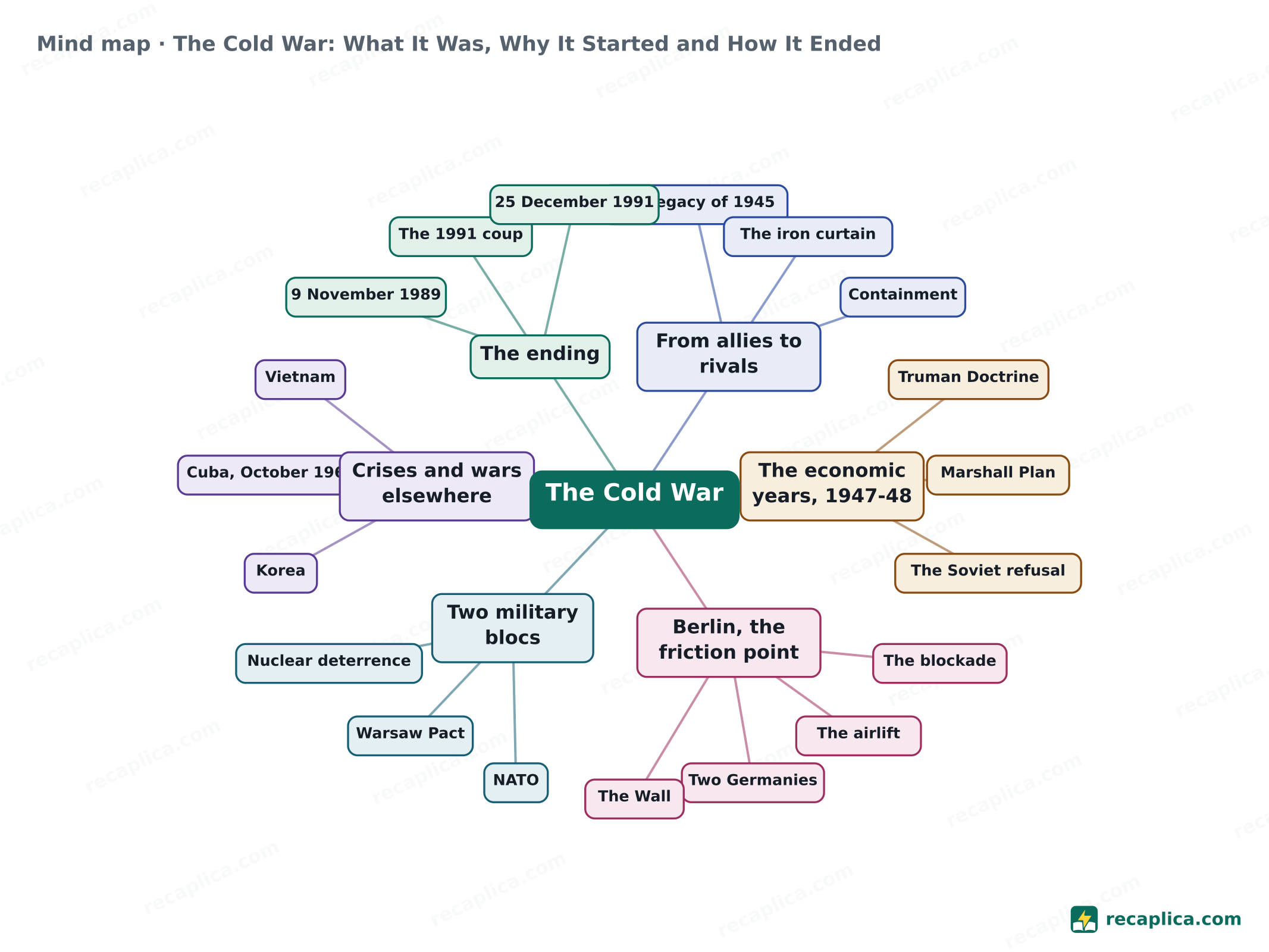
- The Cold War
- From allies to rivals
- The legacy of 1945 Only two genuinely strong powers left, Europe occupied and in ruins.
- The iron curtain Churchill's speech at Fulton, 5 March 1946.
- Containment Kennan, the long telegram and the 1947 X article.
- The economic years, 1947-48
- Truman Doctrine 12 March 1947, $400 million for Greece and Turkey.
- Marshall Plan Announced 5 June 1947, over $12 billion to Western Europe.
- The Soviet refusal Moscow rejects the plan and blocks its satellites from joining.
- Berlin, the friction point
- The blockade From 24 June 1948, land routes to the western sectors closed.
- The airlift Supplies from the air, day and night, until the blockade was lifted.
- Two Germanies Federal Republic and Democratic Republic, both founded in 1949.
- The Wall 155 km around West Berlin, from 13 August 1961.
- Two military blocs
- NATO 4 April 1949, twelve founding members, collective defence.
- Warsaw Pact 14 May 1955, an answer to West Germany joining NATO.
- Nuclear deterrence Nobody strikes first because the reprisal would be devastating.
- Crises and wars elsewhere
- Korea Conflict from 1950 to 1953.
- Cuba, October 1962 From the missiles spotted on the 14th to the withdrawal announced on the 28th.
- Vietnam War ended in 1975.
- The ending
- 9 November 1989 The Berlin Wall is opened.
- The 1991 coup It fails in August and fatally weakens Gorbachev.
- 25 December 1991 Gorbachev resigns, the Soviet flag leaves the Kremlin.
- From allies to rivals
Quiz: test yourself
Answer the questions to check what you have learned: you get instant feedback and a short explanation.
Flashcards
Tap the card to flip it and check whether you remember the answer, then move to the next one.
Explain it in your own words
The ultimate test: if you can explain it in simple words, you've truly understood it. Write your explanation, then compare it with the Recap.
The Cold War was the confrontation between the United States and the Soviet Union that ran from the end of the Second World War to 1991. It is called "cold" because the two superpowers never fought each other directly: both had nuclear weapons, and an open clash would have been too destructive for either side to survive intact. Instead they competed through rival military alliances, economic aid used as political leverage, espionage, propaganda and wars fought elsewhere — in Korea and in Vietnam. Europe was split along a line Churchill called an "iron curtain" in 1946, and Berlin became the sharpest point of contact. The confrontation ended between 1989, when the Berlin Wall came down, and 25 December 1991, when Gorbachev resigned and the Soviet Union ceased to exist.
Frequently asked questions
When did the Cold War start and when did it end?
There is no single opening date, because nobody declared it: it grew out of the aftermath of the Second World War, and historians use Churchill's Fulton speech of 5 March 1946 and the Truman Doctrine of 12 March 1947 as markers. The ending has precise dates: the Berlin Wall was opened on 9 November 1989, and on 25 December 1991 Gorbachev resigned as president of the Soviet Union, which then ceased to exist.
Who were the two superpowers, and who stood with them?
On one side the United States and Western Europe, joined from 4 April 1949 in NATO, whose twelve founding members were the United States, Canada, Belgium, Denmark, France, Iceland, Italy, Luxembourg, the Netherlands, Norway, Portugal and the United Kingdom. On the other side the Soviet Union and the communist-governed countries of Eastern Europe, bound from 14 May 1955 by the Warsaw Pact: Albania, Bulgaria, Czechoslovakia, East Germany, Hungary, Poland and Romania.
What was the iron curtain?
An image, not a structure. On 5 March 1946, at Westminster College in Fulton, Missouri, Winston Churchill said that "from Stettin in the Baltic to Trieste in the Adriatic an iron curtain has descended across the Continent". He meant the line separating the part of Europe under Soviet influence from the rest. The Berlin Wall, built fifteen years later, was its most visible stretch: 155 kilometres of barrier around West Berlin.
Why did the two superpowers never attack each other?
Because both had nuclear weapons: whoever struck first would face a reprisal capable of destroying them in turn, which left an attack with no possible gain. The contest moved instead to ground where a side could lose without dying: the economy, alliances, espionage, the space race. And it moved into third countries, such as Korea from 1950 to 1953 and Vietnam, where the war ended in 1975.
How many people died at the Berlin Wall?
According to the Stiftung Berliner Mauer, the German foundation that documents the Wall, at least 140 people were killed or lost their lives because of the East German border regime between 1961 and 1989; 91 of them, mostly people attempting to flee, were shot by border guards. The Wall had been built to stop those departures: by August 1961 East Germany had lost a sixth of its population, at least four million people.