The History of Carbonara: True Origins and False Myths
In 30 seconds quick read
Carbonara passes for one of the oldest dishes in the Roman tradition, but it is a twentieth-century dish: classic Roman cookbooks never mention it, and as late as 1949 Ada Boni's famous collection does not record it. The oldest known written trace of the name dates from 23 August 1939, in a Dutch-language newspaper of the Dutch East Indies that mentions a trattoria in Trastevere. The most famous hypothesis has the dish born in September 1944 from the meeting between an Italian cook and Allied army rations, but it remains a hypothesis, and historians still argue about it. The first written recipes, from the 1950s, were very different from today's: the first Italian version, from 1954, called for pancetta, gruyère and garlic. The modern canon — guanciale, pecorino, egg and pepper — only settled in the 1990s.
Key Points
- Carbonara is a twentieth-century dish: it does not appear in earlier Roman cookbooks, and even the 1949 edition of Ada Boni's classic collection has no trace of the name.
- The oldest written mention known today is from 23 August 1939: De Koerier, a Dutch-language newspaper of the Dutch East Indies, mentions a Trastevere trattoria renowned for its spaghetti alla carbonara.
- The most famous hypothesis has it born on 22 September 1944 in Riccione: Bolognese cook Renato Gualandi said he improvised it with Allied rations — bacon, cream, cheese and powdered egg yolk.
- The first written recipes only appear in 1952-1954 and look nothing like today's dish: the first one published in Italy, in August 1954, used pancetta, gruyère and garlic.
- Guanciale enters the story at the end of the 1950s and the modern canon settles in the 1990s; in the decades between, cream, garlic, onion and wine were normal variations, not heresies.
- Historians are still divided on the origins: the discovery of the 1939 mention reopened the debate between those who see a dish born from the encounter with the Americans and those who see an older Roman root.
Key figures
- 23 August 1939 the date of the oldest known written trace of the name, in an article in De Koerier, a newspaper of the Dutch East Indies, mentioning a trattoria in Trastevere Source: Il Post
- August 1954 the first carbonara recipe published in Italy, in the magazine La Cucina Italiana, made with pancetta, gruyère and garlic Source: Luca Cesari, Ricette storiche
- 250 ml the cream called for per 400 grams of spaghetti in Gualtiero Marchesi's 1989 carbonara, when cream was still a normal part of the dish Source: Luca Cesari, Ricette storiche
Deep Dive
A monument younger than it looks
Carbonara feels like a dish that has always existed, handed down intact through centuries of Roman cooking. Its documented history, though, fits entirely inside the twentieth century.
The strongest piece of evidence is an absence. Roman cookbooks never mention carbonara, and as late as 1949 Ada Boni’s collection, a classic of the genre, does not record it: it has spaghetti al guanciale, without egg, closer if anything to today’s gricia. For a dish supposedly handed down for centuries, that absence is hard to explain: Roman recipes were written down, printed and reprinted, and of this one there is no trace.
Reconstructing its real history is archive detective work, done with yellowed newspapers, menus and travel guides. That is the method of food historians such as Luca Cesari, who has gathered the carbonara clues decade by decade. And the clues tell a story very different from the legend.
The charcoal burners legend
The romantic version says carbonara was born centuries ago among the carbonai, the workers who made charcoal in the Apennine woods: an energy-rich dish, made with ingredients that kept well. The name, in this telling, would come from them.
It is a fine story, but only a story: no document supports it, and food historians dismiss it as unhistorical. The name “carbonara” appears in the sources already fully formed, with nobody explaining its origin. Legends like this one usually spring up after a dish becomes successful, to give it the pedigree it lacks.
The American hypothesis: Riccione, 22 September 1944
The most detailed account of the dish’s birth comes from a Bolognese cook, Renato Gualandi. According to his testimony, on 22 September 1944 — in an Italy split in two by World War 2 — he had to prepare a lunch in Riccione for a meeting between the British Eighth Army and the American Fifth Army. His pantry held whatever the Allies supplied: bacon, cream, cheese and powdered egg yolk. He combined them over pasta, with a dusting of pepper.
Military rations were a product of the large-scale food industry born with the industrial revolution: tinned meat and dehydrated eggs crossed oceans without spoiling, and they landed in a hungry country. Gualandi then became a cook for the Allied troops in Rome, from September 1944 to April 1945: long enough, according to this hypothesis, to make the dish known in the capital.
It is a fascinating reconstruction, rich in detail. But it remains a testimony, not a document — and this is exactly where the story gets complicated.
The plot twist: Trastevere, 1939
In February 2026 two Dutch journalists, Edwin Winkels and Janneke Vreugdenhil, published a discovery that forced everyone to rethink the story: an article dated 23 August 1939 in De Koerier, a Dutch-language newspaper of the Dutch East Indies, described the rivalry between two trattorias in Trastevere and named spaghetti alla carbonara as the speciality of one of them.
No recipe, just the name. But a name circulating in 1939 — five years before Riccione, before the war had even started — changes the picture. Until then, the oldest known mention was Italian and post-war: an article by Renato Mucci in the Giornale di Trieste dated 1 May 1948. The discovery has been acknowledged on both sides of the debate: Alberto Grandi, the historian who made the American-origin thesis famous, accepts the finding while still considering the Americans central to the story; Luca Cesari has spoken of a history that needs rewriting.
The sources, in short, do not allow a verdict today. Either a carbonara (perhaps different from the current one) already existed in Rome before the war, and 1944 was its relaunch; or the name referred to a dish that the war then transformed. Honesty requires presenting both readings as hypotheses.
The first written recipes are not the one you know
If the name remains wrapped in mystery, the recipes are well documented — and full of surprises. The first known written recipe appeared neither in Rome nor in America: it came out in April 1952 in La Croix du Nord, a newspaper from Lille, under the name of Roman actor Aldo Fabrizi, and it was very different from today’s dish. A few months later, in December 1952, carbonara appears in a guide to Chicago restaurants written by Patricia Bronté, who recorded it at Armando’s.
Then came 1954, the year carbonara broke through: the New York Times described it in a July article about Rome’s Trattoria al Moro, Elizabeth David published a version with pancetta and parmesan, and in August the first recipe published in Italy appeared, in the magazine La Cucina Italiana. That same year an official list of regional specialities registered it among the dishes of Lazio: the dish “without a history” was entering state records.
| Year | Where | Fat and cheese |
|---|---|---|
| 1952 | Chicago guide (Bronté) | Pancetta and parmesan |
| 1954 | La Cucina Italiana | Pancetta, gruyère and garlic |
| 1954 | Elizabeth David | Pancetta and parmesan |
| 1955 | Felix Dessì, La signora in cucina | Pancetta and parmesan, pecorino as an alternative |
| 1960 | Luigi Carnacina, La grande cucina | Guanciale |
You read that right: the first carbonara published in Italy had gruyère and garlic, and neither guanciale nor pecorino. Pecorino shows up in 1955 as a mere alternative to parmesan; guanciale is first mentioned in 1957, in an American travel guide, and only in 1960 does it enter a major Italian manual, Luigi Carnacina’s La grande cucina.
Practical example: imagine ordering a carbonara in 1954, in 1975 and today. In 1954 you would get pasta with pancetta, gruyère and garlic; in 1975, most likely a version softened with cream, perhaps served in an elegant restaurant; today, crispy guanciale and a cream of egg yolk and pecorino. Ask for anything else at your own risk. Three different dishes, one name: that is how living recipes work, changing with every generation.
Cream and garlic, the “heresies” that were the norm
Anyone who cries scandal today at cream in carbonara would jump out of their chair leafing through Italian cookbooks from the 1960s to the 1980s: cream was an entirely normal presence, even at the highest level. Gualtiero Marchesi’s carbonara, published in 1989, called for 250 ml of cream per 400 grams of spaghetti. In the dish’s first forty years, alongside cream and garlic, the sources record variations with wine, onion, parsley and even bell pepper.
The great clean-up came in the 1990s: the accessory ingredients disappeared one by one and the recipe slimmed down to the trio of egg (yolk above all), pecorino and guanciale, plus pepper. That is the canon we now defend as “original”: and it is, paradoxically, the youngest version of all.
Even today, for that matter, the unanimity is thinner than it seems: the recipe published by the Accademia Italiana della Cucina, Italy’s culinary academy, includes a clove of garlic and a spoonful of olive oil, two ingredients many purists consider unacceptable. If even the institutions cannot agree, perhaps “the true carbonara” is the wrong question.
What a plate of pasta can teach
The history of carbonara is a small handbook on how traditions work. A dish born yesterday, from a meeting between cultures in years of hunger and exchange, became within two generations a symbol of identity so strong that questioning its age triggers furious reactions. Yet archive research keeps moving the dates, and every new finding, like the 1939 one, reopens the file.
None of this takes anything away from the dish. It simply means that tradition is living material, reworked by every generation: and sometimes, as in this case, it is younger than our grandparents.
Common myths
-
✗ Myth Carbonara is an ancient Roman dish, handed down for centuries.
✓ Reality Many people take this for granted, but there is not a single trace of carbonara before the twentieth century: it is absent from classic Roman cookbooks and even from the 1949 edition of Ada Boni's collection, which does record spaghetti al guanciale (without egg, closer to gricia). The oldest mention of the name is from 1939 and the first written recipes are from the 1950s. It feels ancient because it became a symbol of identity, and we instinctively give symbols a long past; but a dish's worth does not depend on its age.
-
✗ Myth The original recipe is today's one: guanciale, pecorino, egg and pepper.
✓ Reality The opposite is true: the first written recipes were different. The one published in France in April 1952 under actor Aldo Fabrizi's name was far from today's version; the Chicago one from December 1952 used pancetta and parmesan; the first Italian one, from August 1954, called for pancetta, gruyère and garlic. Guanciale only enters the scene at the end of the 1950s, and the canon we now call "original" settled in the 1990s: of all the versions, it is the most recent.
-
✗ Myth Cream and garlic are heresies invented by foreigners who do not understand Italian cooking.
✓ Reality Historically this is hard to defend: garlic appears in the first Italian recipe of 1954, and even the recipe published today by the Accademia Italiana della Cucina includes a clove of garlic and a spoonful of olive oil. Cream, already present in Gualandi's account of 1944, was normal between the 1960s and the 1980s even in the kitchens of great Italian chefs: Marchesi used 250 ml of it in 1989. The "foreigners' mistakes" are often older Italian versions, frozen abroad while the recipe kept changing in Italy.
Mind map
Drag the background to move around and the nodes to reposition them; use − and + to collapse and expand branches.
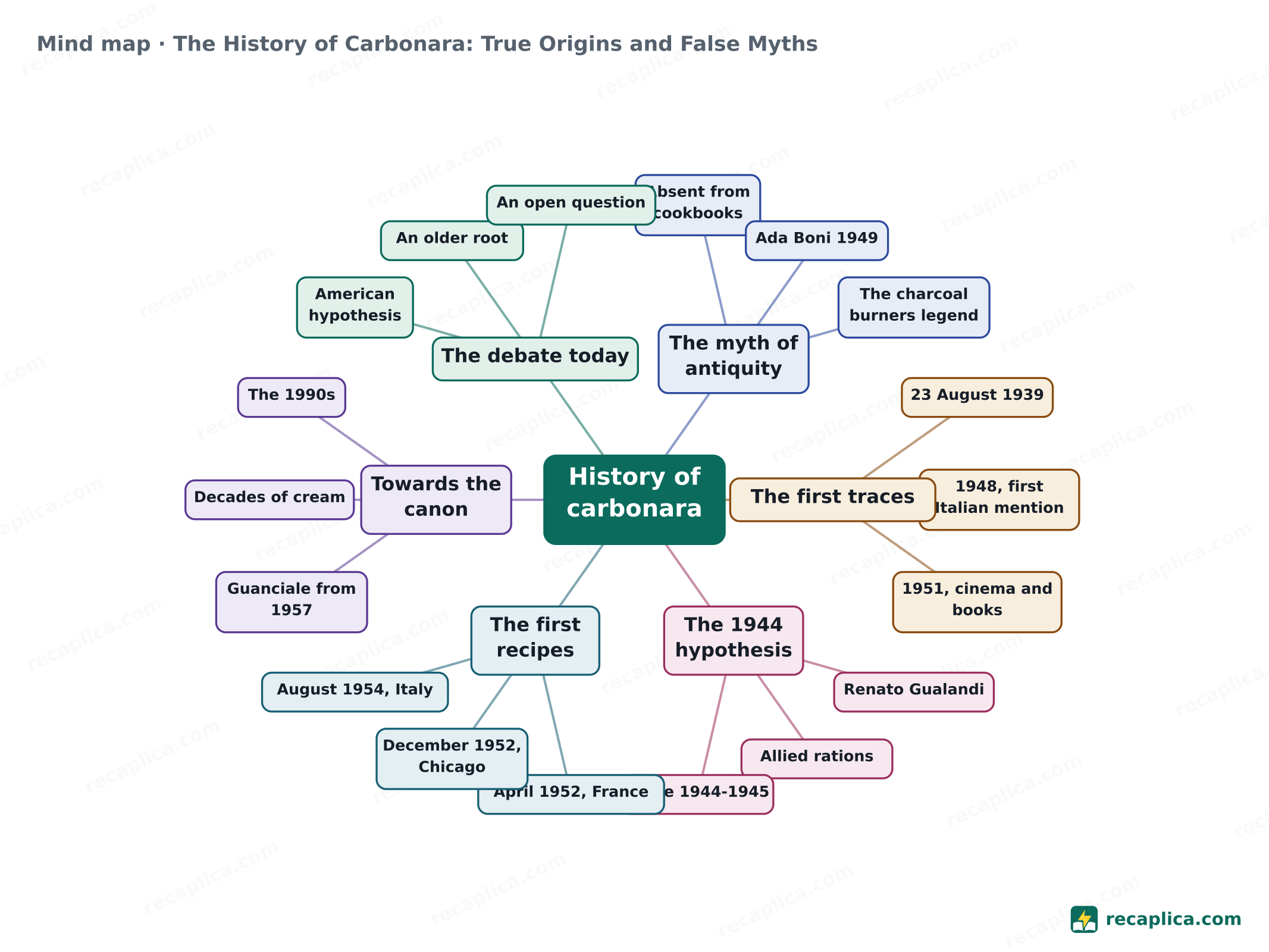
- History of carbonara
- The myth of antiquity
- Absent from cookbooks No trace in Roman cookbooks before the twentieth century.
- Ada Boni 1949 Records spaghetti al guanciale without egg, not carbonara.
- The charcoal burners legend Evocative but with no documentary evidence.
- The first traces
- 23 August 1939 The newspaper De Koerier mentions a Trastevere trattoria.
- 1948, first Italian mention An article by Renato Mucci in the Giornale di Trieste.
- 1951, cinema and books A film and a book about poet Trilussa name the dish.
- The 1944 hypothesis
- Renato Gualandi A Bolognese cook who said he improvised it in Riccione.
- Allied rations Bacon, cream, cheese and powdered egg yolk.
- Rome 1944-1945 Gualandi cooks for Allied troops in the capital.
- The first recipes
- April 1952, France In La Croix du Nord, under Aldo Fabrizi's name.
- December 1952, Chicago In Patricia Bronté's guide, with pancetta and parmesan.
- August 1954, Italy La Cucina Italiana, with pancetta, gruyère and garlic.
- Towards the canon
- Guanciale from 1957 First mentioned in an American guide, then Carnacina 1960.
- Decades of cream Normal from the 1960s to the 1980s, Marchesi 1989 included.
- The 1990s The recipe settles on guanciale, pecorino, egg and pepper.
- The debate today
- American hypothesis Alberto Grandi sees the Americans at the centre of the story.
- An older root The 1939 mention reopens the archive hunt.
- An open question The historians themselves speak of a history to rewrite.
- The myth of antiquity
Quiz: test yourself
Answer the questions to check what you have learned: you get instant feedback and a short explanation.
Flashcards
Tap the card to flip it and check whether you remember the answer, then move to the next one.
Explain it in your own words
The ultimate test: if you can explain it in simple words, you've truly understood it. Write your explanation, then compare it with the Recap.
Carbonara passes for one of the oldest dishes in the Roman tradition, but it is a twentieth-century dish: classic Roman cookbooks never mention it, and as late as 1949 Ada Boni's famous collection does not record it. The oldest known written trace of the name dates from 23 August 1939, in a Dutch-language newspaper of the Dutch East Indies that mentions a trattoria in Trastevere. The most famous hypothesis has the dish born in September 1944 from the meeting between an Italian cook and Allied army rations, but it remains a hypothesis, and historians still argue about it. The first written recipes, from the 1950s, were very different from today's: the first Italian version, from 1954, called for pancetta, gruyère and garlic. The modern canon — guanciale, pecorino, egg and pepper — only settled in the 1990s.
Frequently asked questions
Who invented carbonara?
Nobody knows for certain. The most detailed account comes from Bolognese cook Renato Gualandi, who claimed he improvised it on 22 September 1944 in Riccione with Allied army rations and later brought it to Rome. But that is a testimony, not a document, and the discovery of a mention of the dish in a 1939 newspaper shows the name was already circulating before the war. Food historians, from Luca Cesari to Alberto Grandi, consider the question still open.
When was carbonara born?
Its documented history starts in the twentieth century. The oldest known written trace of the name is an article dated 23 August 1939 in De Koerier, a newspaper of the Dutch East Indies; the first known Italian mentions come after the war, starting with a 1948 article, and the first written recipes only in 1952-1954. No cookbook records it before then: everything told about centuries-old origins belongs to legend.
Did the original carbonara have cream in it?
The first written recipes of the 1950s did not include it, but cream does appear in Gualandi's account of 1944, and between the 1960s and the 1980s it was completely normal, even in high-end kitchens: Gualtiero Marchesi's 1989 version used 250 ml of cream for 400 grams of spaghetti. The idea that cream is heresy is as recent as the modern canon, that is, from the 1990s.
Why is it called carbonara?
There is no documented explanation. The most famous story — the dish of the carbonai, the charcoal burners working in the Apennine woods — is evocative but unsupported: food historians consider it a legend built after the fact. The name appears in the sources already fully formed, with no document explaining where it came from.
Is carbonara an American dish?
That is the thesis made famous by historian Alberto Grandi: the ingredients of American soldiers — bacon and powdered egg yolk — supposedly met Italian pasta in 1944-45. The 1939 mention, found in 2026, complicates this reconstruction, because it shows the name existed before the war; Grandi himself still considers the Americans central to the dish's spread. The honest answer is that carbonara as we know it has several parents, Italian and not only.