Skip to content
recaplica

    One moment: security check

    Cloudflare wants to make sure you're not a robot. Tick the box below and your search will continue on its own.

    IT
    recaplica Public Education Movement: How Compulsory Schooling Took Hold
    © 2026 Recaplica · recaplica.com — All rights reserved
    Home › History

    Public Education Movement: How Compulsory Schooling Took Hold

    By Recaplica Newsroom · Updated on October 19, 2026

    What to print

    Page numbers appear when printing with default margins.

    Slides

    Choose a cut

    Flash10 slidesThe essential thread, to present in classFull16 slidesEvery chapter and the deeper detail

    Both come with speaker notes.

    Telegram channel
    recaplica Clear in 30 seconds, yours in 10 minutes.
    In 30 seconds Key points Figures Deep dive Slides Myths Mind map Quiz Flashcards FAQ

    In 30 seconds quick read

    In newly unified Italy, in 1861, roughly three people out of four could neither read nor write. The 1859 Casati Law had already set compulsory schooling down as a principle, but it took the 1877 Coppino Law to make it real, with penalties for families who ignored it. The same arc, on different timelines and with different tools, played out in the United States under Horace Mann and in England through the laws of 1870 and 1880. In every case, a law on its own wasn't enough: by 1921, Italy was still split between a nearly literate North and a South where illiteracy still topped 49% in several regions.

    Key Points

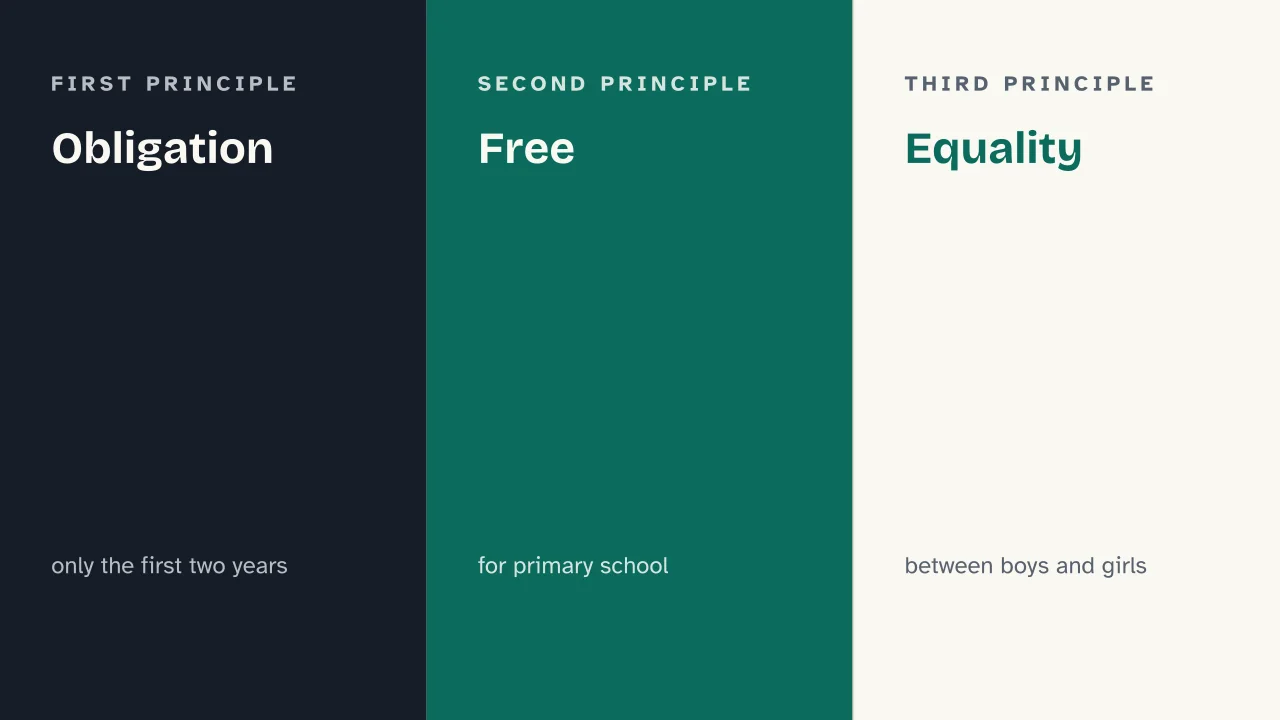
    • The Casati Law (1859) set out obligation, free access and equal schooling for boys and girls in primary education, but only made the first two years compulsory.
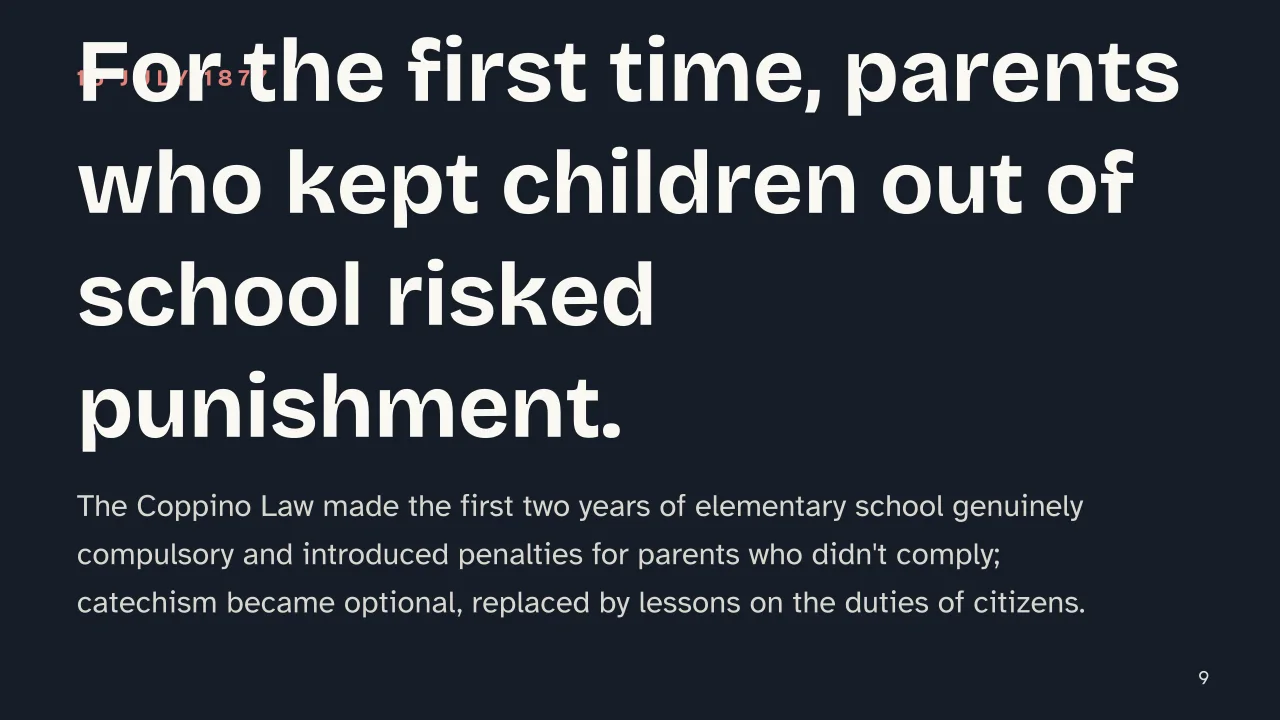
    • The Coppino Law (1877) made that obligation enforceable, with penalties for parents who didn't comply, and replaced mandatory catechism with lessons on the duties of citizens.
    • In the United States, Horace Mann led the common school movement in Massachusetts from 1837, and in 1852 the state became the first to require school attendance by law.
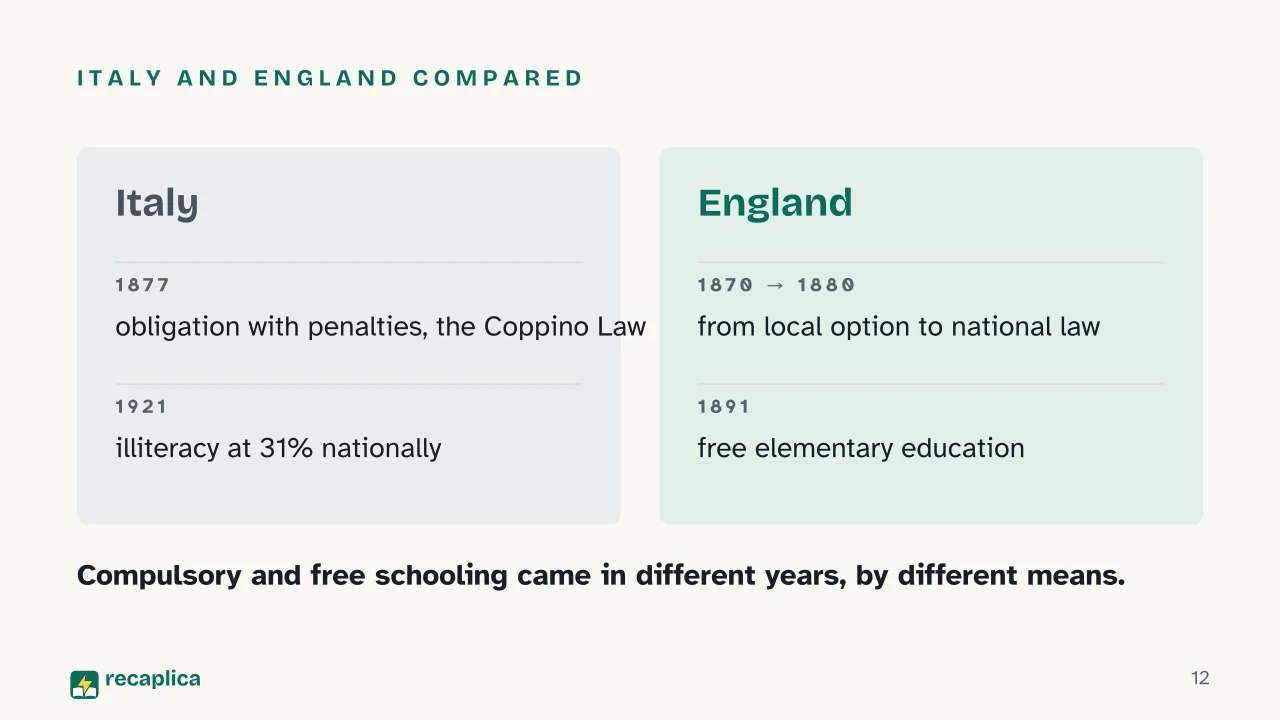
    • In England, compulsory attendance didn't arrive nationwide until 1880 (the Mundella Act), and free schooling followed in 1891, after a decade in which the 1870 law left the choice to local school boards.
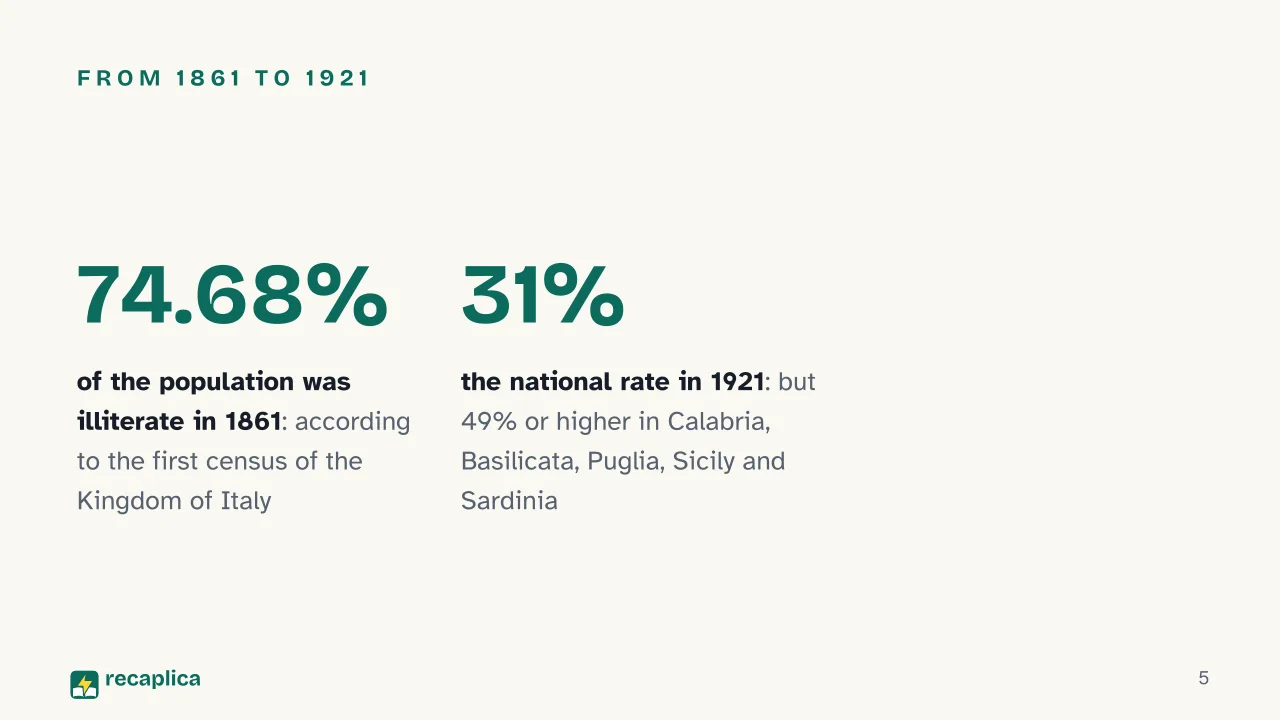
    • Illiteracy in Italy fell from 74.68% in 1861 to 31% in 1921, but the gap between North and South stayed enormous.

    Key figures

    • 74.68% Share of Italy's population recorded as illiterate in the 1861 census, according to Treccani. Source: Treccani, entry Analfabetismo
    • 1877 Year of the Coppino Law, which made the first two years of elementary school genuinely compulsory and introduced penalties for parents who ignored it. Source: Treccani, entry Michele Coppino
    • 1852 The year a state law in Massachusetts first forced every child into a classroom. Source: Encyclopedia.com, entry Horace Mann

    Deep Dive

    In 1861, at the first census of the newly unified Kingdom of Italy, 74.68% of the population aged six and over was recorded as illiterate. It wasn’t a new problem, and it wasn’t confined to the South: already in 1848, before unification, Piedmont proper counted 65.3 illiterate people per 100 residents, and in the Duchy of Parma in 1857 the share reached 84.2%. The country that had just become politically unified remained, for the most part, a country of people who couldn’t read or write.

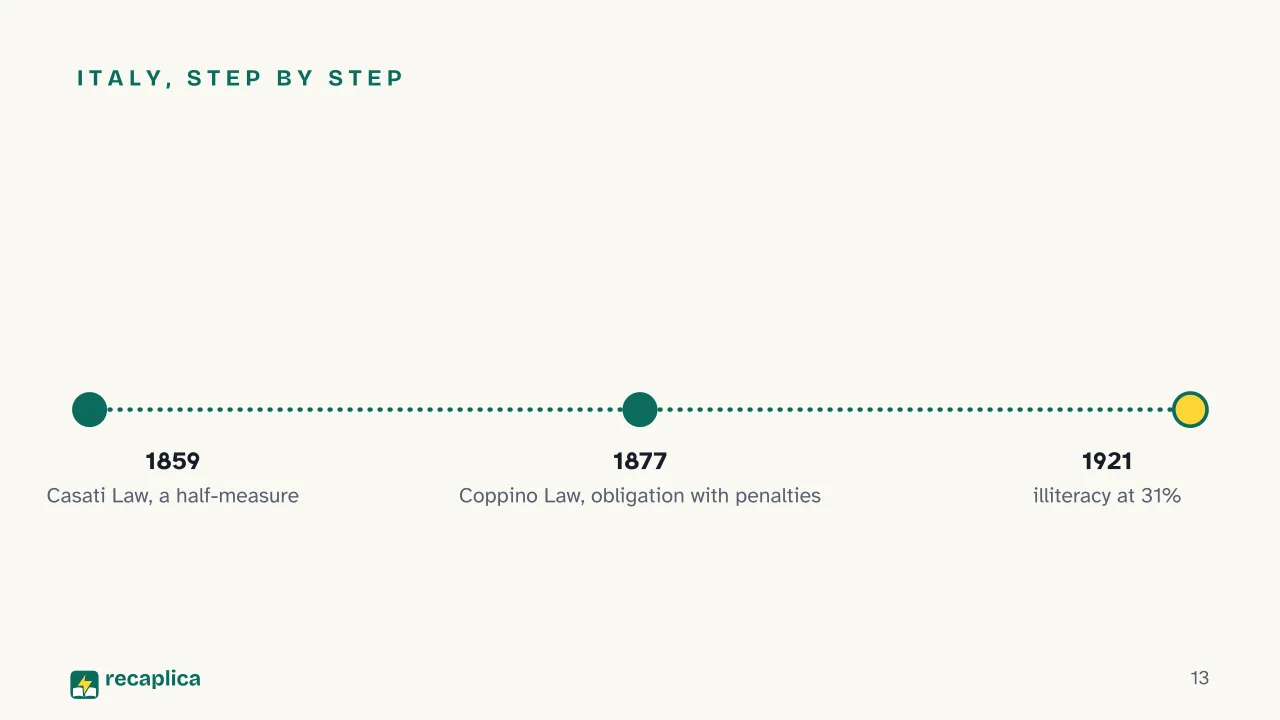
    The first response came even before Italy was fully unified. The Casati Law, issued on 13 November 1859 for the Kingdom of Sardinia and newly annexed Lombardy, put three principles for primary education into writing: compulsory schooling, free access, and equal access for both sexes. Once extended to the rest of Italy after unification, that legal framework stayed in force, with amendments, for over sixty years, until the 1923 Gentile reform. The obligation it introduced, though, covered only the first of the two two-year blocks that made up elementary school — children aged 6 to 9 — with no penalty for families who ignored it.

    Worked example: picture a farming family in 1860, in any Italian region. The Casati Law said their children had both the right and the duty to attend school up to age 9. But if the family needed those children’s hands in the fields, and nobody checked or penalized those who stayed home, that duty remained on paper only.

    It took another eighteen years for the obligation to become real. The law of 15 July 1877, known as the Coppino Law after education minister Michele Coppino, made it punishable for the first time to keep a child out of the classroom. The law was part of the broader reform program of Agostino Depretis’s Historical Left, in which Coppino had served as education minister since March 1876, and it passed the Chamber of Deputies 208 votes to 20. Another effect of the Coppino Law touched religious instruction: catechism, previously compulsory, became optional and taught only at parents’ request, replaced as a standard subject by lessons on “the duties of man and citizen.”

    MilestoneYearWhat changed
    Casati Law1859Obligation, free access and equality, but only the first two years, with no penalties
    Coppino Law1877Obligation enforceable, with penalties for parents who ignored it
    Massachusetts (Horace Mann)1852First US state with compulsory attendance by law
    Elementary Education Act1870Census of schools and children, obligation left to local boards
    Mundella Act1880Compulsory attendance up to age 10 across England and Wales

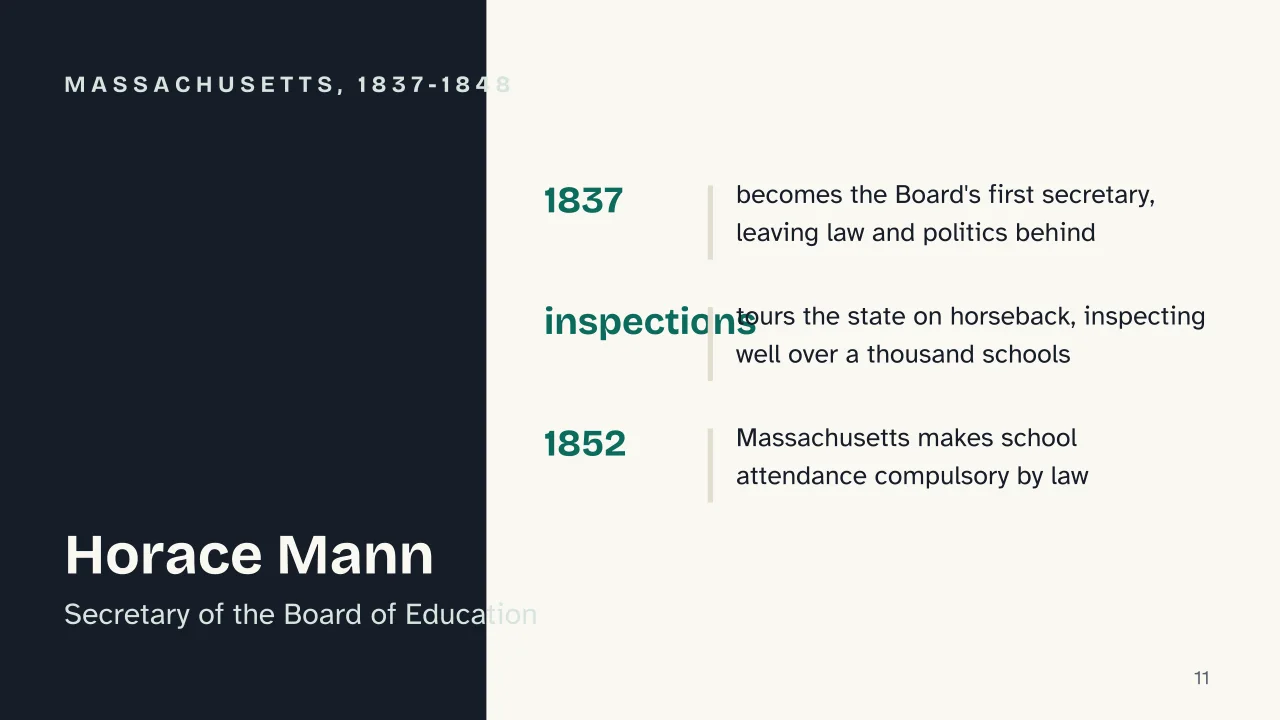
    The same arc, on its own timeline, had already played out elsewhere. In the United States, Horace Mann became the first secretary of the Massachusetts Board of Education in 1837, giving up a promising career in law and politics for the post. He held it for twelve years, until 1848, filing an annual report to the Massachusetts legislature and personally inspecting more than a thousand schools on horseback over six years. Mann called education the “great equalizer” of social conditions. Before he took office, in the 1830s, a contemporary survey had estimated that only a third of Massachusetts children of school age actually attended. In 1852, Massachusetts became the first American state to make school attendance compulsory by law for every child.

    England’s path was slower. The Elementary Education Act of 1870, known as the Forster Act, required local authorities to survey how many children lived in their area and how many schools already existed; section 74 then left it to individual school boards to decide whether to make attendance compulsory, with exemptions for illness, a distance of more than three miles, or a child already judged sufficiently educated. By 1873, only 40% of the English population lived in districts that had made that choice. Between 1870 and 1880, school boards opened or took over somewhere between 3,000 and 4,000 schools, before the Elementary Education Act of 1880, the Mundella Act, made attendance compulsory up to age 10 across England and Wales, with a few remaining exemptions. Free schooling followed even later, in 1891, in both board schools and voluntary religious schools.

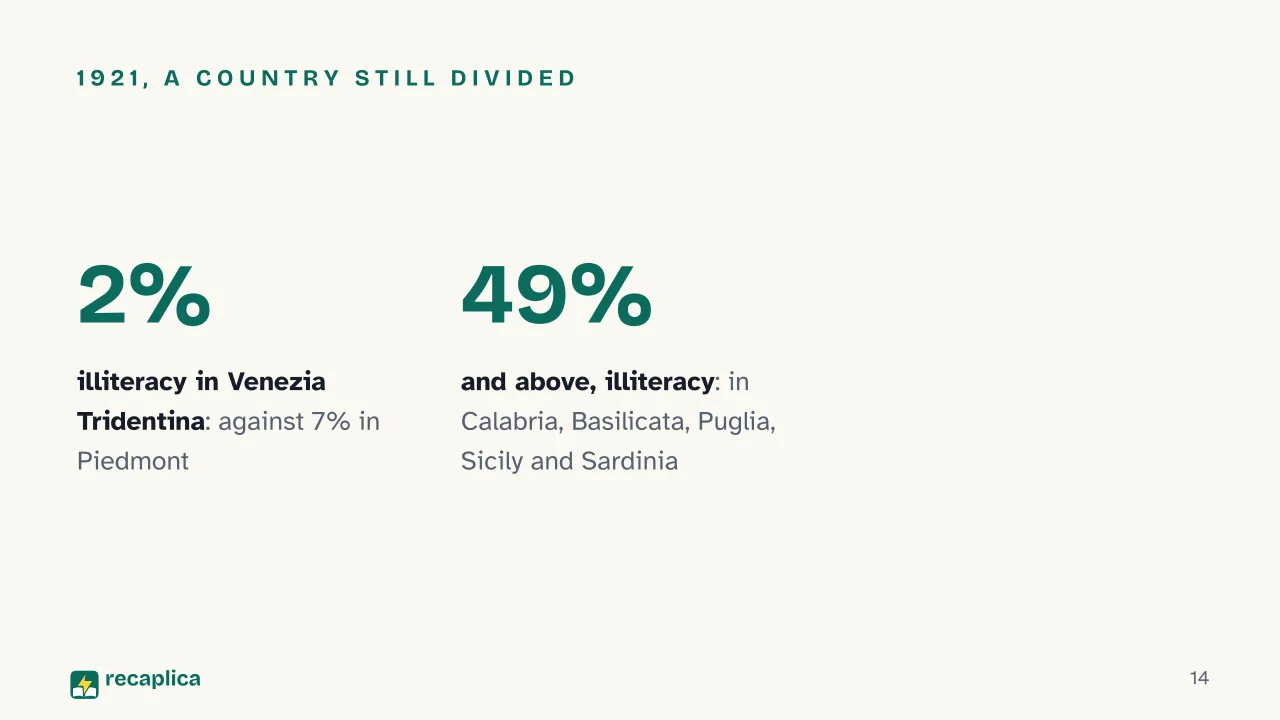
    Back in Italy, the obligation and its penalties didn’t close the regional gap on their own. Illiteracy fell from 68.8% in 1871 to 62.8% in 1881, to 48.5% in 1901, 43.1% in 1911 and 31% in 1921, with the North by then nearly fully literate: 2% in Venezia Tridentina, 7% in Piedmont, 9% in Lombardy, 10% in Liguria. In the South, illiteracy was still at 49% or higher in Calabria, Basilicata, Puglia, Sicily and Sardinia. More than sixty years after the Casati Law, and over forty after the Coppino Law, the public school movement had shrunk the problem, not solved it.

    The right to education is recognized as a universal principle, and its roots reach back to ancient education systems and to 17th-century educational thinkers writing two centuries before the Casati and Coppino laws.

    Slide deck

    Slides ready to download and make your own in PowerPoint or Google Slides, with speaker notes. Pick the Flash cut or the Full one.
    Slide 1 of the presentation on Public Education Movement: The Public Education MovementSlide 2 of the presentation on Public Education Movement: How many people could read and write?Slide 3 of the presentation on Public Education Movement: From 1861 to 1921Slide 4 of the presentation on Public Education Movement: Chapter 01: A country that couldn't readSlide 5 of the presentation on Public Education Movement: From 1861 to 1921Slide 6 of the presentation on Public Education Movement: Chapter 02: The Casati LawSlide 7 of the presentation on Public Education Movement: Obligation · Free · EqualitySlide 8 of the presentation on Public Education Movement: Chapter 03: The Coppino LawSlide 9 of the presentation on Public Education Movement: For the first time, parents who kept children out of school risked punishment.Slide 10 of the presentation on Public Education Movement: Chapter 04: The same story, elsewhereSlide 11 of the presentation on Public Education Movement: Massachusetts, 1837-1848Slide 12 of the presentation on Public Education Movement: Italy and England comparedSlide 13 of the presentation on Public Education Movement: Italy, step by stepSlide 14 of the presentation on Public Education Movement: 1921, a country still dividedSlide 15 of the presentation on Public Education Movement: What did the Coppino Law add that the Casati Law hadn't?Slide 16 of the presentation on Public Education Movement: Now, time to review
    Flash10 slidesThe essential thread, to present in classFull16 slidesEvery chapter and the deeper detail

    Common myths

    • ✗ Myth Italian schools were free and compulsory from the moment the country was unified.

      ✓ Reality The 1859 Casati Law set obligation down as a principle, but only the first two years of elementary school were compulsory, and there was no real penalty for parents who kept children home. It took another eighteen years, until the 1877 Coppino Law, before the obligation came with actual consequences.

    • ✗ Myth Once a compulsory-schooling law passes, illiteracy disappears quickly.

      ✓ Reality By 1921, forty-four years after the Coppino Law, Italy's illiteracy rate had dropped to 31% nationally, yet it was still at 49% or higher in Calabria, Basilicata, Puglia, Sicily and Sardinia, while regions like what was then Venezia Tridentina were already down to 2%.

    • ✗ Myth Compulsory public education is a recent or distinctly Italian invention.

      ✓ Reality Massachusetts made school attendance compulsory in 1852, a quarter-century before Italy's Coppino Law, while England didn't reach nationwide compulsory attendance until 1880, three years after Italy did: every country moved on its own schedule.

    Mind map

    Drag the background to move around and the nodes to reposition them; use − and + to collapse and expand branches.
    Customize
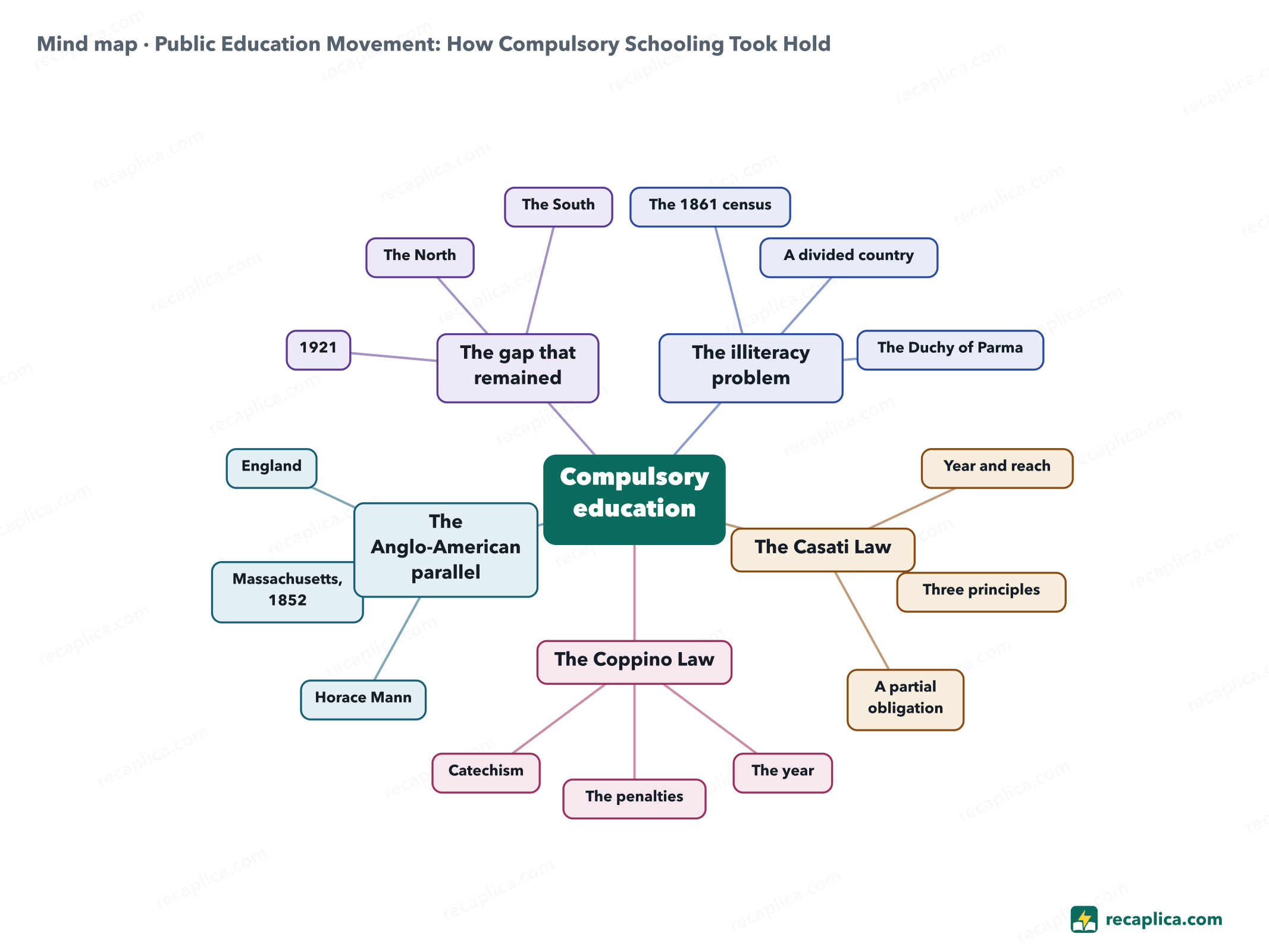
    Mind map: Public Education Movement: How Compulsory Schooling Took Hold
    • Compulsory education
      • The illiteracy problem
        • The 1861 census 74.68% of Italians recorded as illiterate
        • A divided country already in 1848, Piedmont counted 65.3 illiterate people per 100
        • The Duchy of Parma 84.2% illiteracy in 1857
      • The Casati Law
        • Year and reach 13 November 1859, Kingdom of Sardinia and Lombardy, later extended to a unified Italy
        • Three principles obligation, free access, equality between boys and girls
        • A partial obligation only the first two years of elementary school, with no real penalties
      • The Coppino Law
        • The year 15 July 1877
        • The penalties sanctions for families who ignored the obligation
        • Catechism becomes optional, replaced by lessons on the duties of citizens
      • The Anglo-American parallel
        • Horace Mann Secretary of the Massachusetts Board of Education, 1837 to 1848
        • Massachusetts, 1852 first American state with compulsory attendance by law
        • England local option from 1870, national obligation from 1880, free schooling from 1891
      • The gap that remained
        • 1921 illiteracy at 31% nationally
        • The North 2% in Venezia Tridentina, 7% in Piedmont
        • The South 49% or higher in Calabria, Basilicata, Puglia, Sicily and Sardinia

    Quiz: test yourself

    Answer the questions to check what you have learned: you get instant feedback and a short explanation.

    Grade 0/10 0/5
    1 What did the 1859 Casati Law establish for primary education?

    The Casati Law set three founding principles (obligation, free access, equality between boys and girls) but only made the first two years of elementary school compulsory.

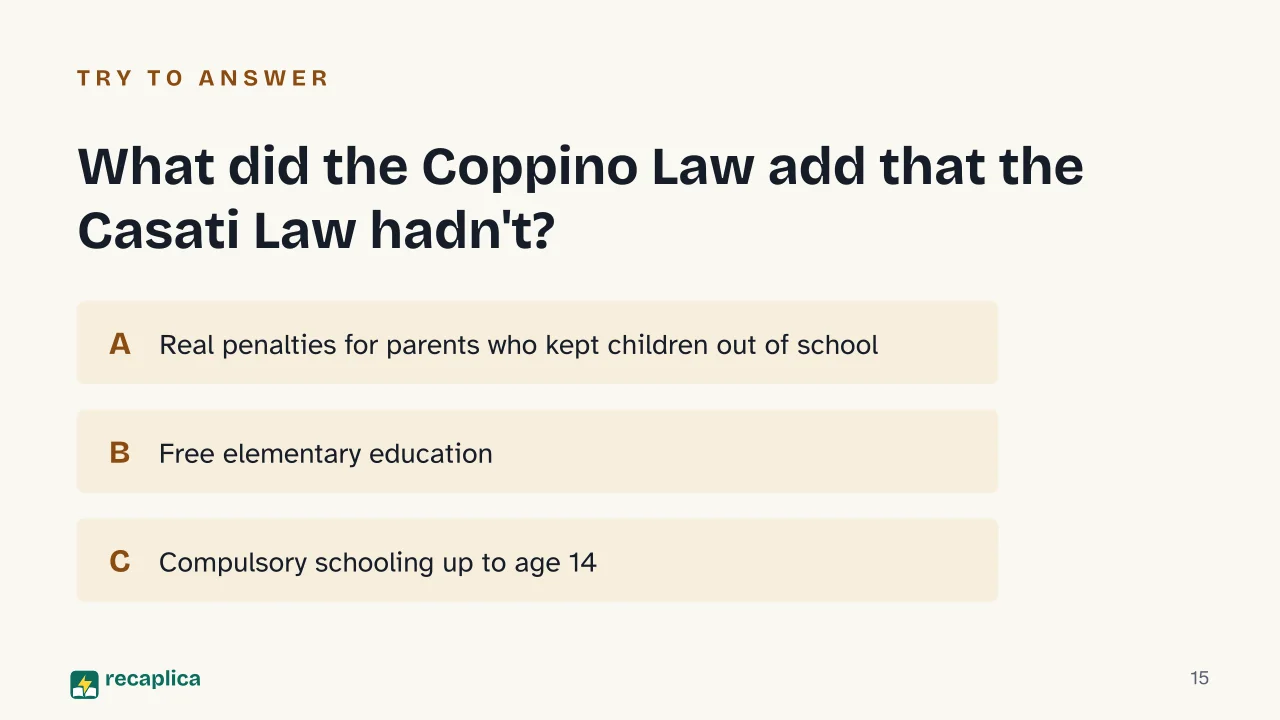
    2 What did the 1877 Coppino Law add that the Casati Law hadn't?

    The Coppino Law made the obligation enforceable for the first time, with penalties for parents who ignored it, and made catechism optional, replacing it with lessons on the duties of citizens.

    3 Who led the common school movement in the United States starting in 1837?

    Horace Mann became the first secretary of the Massachusetts Board of Education in 1837, leaving a career in law and politics, and led the common school movement for twelve years.

    4 True or false: in England, nationwide compulsory school attendance arrived with the 1870 law.

    The 1870 law only gave local school boards the power, not the obligation, to enforce attendance: by 1873 it applied to just 40% of the English population. Nationwide obligation only arrived with the 1880 Mundella Act.

    5 According to Treccani's census figures, what was Italy's illiteracy rate in 1921, and how was it spread across the country?

    By 1921 illiteracy had fallen to 31% nationally, but it remained at 49% or higher in Calabria, Basilicata, Puglia, Sicily and Sardinia, against just 2% in Venezia Tridentina.

    Answers: 1-A · 2-A · 3-A · 4-B · 5-A

    Flashcards

    Tap the card to flip it and check whether you remember the answer, then move to the next one.

    1 / 8

    Explain it in your own words

    The ultimate test: if you can explain it in simple words, you've truly understood it. Write your explanation, then compare it with the Recap.

    Your explanation is saved only on this device.

    In newly unified Italy, in 1861, roughly three people out of four could neither read nor write. The 1859 Casati Law had already set compulsory schooling down as a principle, but it took the 1877 Coppino Law to make it real, with penalties for families who ignored it. The same arc, on different timelines and with different tools, played out in the United States under Horace Mann and in England through the laws of 1870 and 1880. In every case, a law on its own wasn't enough: by 1921, Italy was still split between a nearly literate North and a South where illiteracy still topped 49% in several regions.

    Frequently asked questions

    When did compulsory education begin in Italy?

    With the 1859 Casati Law, limited to the first two years of elementary school and carrying no real penalties. It was the 1877 Coppino Law that introduced actual penalties for families who kept children out of school.

    What was the Coppino Law?

    It was the law of 15 July 1877, named after education minister Michele Coppino, which made it punishable to keep a child out of the first two years of elementary school. The same law made catechism optional rather than mandatory, replacing it with civic lessons on the duties of citizens.

    Why is the 19th century called the era of the public school movement?

    Because the Casati and Coppino laws were designed to bring basic education to the whole population, not just to families who could already afford private tutoring, in a country where roughly three out of four people couldn't read or write in 1861.

    Did compulsory education wipe out illiteracy in Italy right away?

    No. Illiteracy fell gradually, from 74.68% in 1861 to 31% in 1921, but a huge gap between North and South remained: by 1921 some northern regions were nearly fully literate, while several southern regions still had illiteracy rates above 49%.

    Did compulsory education start earlier in Italy or in the United States?

    Earlier in the United States: Massachusetts made school attendance compulsory by law in 1852, a quarter-century before Italy's 1877 Coppino Law. England, by contrast, didn't reach nationwide compulsory attendance until 1880, with the Mundella Act.

    Sources

    • Treccani, Analfabetismo (Enciclopedia Italiana)
    • Treccani, Coppino, Michele (Dizionario Biografico degli Italiani - L'Unificazione)
    • Treccani, La lingua e la scuola (L'Unificazione)
    • Encyclopedia.com, Horace Mann (Education Biographies)
    • Wikipedia, Elementary Education Act 1870

    Every Recap goes through an independent review before publication.

    Every evening, the day's new Recaps on our Telegram channel. Join the channel →

    Keep learning

    • History Giovanni Gentile: Actual Idealism and Fascism Giovanni Gentile was a Sicilian philosopher, born in 1875 and killed in Florence in 1944. His doctrine, actual idealism or actualism, holds that reality exists only as it is being made, in the act of thinking. In 1923, while Minister of Education, he joined the National Fascist Party, and Treccani ties the choice to the consistency of his philosophy. In 1925 he drafted the Manifesto of the Fascist Intellectuals, which Croce answered with a counter-manifesto. In 1932 he wrote the first part of the Italian Encyclopedia entry on Fascism. Read the Recap →
    • History Giovanni Gentile and the 1923 School Reform: What Changed in Italian Education Giovanni Gentile was a philosopher who served as Italy's education minister in Mussolini's first government, from October 1922 to July 1924. In 1923 he reorganized the country's schools through three royal decrees, issued between May and October. Primary school went from four years to five, a new scientific lyceum appeared, and secondary education took a classical slant, with entrance exams and capped enrollment. Few of the ideas were new, since most had been debated before Mussolini came to power. The reform was adjusted from 1924 on, and the unified middle school of 1962 later replaced the separate tracks. Read the Recap →
    • History Kindergarten Origin: Who Invented It and Where the First Ones Opened Kindergarten began in Germany, where Friedrich Froebel built a school for small children around play and opened the first one in Blankenburg, in 1837 or 1840 depending on the source. In Italy, a few years earlier, the priest Ferrante Aporti had started infant schools in Cremona between 1827 and 1829; the sources disagree on the exact year. The scholar Emma Gasperi notes that his schools already taught reading, writing, arithmetic and the catechism, because Aporti knew many poor children would get no other schooling. After the Agazzi sisters and Maria Montessori, a 1968 law created Italy's state nursery school for children up to six, and a 2003 law makes preschool the first stage of the education system. Read the Recap →

    recaplica

    Clear in 30 seconds, yours in 10 minutes.

    Recaps Mind maps Request a Recap Telegram channel Mind map maker Our method About Privacy & cookies Legal notes & terms of use

    © 2026 Recaplica · A project by Curi S.r.l. — VAT IT05472000750

    Statistics, only if you say so

    To learn which Recaps help most we would use Google Analytics, with aggregate, anonymous data. It starts only with your OK, and you can change your mind anytime. Privacy policy