The Water Cycle: What It Is and How It Works, Stage by Stage
In 30 seconds quick read
The water cycle is water's never-ending journey between the oceans, the atmosphere and the land. The sun's heat makes it evaporate, the vapor condenses into clouds high up, then water falls back as rain or snow and returns to the sea through rivers and groundwater. Along the way it changes state again and again, but it is never created or destroyed. That is why the cycle has no starting point and no end.
Key Points
- The engine of the cycle is the sun: its heat evaporates water from oceans, lakes and rivers; gravity brings it back down.
- Water rises as vapor (evaporation and transpiration), condenses into clouds and falls back as rain or snow.
- Back on land, water flows toward rivers and the sea (runoff) or soaks into the ground and feeds aquifers (infiltration).
- 96.5% of Earth's water is in the oceans; only 2.5% is freshwater, and almost all of it is locked in ice and underground.
- Every stop lasts a different amount of time: vapor stays in the atmosphere about 9 days, while a molecule can sit in the ocean for over 3,000 years.
- Water is never used up: it only changes state and place, circulating endlessly from one reservoir to another.
Key figures
- 96.5% the share of Earth's water held in the oceans Source: USGS
- ≈9 days the average time a water molecule spends in the atmosphere before falling back Source: UCAR
- 3,000+ years the average time a water molecule spends in the ocean before evaporating Source: UCAR
Deep Dive
A journey with no starting point
The water in your glass may have passed through an ocean, a cloud over the Alps and the root of a pine tree. The water cycle (textbooks also call it the hydrologic cycle) is this never-ending journey between the planet’s three great reservoirs: the oceans, the atmosphere and the land. Along the way, water changes state — liquid, vapor, ice — but it is never created or destroyed: it only changes place.
Two forces keep everything moving. The heat of the sun lifts water by making it evaporate; gravity brings it back down and pushes it, drop by drop, toward the sea.
The way up: from water to sky
The sun warms oceans, lakes and rivers, and some of the molecules at the surface break free and become water vapor, an invisible gas that rises into the air: this is evaporation. According to UCAR, about 86% of the water that evaporates worldwide each year comes from the oceans.
Plants take part too. Through transpiration they release vapor from their leaves, out of the same stomata that let in carbon dioxide for photosynthesis. Snow and ice, finally, can skip a stop: through sublimation they pass directly from solid to vapor.
Practical example: laundry on the line dries even on a cold, windy day. The water does not “vanish”: it evaporates molecule by molecule, and the wind carries the vapor away before the air around the clothes gets saturated.
Up in the sky: condensation and clouds
As it rises, the air cools and the vapor condenses: it turns back into microscopic liquid droplets, or freezes into tiny crystals, that stay suspended in the air. These are clouds. When droplets and crystals merge and grow too heavy, gravity wins: they fall as precipitation — rain, snow or hail, depending on the temperatures they meet on the way down.
Practical example: the fogged-up bathroom mirror after a shower is condensation in miniature. Warm vapor meets a cold surface and turns back into liquid. Clouds are born the same way, just a few kilometers higher up.
The return: rivers, soil and aquifers
Back on land, water takes one of two roads. Part of it flows over the surface (runoff), collecting in streams and rivers until it reaches the sea again. Another part soaks into the ground (infiltration) and fills the pores and cracks of rocks: these are the aquifers, which according to the USGS store 30.1% of all the planet’s freshwater. From there, water resurfaces in springs and wells, or stays underground for a long time.
A small share travels through us: we drink it, and every cell in our body works bathed in water. Then we hand it back to the cycle, partly through breath and sweat, the rest down the drain.
How long each stop lasts
The journey has no single rhythm: some stops last days, others millennia. The average times estimated by UCAR:
| Stop on the journey | Average stay |
|---|---|
| Atmosphere (vapor) | about 9 days |
| Soil | 1-2 months |
| Ocean | over 3,000 years |
| Ice caps and glaciers | thousands to hundreds of thousands of years |
Where Earth’s water is
Almost all the planet’s water — 96.5%, according to the USGS — is salty and sits in the oceans. Freshwater is just 2.5% of the total, and almost all of it is hard to reach: 68.6% is frozen in glaciers and polar ice caps, and 30.1% lies in underground aquifers. Rivers carry just 0.006% of all freshwater, lakes 0.26%.
Why the cycle matters to us
The cycle decides where and when freshwater is available. As the climate warms, it is changing pace: more heat means more evaporation and, according to UCAR, heavier precipitation in some regions and stronger droughts in others. That is why NASA follows the journey from above with its satellite missions: the data they gather helps predict floods and droughts further in advance.
Common myths
-
✗ Myth Clouds are made of water vapor.
✓ Reality Water vapor is an invisible gas: as long as it stays vapor, you cannot see it. Clouds appear when the vapor cools and condenses into liquid water droplets or ice crystals, so small and light that they stay suspended in the air.
-
✗ Myth Most freshwater flows in rivers and lakes.
✓ Reality Rivers and lakes hold only a tiny fraction: according to the USGS, 68.6% of freshwater is frozen in glaciers and ice caps and 30.1% sits in underground aquifers. Rivers carry just 0.006%, lakes 0.26%.
-
✗ Myth When we use water, we use it up and it disappears.
✓ Reality Water is not destroyed: after use it returns to the cycle through drains, treatment plants and evaporation. The real problem is the local supply of clean freshwater, which can run out wherever it is pumped faster than the cycle refills it.
Mind map
Drag the background to move around and the nodes to reposition them; use − and + to collapse and expand branches.
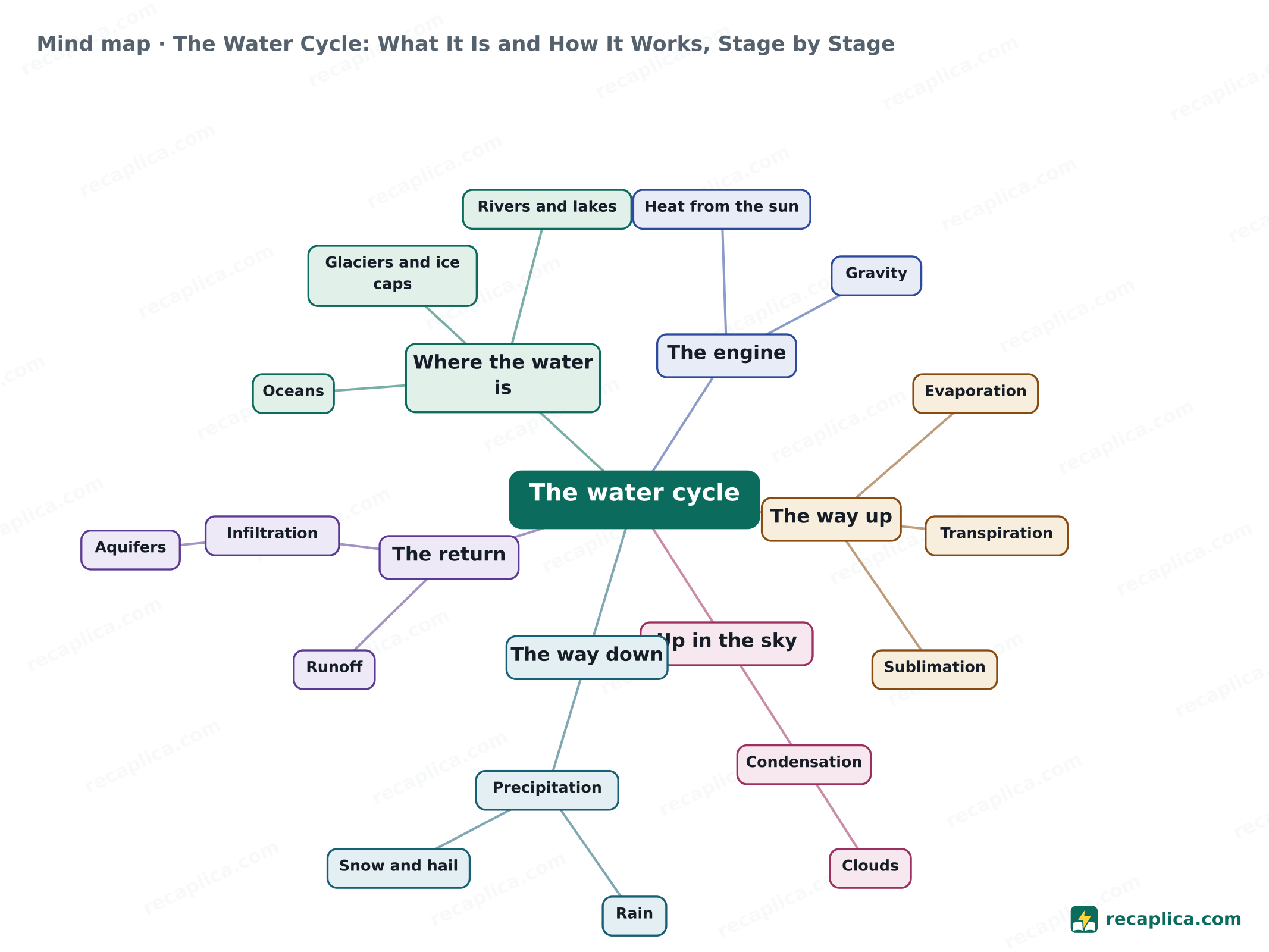
- The water cycle
- The engine
- Heat from the sun Evaporates water and lifts it up.
- Gravity Pulls water back down and toward the sea.
- The way up
- Evaporation From oceans, lakes and rivers.
- Transpiration Vapor released by plant leaves.
- Sublimation From snow and ice, skipping the liquid state.
- Up in the sky
- Condensation
- Clouds Liquid droplets and ice crystals.
- Condensation
- The way down
- Precipitation
- Rain
- Snow and hail
- Precipitation
- The return
- Runoff Water flows toward rivers and the sea.
- Infiltration
- Aquifers Hold 30.1% of all freshwater.
- Where the water is
- Oceans 96.5% of the total, salt water.
- Glaciers and ice caps 68.6% of all freshwater.
- Rivers and lakes A tiny fraction of freshwater.
- The engine
Quiz: test yourself
Answer the questions to check what you have learned: you get instant feedback and a short explanation.
Flashcards
Tap the card to flip it and check whether you remember the answer, then move to the next one.
Explain it in your own words
The ultimate test: if you can explain it in simple words, you've truly understood it. Write your explanation, then compare it with the Recap.
The water cycle is water's never-ending journey between the oceans, the atmosphere and the land. The sun's heat makes it evaporate, the vapor condenses into clouds high up, then water falls back as rain or snow and returns to the sea through rivers and groundwater. Along the way it changes state again and again, but it is never created or destroyed. That is why the cycle has no starting point and no end.
Frequently asked questions
Why is it called a 'cycle'?
Because it has no beginning and no end: the same water moves endlessly from oceans to atmosphere to land and back to the oceans, changing state but never running out.
Can Earth run out of water?
The planet's total amount of water stays practically constant, because the cycle keeps recycling it. What can run short is the freshwater available in a specific place at a specific time: aquifers, for example, refill far more slowly than they can be emptied.
What is the difference between evaporation and transpiration?
Evaporation starts from water surfaces and soil; transpiration is the vapor released by plant leaves through their stomata. Seen from the atmosphere they are the same thing: water rising as a gas.
What is an aquifer?
Water that fills the pores and cracks of rocks and soil deep underground, carried there by infiltration. From an aquifer, water resurfaces in springs or is pumped up through wells.
Do snow and ice take part in the cycle too?
Yes. Melting snow feeds rivers and aquifers, and snow and ice can even turn directly into vapor (sublimation). The polar ice caps are the longest stop on the journey: they can hold water for hundreds of thousands of years.