The Greenhouse Effect: What It Is and How It Works
In 30 seconds quick read
The greenhouse effect is the natural mechanism by which certain gases in the atmosphere, such as carbon dioxide and water vapor, trap part of the heat that Earth sends back toward space. It works like a blanket: without it, the planet's average temperature would be about -18°C instead of the current 15°C. Since the mid-1700s, though, burning coal, oil and gas has raised atmospheric CO₂ by 50%, and the blanket has grown thicker. The result is global warming: 2024 was the warmest year on record.
Key Points
- The greenhouse effect is the natural process by which certain atmospheric gases trap heat near Earth's surface.
- The main greenhouse gases are water vapor, carbon dioxide (CO₂), methane, nitrous oxide, ozone and CFCs.
- Without the greenhouse effect, Earth's average temperature would be about -18°C instead of today's 15°C: it is what makes the planet livable.
- Since the mid-1700s, CO₂ has risen by about 50%, from 280 to about 429 parts per million (measured at Mauna Loa): the greenhouse effect has grown stronger.
- The human-caused strengthening produces global warming: 2024 was the warmest year on record, 1.6°C above the 1850-1900 level.
- The problem is not the greenhouse effect itself, which is vital, but its enhancement.
Key figures
- -18°C Earth's average temperature without the natural greenhouse effect, against today's roughly 15°C Source: NASA
- +50% the rise in atmospheric CO₂ compared with pre-industrial times, from about 280 ppm to a 2024 global average of 422.8 ppm Source: NOAA
- +1.6°C the 2024 anomaly, the warmest year on record, compared with the 1850-1900 pre-industrial period Source: Copernicus
Deep Dive
A blanket around the planet
Sunlight crosses the atmosphere almost undisturbed and warms Earth’s surface. Once warmed, the planet gives that energy back as infrared radiation: invisible heat climbing toward space. This is where the greenhouse gases come in, molecules able to absorb that outgoing heat and send part of it back down.
The result is what a blanket does on a cold night. The blanket makes no heat of its own: it slows the escape of yours. In the same way, greenhouse gases do not warm Earth by themselves, but they keep near the surface heat that would otherwise slip away.
Practical example: in deserts, the temperature plunges as soon as night falls. Dry air holds very little water vapor, which means very little “local” greenhouse gas, so the heat stored during the day escapes toward space almost unhindered. On a humid or cloudy night, instead, the heat stays trapped and the temperature drops far more slowly.
Meet the greenhouse gases
The atmosphere is made mostly of nitrogen and oxygen, which are “transparent” to infrared heat: they let it through. Greenhouse gases are a small minority of the air, yet they are enough to decide the climate of the whole planet.
| Gas | Where it comes from |
|---|---|
| Water vapor | Evaporation from oceans, lakes and plants; the most abundant |
| Carbon dioxide (CO₂) | Fossil fuels, wildfires, the breathing of living things |
| Methane (CH₄) | Livestock, rice paddies, landfills, oil and gas extraction |
| Nitrous oxide (N₂O) | Farm fertilizers and combustion |
| Ozone and fluorinated gases (CFCs) | Chemical reactions in the atmosphere; refrigerants and industry |
Water vapor deserves a note. It is the most abundant greenhouse gas, but we do not emit it directly in significant amounts: it increases as a consequence of warming, because warmer air holds more moisture, and so it amplifies it. Scientists call this loop a feedback.
Natural, in fact vital
The greenhouse effect is not a recent invention nor, in itself, a problem: it has existed for billions of years and it is the reason Earth is livable. The planet’s average temperature is about 15°C; without the natural greenhouse effect it would be roughly 33°C lower, around -18°C: a planet of frozen oceans, where life as we know it would never have taken hold.
Nature, moreover, has kept the system in balance all along: photosynthesis constantly pulls CO₂ out of the air to turn it into sugars and wood, while the oceans absorb another share.
From the right blanket to a double one
The trouble began when we started adding layers to the blanket. With the Industrial Revolution, humanity began burning coal, then oil and gas, releasing into the atmosphere carbon that had stayed underground for millions of years. Since then, the growth of the world economy, the one we now measure with GDP, has moved hand in hand with emissions.
The numbers tell the rest. Before the industrial era, atmospheric CO₂ stood at about 280 parts per million (ppm); in July 2026 the Mauna Loa observatory in Hawaii measured a monthly average of 429 ppm. An increase of roughly 50%. And CO₂ alone, according to NOAA, is responsible for about 80% of the extra heating influence added by human-produced greenhouse gases since 1990. Methane is racing too: in 2024 it reached 1,897 parts per billion, its highest level in 800,000 years.
Practical example: since 1958, a station on the Mauna Loa volcano has measured the CO₂ in the air day after day: it is the longest record of direct measurements in the world. The resulting graph, the Keeling curve, climbs like a staircase, one step every year, with a small seasonal wiggle caused by Northern Hemisphere plants absorbing more CO₂ in summer.
The thickened blanket produces what we call global warming. According to the European climate service Copernicus, 2024 was the warmest year on record: an average temperature of 15.10°C, that is 1.6°C above the pre-industrial level (1850-1900), and the first calendar year past the 1.5°C threshold.
A mechanism to understand, not to fear
Telling the natural greenhouse effect apart from the enhanced one is the key to this whole topic, at school as much as in public debate. The mechanism itself has worked for billions of years and keeps us alive; it is the roughly 150 ppm of CO₂ added in a little over two and a half centuries that has upset the balance. Once that is clear, much of the news about climate suddenly makes more sense.
Common myths
-
✗ Myth The greenhouse effect is a problem we should eliminate.
✓ Reality It is an essential natural mechanism: without the greenhouse effect, Earth's average temperature would be about -18°C and the oceans would be frozen. The problem is not the mechanism but its enhancement, caused by the greenhouse gases human activities add.
-
✗ Myth The ozone hole and the greenhouse effect are the same thing.
✓ Reality They are two different phenomena. The ozone hole is the thinning of the layer that shields us from ultraviolet rays, caused by gases such as CFCs; the greenhouse effect is about heat trapped in the atmosphere. They only partly overlap, because some gases (the CFCs themselves) contribute to both.
-
✗ Myth The climate has always changed, so today's warming is natural.
✓ Reality What is off the scale is the speed: CO₂ is now rising 100-200 times faster than the natural increases at the end of the last ice age. And levels like today's had not been seen for about 3 million years, when the planet was 2.5-4°C warmer than pre-industrial times.
Mind map
Drag the background to move around and the nodes to reposition them; use − and + to collapse and expand branches.
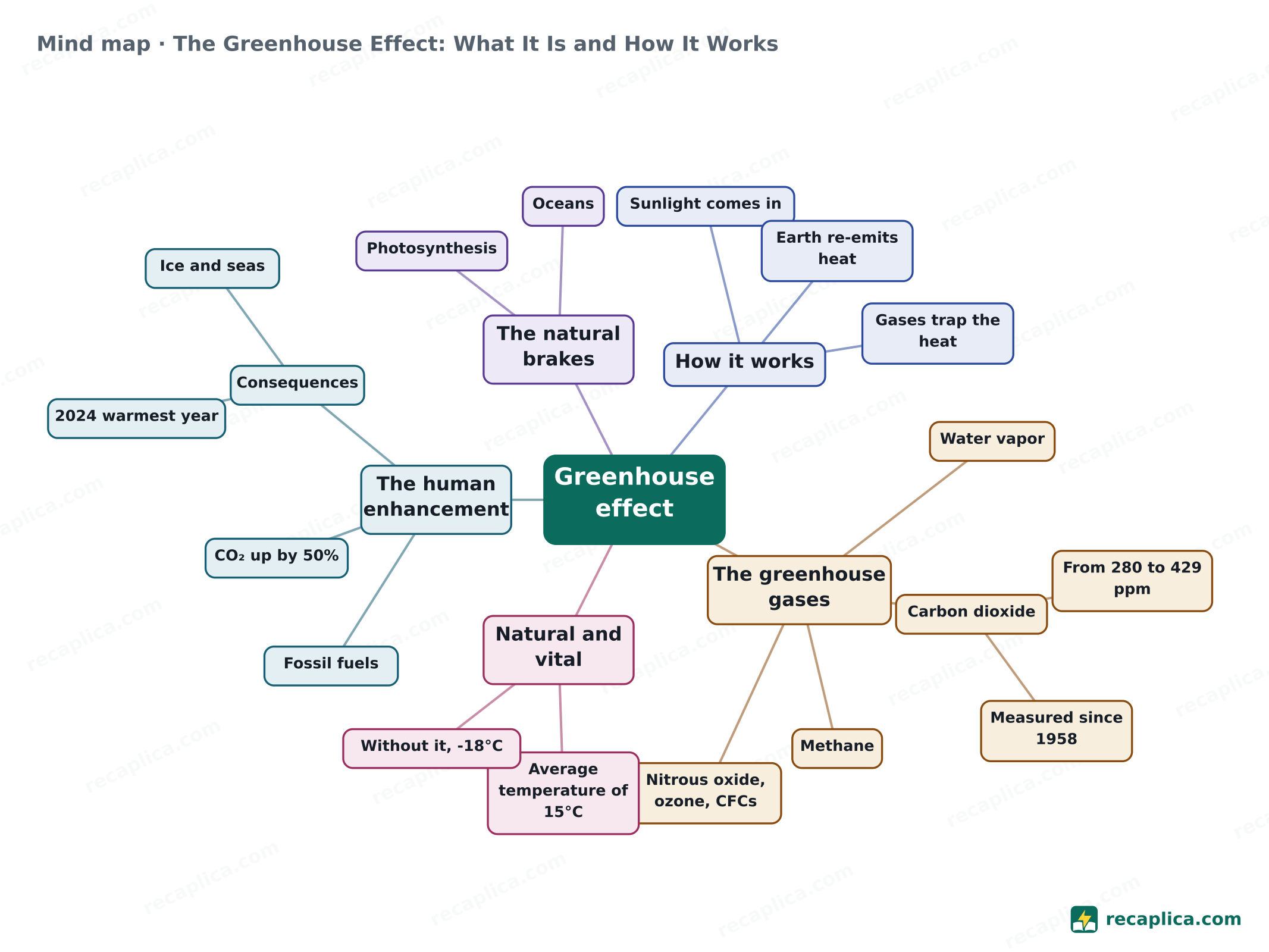
- Greenhouse effect
- How it works
- Sunlight comes in It crosses the atmosphere and warms the surface.
- Earth re-emits heat As invisible infrared radiation.
- Gases trap the heat They absorb it and send part of it back down, like a blanket slowing the escape of heat.
- The greenhouse gases
- Water vapor The most abundant, it amplifies the warming.
- Carbon dioxide CO₂, the main one humans emit.
- From 280 to 429 ppm
- Measured since 1958 At Mauna Loa, the world's longest direct record.
- Methane From livestock, rice paddies, landfills, drilling.
- Nitrous oxide, ozone, CFCs
- Natural and vital
- Average temperature of 15°C
- Without it, -18°C About 33°C colder, frozen oceans.
- The human enhancement
- Fossil fuels Coal, oil and gas since the Industrial Revolution.
- CO₂ up by 50%
- Consequences
- 2024 warmest year 1.6°C above the 1850-1900 period.
- Ice and seas Melting ice, rising sea level.
- The natural brakes
- Photosynthesis Plants absorb CO₂ from the air.
- Oceans They absorb heat and part of the excess CO₂.
- How it works
Quiz: test yourself
Answer the questions to check what you have learned: you get instant feedback and a short explanation.
Flashcards
Tap the card to flip it and check whether you remember the answer, then move to the next one.
Explain it in your own words
The ultimate test: if you can explain it in simple words, you've truly understood it. Write your explanation, then compare it with the Recap.
The greenhouse effect is the natural mechanism by which certain gases in the atmosphere, such as carbon dioxide and water vapor, trap part of the heat that Earth sends back toward space. It works like a blanket: without it, the planet's average temperature would be about -18°C instead of the current 15°C. Since the mid-1700s, though, burning coal, oil and gas has raised atmospheric CO₂ by 50%, and the blanket has grown thicker. The result is global warming: 2024 was the warmest year on record.
Frequently asked questions
Is the greenhouse effect harmful?
No, in itself it is vital: without it, Earth would be a frozen planet averaging -18°C. The problem is its strengthening: human activities add extra greenhouse gases, more heat is trapped and temperatures rise.
What is the difference between the greenhouse effect, global warming and climate change?
The greenhouse effect is the mechanism by which the atmosphere traps heat. Global warming is the long-term rise in temperature caused by its enhancement. Climate change is the wider set of consequences, from melting ice sheets to the rising level of the seas.
Why is it called the 'greenhouse effect'?
By analogy with garden greenhouses, where glass lets sunlight in and keeps heat inside. The analogy is imperfect, though: glass mostly stops warm air from rising away, while greenhouse gases absorb infrared radiation and re-emit it in all directions.
How do we know how much CO₂ the atmosphere held before modern measurements?
Thanks to ice cores drilled in Antarctica: snow piling up over millennia trapped tiny bubbles of the air of its time. Analyzing them reconstructs the atmosphere of the past, and that is how we know pre-industrial CO₂ sat around 280 ppm.