Why does chocolate melt in your mouth? The science of cocoa butter
In 30 seconds quick read
Chocolate melts in your mouth thanks to cocoa butter, the fat that makes up about 30% of a bar and melts at around 34 °C, just below body temperature. Its molecules can stack into six different crystal forms, each with its own melting point, and only form V delivers the gloss, the crisp snap and the perfect melt on the tongue. Chocolatiers get it through tempering, a controlled temperature cycle that steers crystallization. When the structure rearranges on its own, the whitish film of fat bloom appears on the surface.
Key Points
- Cocoa butter is about 30% of chocolate and melts at around 34 °C: above room temperature, below the body's 37 °C. That is why it sits solid on the shelf and turns liquid on the tongue.
- The same fat molecules can crystallize in six different forms (polymorphism), with melting points ranging from about 17 to about 36 °C.
- Form V is the right one: it makes chocolate glossy, crisp when snapped, and able to melt in the mouth without feeling waxy.
- Tempering is a temperature cycle (full melt, cooling towards 28 °C, reheating to about 32 °C) that wipes out the unstable crystals and keeps only form V seeds.
- The white coating (fat bloom) is not mold: it is cocoa butter that migrated to the surface and recrystallized as form VI, harder and slower to melt.
Key figures
- ≈34 °C the melting point of form V, the crystal of well-tempered chocolate Source: Royal Society of Chemistry
- 6 the crystal forms cocoa butter can solidify into Source: Nature Communications
- ≈30% the share of cocoa butter in a chocolate bar Source: Nature Communications
Deep Dive
A fat with perfect timing
The secret is not the sugar, nor the cocoa powder, but the cocoa butter: the fat extracted from the beans of the Theobroma cacao tree, which on its own makes up about 30% of a bar. Its most precious feature is timing: it melts at around 34 °C, above the temperature of a room but below the body’s 37 °C. On the kitchen shelf, chocolate is a solid that snaps; on the tongue, seconds later, it is cream.
This fat is a lipid, the same family of molecules that builds the membranes of cells. The cacao tree stores it in its beans as an energy reserve, assembling it from the sugars made through photosynthesis.
But a conveniently placed melting point is not the whole story. The rest lies in how cocoa butter’s molecules pack together when they solidify.
Same bricks, six different buildings
Cocoa butter is made of triglycerides: fat molecules built from three fatty acids (in cacao, mostly stearic, oleic and palmitic) attached to a glycerol backbone. When melted chocolate cools, these triglycerides stack into a crystal lattice, like bricks piled up in a warehouse.
And here is the catch: the same bricks can be piled in six different ways. Chemists call this polymorphism and number the six crystal forms I to VI. The chemical composition is identical; what changes is the order and tightness of the pile, and with it the melting point, the hardness and the look.
| Form | Melts at | What it’s like |
|---|---|---|
| I | 17.3 °C | Soft, crumbly |
| II | 23.3 °C | Crumbly, melts far too easily |
| III | 25.5 °C | A bit firmer, still unstable |
| IV | 27.3 °C | Firmer, but still melts easily |
| V | 33.8 °C | The right one: glossy, crisp, melts in the mouth |
| VI | 36.3 °C | Too hard, slow to melt |
Form V, the crystal we want
Of six possible piles, only one gives chocolate every quality we expect. Form V is packed just right: it makes the surface glossy, lets the bar break with a clean snap and — above all — melts at 33.8 °C, so close to body temperature that in the mouth the change from solid to liquid is quick and complete. The unstable forms already melt at room temperature; form VI, at the other end, melts too slowly in the mouth and leaves a waxy feel.
Practical example: snap a freshly bought bar: it cracks sharply and the surface catches the light. Now try a bar that melted in a bag and hardened again on its own: it bends almost silently and looks dull. Identical ingredients, different crystals.
Tempering: taking charge of crystallization
Left to itself, melted cocoa butter crystallizes more or less at random, mixing unstable forms. Tempering exists to prevent that: it is a temperature cycle that forces the fat to stack only as form V. The typical sequence described by the Royal Society of Chemistry:
- Full melt at around 40 °C: every pre-existing crystal disappears, the slate is wiped clean.
- Gradual cooling towards 28 °C: the first crystals appear, good and unstable alike.
- Reheating to about 32 °C: forms I to IV, which all melt below this threshold, dissolve again. Only the form V “seeds” survive.
- Pouring into molds: as it cools, the rest of the cocoa butter molds itself onto the surviving seeds and copies their structure.
It is the same principle as sugar or salt crystals growing around an initial germ: latecomers imitate whoever was already there. Tempering simply decides who was already there.
The white coating: fat bloom
Form V has one flaw: it is not the most stable form. Over months, or much faster if the chocolate gets warm, the crystals slowly rearrange into form VI. Part of the fat melts, migrates towards the surface and recrystallizes there as a grayish-white film: fat bloom.
It is not mold and it does not make the chocolate unsafe: it is the same cocoa butter as before, just stacked worse and in the wrong place. The bar loses its gloss, gets harder and melts less readily. Cold slows the change, because it strips the molecules of the energy they need to rearrange; heat swings speed it up.
Practical example: a bar forgotten in a car in summer partly melts and solidifies again without tempering. A few days later the surface is streaked with white: the fat that surfaced has recrystallized — textbook fat bloom.
What about white chocolate?
White chocolate contains no cocoa solids, the dark and bitter part of the bean: that is why it does not taste like dark chocolate. But about a fifth of its weight is cocoa butter, and in the mouth it behaves like the rest: the smooth melt is all about the fat, not the color. White, milk or dark, every well-made chocolate aims at the same finish line: form V crystals waiting for the warmth of the tongue to melt.
Common myths
-
✗ Myth The white coating on chocolate is mold.
✓ Reality It is fat bloom: part of the cocoa butter melts, migrates to the surface and recrystallizes as form VI, more stable but dull. It happens with time or after a heat swing, and the chocolate remains safe to eat.
-
✗ Myth White chocolate has nothing to do with cacao.
✓ Reality It contains no cocoa solids, which is why it does not taste like dark chocolate. But about a fifth of its weight is cocoa butter, the very fat of the cacao bean: the part that melts in your mouth.
-
✗ Myth If chocolate melts, just let it cool and it goes back to how it was.
✓ Reality Without tempering, cocoa butter recrystallizes in the unstable forms, which melt at lower temperatures: the result is dull, soft, and the white coating shows up fast. Same ingredients, different structure.
Mind map
Drag the background to move around and the nodes to reposition them; use − and + to collapse and expand branches.
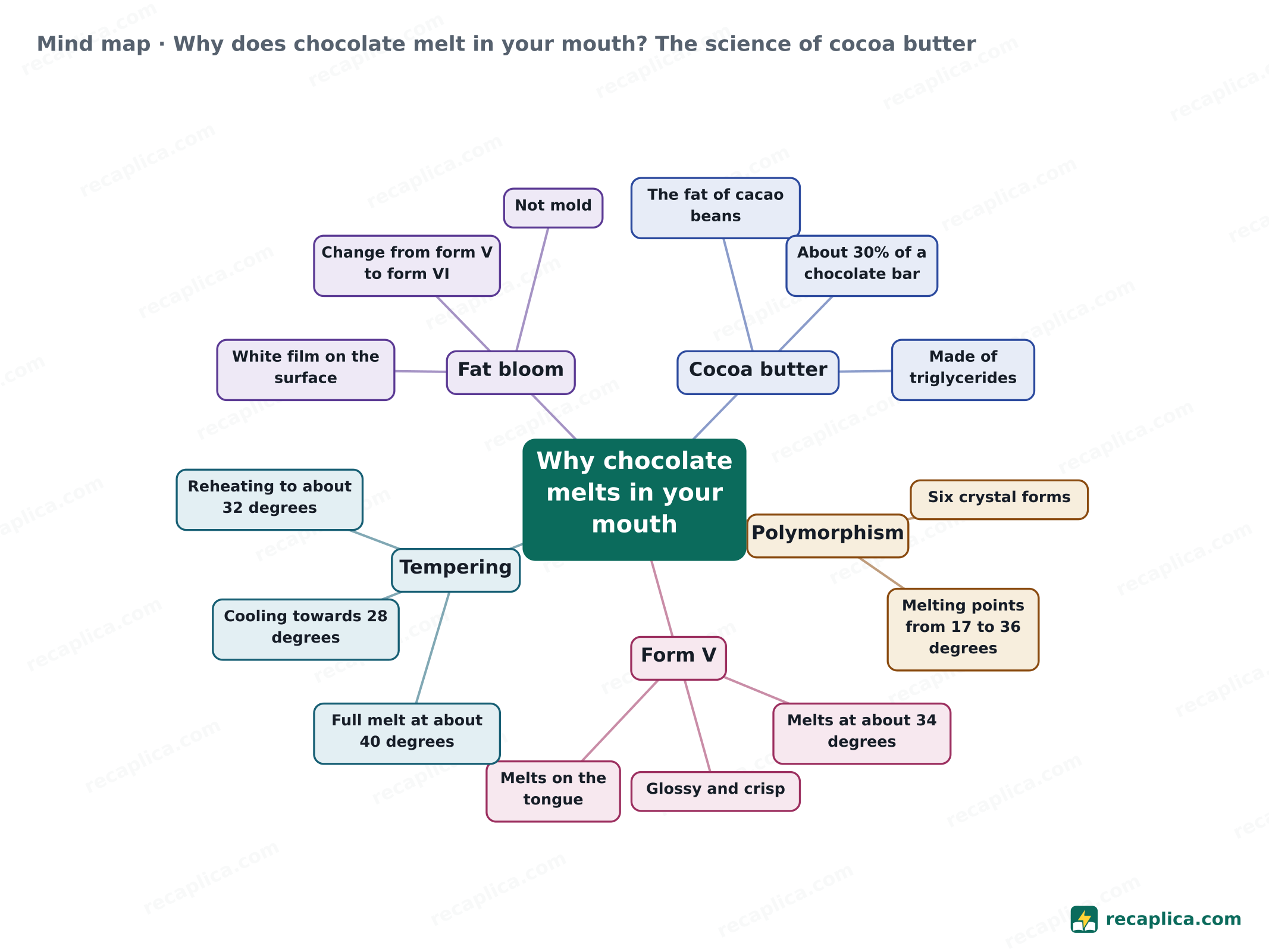
- Why chocolate melts in your mouth
- Cocoa butter
- The fat of cacao beans
- About 30% of a chocolate bar
- Made of triglycerides Mostly stearic, oleic and palmitic acids.
- Polymorphism
- Six crystal forms Same molecules, different stacking.
- Melting points from 17 to 36 degrees
- Form V
- Melts at about 34 degrees Below the body's 37 degrees.
- Glossy and crisp
- Melts on the tongue
- Tempering Steers crystallization towards form V.
- Full melt at about 40 degrees
- Cooling towards 28 degrees
- Reheating to about 32 degrees Melts the unstable forms, form V seeds survive.
- Fat bloom
- White film on the surface
- Change from form V to form VI
- Not mold
- Cocoa butter
Quiz: test yourself
Answer the questions to check what you have learned: you get instant feedback and a short explanation.
Flashcards
Tap the card to flip it and check whether you remember the answer, then move to the next one.
Explain it in your own words
The ultimate test: if you can explain it in simple words, you've truly understood it. Write your explanation, then compare it with the Recap.
Chocolate melts in your mouth thanks to cocoa butter, the fat that makes up about 30% of a bar and melts at around 34 °C, just below body temperature. Its molecules can stack into six different crystal forms, each with its own melting point, and only form V delivers the gloss, the crisp snap and the perfect melt on the tongue. Chocolatiers get it through tempering, a controlled temperature cycle that steers crystallization. When the structure rearranges on its own, the whitish film of fat bloom appears on the surface.
Frequently asked questions
Is the white coating on chocolate dangerous?
No. It is cocoa butter that surfaced and recrystallized (fat bloom), not mold: the chocolate is safe to eat. It does lose its gloss and some of its texture, so it is best eaten before that happens.
Why does tempered chocolate snap when you break it?
Because form V crystals are packed tight and neatly ordered: the bar breaks cleanly, with a sharp sound. Poorly crystallized chocolate bends instead, with barely a sound.
Can I keep chocolate in the fridge?
Cold slows the gradual change from form V to form VI, so it helps delay the white coating. What matters most is avoiding heat swings, which melt part of the fat and push it to the surface.
Does white chocolate melt in the mouth like dark chocolate?
Yes, because the melt depends on cocoa butter, which is about a fifth of white chocolate's weight. What is missing is the cocoa solids, meaning the dark, bitter flavor, not the fat that melts.