Arginine: what it is and how it affects nitric oxide, blood pressure, and exercise
In 30 seconds quick read
Arginine is an amino acid the body partly makes on its own and also gets from food, mainly grains, meat and dairy; it's the precursor of nitric oxide, the molecule that relaxes blood vessels. Independent meta-analyses find modest but measurable effects on blood pressure, athletic performance, mild-to-moderate erectile dysfunction and wound healing, often at doses well above what a normal diet provides. The European food safety regulator, EFSA, has nonetheless rejected all the major health claims proposed for arginine, citing the absence of a recognised cause-and-effect relationship at the required standard. There's also a serious, well-documented contraindication: in a clinical trial of patients with a recent heart attack, arginine was linked to significantly higher mortality, serious enough that the trial was stopped early.
Key Points
- Arginine is a semi-essential amino acid, the precursor of nitric oxide, the molecule that regulates the dilation of blood vessels.
- A normal diet already supplies about 4.4 g of arginine a day, mostly from grains, meat and dairy; clinical trials use doses from 2 to 24 g/day, often 2-4 times higher.
- A meta-analysis of 11 randomized trials finds a significant reduction in systolic and diastolic blood pressure with oral arginine supplementation, though the same reviewers urge caution.
- In patients with a recent heart attack, a randomized trial (VINTAGE MI, JAMA 2006) recorded significantly higher mortality with arginine than with placebo, serious enough that the trial was stopped early.
- EFSA rejected all the major health claims proposed for arginine, including erection, muscle mass, sperm production and performance, for lack of a recognised cause-and-effect relationship.
- Single doses above 9 g raise the risk of gastrointestinal problems such as bloating, nausea and diarrhoea.
Key figures
- 8.6% vs 0% the 6-month mortality rate in patients with a recent heart attack treated with arginine compared with the placebo group, in the trial that led to its early termination Source: VINTAGE MI, Schulman et al., JAMA, 2006
- 4.4 g/day the average arginine intake from diet alone, measured in nearly 2,800 adults, before factoring in any supplemental intake Source: Third Tehran Lipid and Glucose Study, population study, 2006-2008
- 3.37 the odds ratio for improvement in mild-to-moderate erectile dysfunction with arginine versus placebo, in a meta-analysis of 540 patients Source: Rhim et al., Journal of Sexual Medicine, 2019
Deep Dive
What arginine is
Arginine is an amino acid, one of the building blocks the body uses to assemble proteins following the instructions written in DNA. It’s classified as a semi-essential, or conditionally essential, amino acid: under normal conditions the body makes enough of it on its own, but at certain life stages or with particular health conditions the need can outstrip internal production, which is when diet starts to matter.
Unlike creatine, another well-studied nitrogen-containing compound in sports science, arginine doesn’t work on the muscle fibres’ energy system and isn’t among the known mechanisms behind muscle hypertrophy, the growth of tissue in response to training. Its best-studied role is different: it’s the starting molecule the body uses to produce nitric oxide.
How it works: the nitric oxide precursor
Inside the cells of the endothelium, the thin layer lining the inside of blood vessels, an enzyme called nitric oxide synthase uses arginine as raw material to produce nitric oxide. Nitric oxide is a messenger that acts locally, almost instantly: it tells the muscular wall of the blood vessel to relax, a process called endothelium-mediated vasodilation.
This mechanism underlies most of arginine’s studied uses: from blood pressure to athletic performance to erectile dysfunction, all phenomena where the widening of blood vessels plays a part. It’s also why arginine often shows up in products marketed as “vasodilators” or “pump” supplements in the fitness world.
Practical example: when blood flow to a tissue needs to increase quickly, during physical exertion for instance, the body doesn’t simply “open a tap”: it relaxes the vessels feeding that tissue. Nitric oxide produced from arginine is one of the chemical signals involved in that process.
How much arginine we already get from diet
Before even discussing supplements, it helps to know how much arginine already arrives through ordinary food. A population study of nearly 2,800 adults (average age 45.9) measured an average intake of about 4.4 g a day, with minimal differences between men and women. The main dietary sources in this sample were grains (about a third of total intake), meat (about 30%) and dairy (about 14%).
The same study found a significant association between higher dietary arginine intake and higher blood concentrations of nitric oxide metabolites, an association that was more pronounced in women, in older adults, and in people who were overweight or obese. This figure helps put the doses used in clinical trials into perspective, since they’re often far higher than a normal diet could ever supply.
Doses studied, field by field
The doses of arginine tested in studies vary widely depending on what’s being measured, and are almost always higher than the average dietary intake.
| Field studied | Dose tested | Typical duration |
|---|---|---|
| Blood pressure | 4-24 g/day (median 9 g/day) | 2-24 weeks |
| Athletic performance, acute dose | 0.075-0.15 g/kg body weight, or 2-6 g | 30-270 minutes before exercise |
| Athletic performance, ongoing use | 1.5-12 g/day | 7-56 days |
| Erectile dysfunction | 1,500-5,000 mg/day | Variable by study |
| Pressure injury wound healing | 2.5-18 g/day | 2-12 weeks |
Notably, in the heart attack trial discussed further below, the dose was gradually raised to 3 g three times a day, or 9 g/day overall: a dose still in the high range compared with the other fields, given to a population of fragile patients recovering from an acute cardiac event.
Blood pressure: what the meta-analyses show
The reference meta-analysis on arginine and blood pressure pooled 11 randomized, double-blind, placebo-controlled trials, totalling 387 participants aged 12 to 79. The result: an average reduction in systolic pressure of 5.39 mmHg and in diastolic pressure of 2.66 mmHg versus placebo, both statistically significant. The same authors conclude that oral arginine supplementation “significantly lowers both systolic and diastolic blood pressure.”
Whoever reviewed this meta-analysis independently, though, added an important note of caution: limitations in the evidence base and a lack of precision in the estimates suggest the conclusions should be considered tentative rather than definitive. It’s a useful reminder whenever a single positive nutrition result makes headlines: the direction of an effect can be real while its exact size stays uncertain until larger, more consistent studies arrive.
Athletic performance: small but measurable effects
A systematic review and meta-analysis published in Nutrients in 2020 examined 15 studies (394 total participants, 282 of them trained or elite athletes) to see what happens to physical performance with arginine supplementation.
On anaerobic performance, tests shorter than 5 minutes, the meta-analysis finds a small but statistically significant effect, with minimal variability across the included studies. On aerobic performance, longer tests up to maximum oxygen consumption, the average effect is larger, but with very high heterogeneity across studies, a sign that results aren’t consistent from one study to the next and so should be read with caution.
For acute protocols, the same authors point to doses around 0.15 g/kg body weight taken 60 to 90 minutes before exertion (about 10-11 g for a 70 kg person), while for ongoing protocols they point to a range between 1.5 and 2 g a day for at least 4-7 doses, or 10-12 g a day for 8 weeks.
Erectile dysfunction: two positions, not one certainty
On arginine and erectile dysfunction, two different readings exist, and it’s important not to flatten them into a single answer.
On one hand, a 2019 meta-analysis of 10 randomized trials and 540 patients with erectile dysfunction finds an odds ratio of 3.37 favouring arginine over placebo, with significant improvements in several sub-scores tied to satisfaction and erectile function (the sexual desire score, by contrast, didn’t change meaningfully). Reported side effects were more frequent in the arginine group (8.3% versus 2.3% for placebo) but none were severe. The authors’ conclusion is nonetheless narrow: arginine can be considered for mild or moderate erectile dysfunction, not as a substitute for prescribed therapy in more severe cases. A separate review of a combination of arginine aspartate and Pycnogenol, a plant extract, found even larger improvements, but that’s a combination of two different substances, not direct evidence of arginine’s effect on its own.
On the other hand, the EFSA Panel assessed the specific claim “arginine helps to induce and improve erection” in 2011 and rejected it, concluding that the available intervention studies didn’t show a cause-and-effect relationship strong enough to authorise it. The two assessments don’t so much contradict each other as answer different questions: the scientific meta-analysis registers a positive signal in the available literature, while EFSA applies the stricter standard required to authorise a claim on a product label, and by that standard the data fell short.
Wound healing in pressure injuries
A field less known to the public but still studied is pressure injuries, skin lesions that form mostly in bedridden patients or those with reduced mobility. A meta-analysis of 8 studies and 196 total patients, conducted in several countries between 2001 and 2017, finds significant improvement in wound healing with arginine supplementation, with a clearly dose-dependent effect: at doses of at least 15 g a day the effect was much larger than at lower doses. No adverse side effects were reported in the data analysed by this review, though this is a specific clinical setting, with patients monitored by healthcare staff, not comparable to the unsupervised use of an over-the-counter supplement.
Safety: the serious contraindication after a heart attack
The most important safety finding on arginine concerns one specific population: people who’ve recently had a heart attack. A randomized, double-blind, placebo-controlled trial (VINTAGE MI, published in JAMA in 2006) enrolled 153 patients with a first ST-elevation heart attack, assigning them to arginine or placebo about six days after admission. The arginine dose was gradually increased to 3 g three times a day (9 g/day overall), maintained for 6 months.
The result led to the trial’s early termination: 8.6% of patients in the arginine group died within 6 months, versus no deaths in the placebo group, a statistically significant difference. Most of the deaths occurred in patients aged 60 or older. Even on a broader composite outcome (death, a new heart attack, or hospitalisation for heart failure), the result was worse with arginine, 16.7% versus 10.1%, with arginine showing no measurable benefit on vascular stiffness or left ventricular function. The trial’s independent safety monitoring board recommended stopping it ahead of schedule, and the authors were blunt in their conclusion: arginine should not be given to patients after a heart attack.
The same researchers discuss a hypothesis for the excess mortality: in older patients with widespread atherosclerosis, the physiological response to arginine might be different, and unfavourable, compared with what’s seen in younger or healthier people. It holds as a general principle: an effect measured in one population (healthy adults, say, in the other studies discussed in this article) doesn’t automatically carry over to a different population with different health conditions, especially in the cardiovascular field.
Other risks: high doses, kidneys, liver, herpes
Aside from the specific contraindication after a heart attack, the literature describes arginine as generally safe, with side effects that are rare and dose-related. According to a review of the gastrointestinal safety of amino acids (a figure reported by concordant secondary sources, not verified against the full text), single doses up to 3-6 g rarely cause problems, while the risk of issues such as bloating, nausea, diarrhoea and abdominal cramps rises mainly with single doses above 9 g, often within daily regimens that are very high overall, above 30 g a day. The proposed mechanism is straightforward: amino acids that are only partly absorbed draw water into the intestine by osmosis, causing diarrhoea. Splitting the daily dose into several servings and taking it with food appears to reduce this risk.
Two other situations call for caution. People with kidney or liver failure may not be able to properly metabolise and excrete supplemental arginine, and so should be monitored. People with herpes infections should be cautious because the herpes simplex virus needs arginine itself to replicate, while another amino acid, lysine, has an antagonistic effect: preliminary data suggest arginine supplementation might not be advisable in the presence of this infection.
Finally, it’s worth remembering that all these mechanisms, from protein synthesis to enzyme activity, take place inside the body’s cells: understanding how a cell works helps explain why an amino acid like arginine can have such different effects depending on the tissue and the health condition of the person taking it.
Common myths
-
✗ Myth Arginine builds muscle mass, just like creatine.
✓ Reality Not so: the EFSA Panel judged the claim on muscle growth and maintenance as general and non-specific, with no recognised cause-and-effect relationship. Arginine works through vasodilation via nitric oxide, not through the phosphocreatine/ATP system that fuels muscular effort, the mechanism behind creatine's genuinely authorised EU claim.
-
✗ Myth Arginine supplements are safe for anyone, no exceptions.
✓ Reality Not true, and it's a potentially dangerous mistake in one specific case. In patients with a recent heart attack, the VINTAGE MI trial recorded significantly higher mortality with arginine than with placebo, 8.6% versus 0% at six months, serious enough that the trial was stopped early for safety reasons. Caution is also advised with kidney or liver failure and with herpes infections, since the virus uses arginine itself to replicate.
-
✗ Myth Arginine resolves erectile dysfunction like a prescription drug.
✓ Reality That's an oversimplification. The strongest available meta-analysis, covering 540 patients, finds a significant benefit, but the same authors recommend it only for mild or moderate cases, not as a substitute for prescribed therapy in more severe cases. On the regulatory side, EFSA rejected the specific claim on erection for lack of a recognised cause-and-effect relationship: independent scientific literature and the European regulatory assessment don't agree on this point.
Mind map
Drag the background to move around and the nodes to reposition them; use − and + to collapse and expand branches.
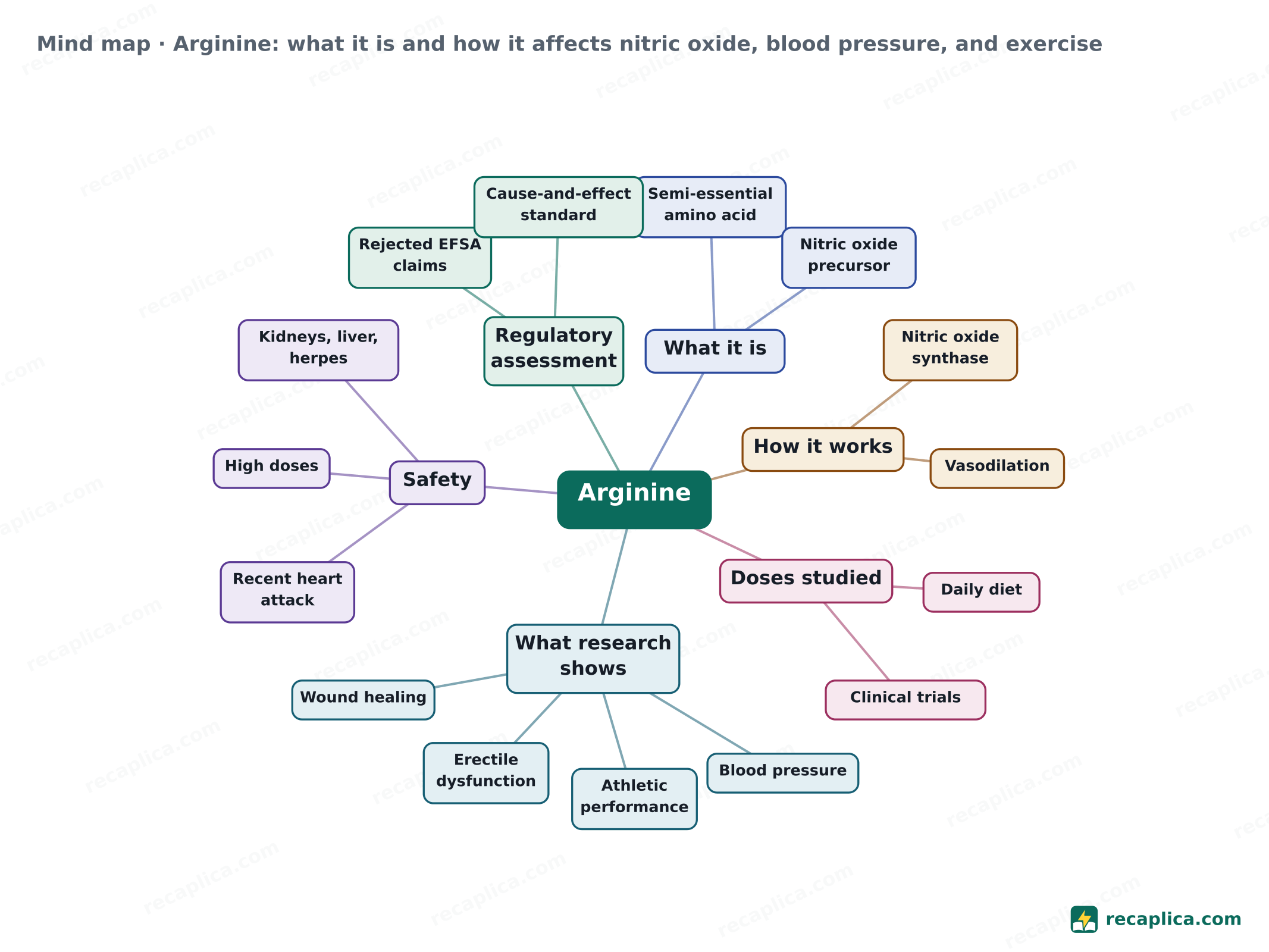
- Arginine
- What it is
- Semi-essential amino acid Partly made by the body, partly obtained from diet.
- Nitric oxide precursor Substrate for the enzyme nitric oxide synthase.
- How it works
- Nitric oxide synthase Enzyme that converts arginine into nitric oxide.
- Vasodilation Relaxation of blood vessel walls.
- Doses studied
- Daily diet About 4.4 g/day on average.
- Clinical trials From 2 to 24 g/day depending on the field.
- What research shows
- Blood pressure Significant reduction in meta-analyses.
- Athletic performance Small effect on short efforts, uncertain on longer ones.
- Erectile dysfunction Benefit in mild-to-moderate cases.
- Wound healing Dose-dependent effect in pressure injuries.
- Safety
- Recent heart attack Higher mortality in a randomized trial.
- High doses Gastrointestinal problems above 9 g in a single dose.
- Kidneys, liver, herpes Caution and medical advice needed.
- Regulatory assessment
- Rejected EFSA claims Erection, muscle mass, sperm production, performance.
- Cause-and-effect standard Relationship not recognised at the required standard.
- What it is
Quiz: test yourself
Answer the questions to check what you have learned: you get instant feedback and a short explanation.
Flashcards
Tap the card to flip it and check whether you remember the answer, then move to the next one.
Explain it in your own words
The ultimate test: if you can explain it in simple words, you've truly understood it. Write your explanation, then compare it with the Recap.
Arginine is an amino acid the body partly makes on its own and also gets from food, mainly grains, meat and dairy; it's the precursor of nitric oxide, the molecule that relaxes blood vessels. Independent meta-analyses find modest but measurable effects on blood pressure, athletic performance, mild-to-moderate erectile dysfunction and wound healing, often at doses well above what a normal diet provides. The European food safety regulator, EFSA, has nonetheless rejected all the major health claims proposed for arginine, citing the absence of a recognised cause-and-effect relationship at the required standard. There's also a serious, well-documented contraindication: in a clinical trial of patients with a recent heart attack, arginine was linked to significantly higher mortality, serious enough that the trial was stopped early.
Frequently asked questions
What exactly is arginine, and why does it come up alongside nitric oxide?
Arginine is an amino acid the body uses, among other things, as raw material to produce nitric oxide, a molecule that helps blood vessels relax. It's called a semi-essential amino acid because the body makes some of it on its own, but under certain conditions the need can exceed what the body can synthesise, which is why it's also found in food, mainly grains, meat and dairy.
Does an arginine supplement build muscle mass?
No recognised cause-and-effect relationship has been found: the EFSA Panel judged the muscle-mass claim as general and non-specific, and rejected it. Arginine works mainly through vasodilation, a different mechanism from the one through which creatine supports muscular effort.
Does arginine really help with erectile dysfunction?
A meta-analysis of 540 patients finds a significant benefit in mild or moderate cases, at doses of 1,500 to 5,000 mg a day, but the same authors don't recommend it for more severe cases, where prescribed therapies remain the indicated option. At the European regulatory level, the specific claim on erection hasn't been authorised, for lack of a cause-and-effect relationship recognised to EFSA's standard.
Is it true that arginine is dangerous after a heart attack?
Yes, and it's one of the most solid safety findings available on arginine. A randomized trial in patients with a recent heart attack, VINTAGE MI, published in JAMA in 2006, recorded significantly higher mortality in the arginine group than in the placebo group, serious enough that the trial's safety monitoring board recommended stopping it early. The same authors conclude that arginine should not be given to patients after a heart attack.
Can I take arginine if I'm on other medication or have a health condition?
This article summarises what studies show across groups of people, not personalised advice for your situation. Talk to a doctor or pharmacist before taking an arginine supplement, especially if you've had a heart attack, have kidney or liver disease, a herpes infection, are pregnant or breastfeeding, or take medication: these are situations that need an individual assessment that general research data can't replace.